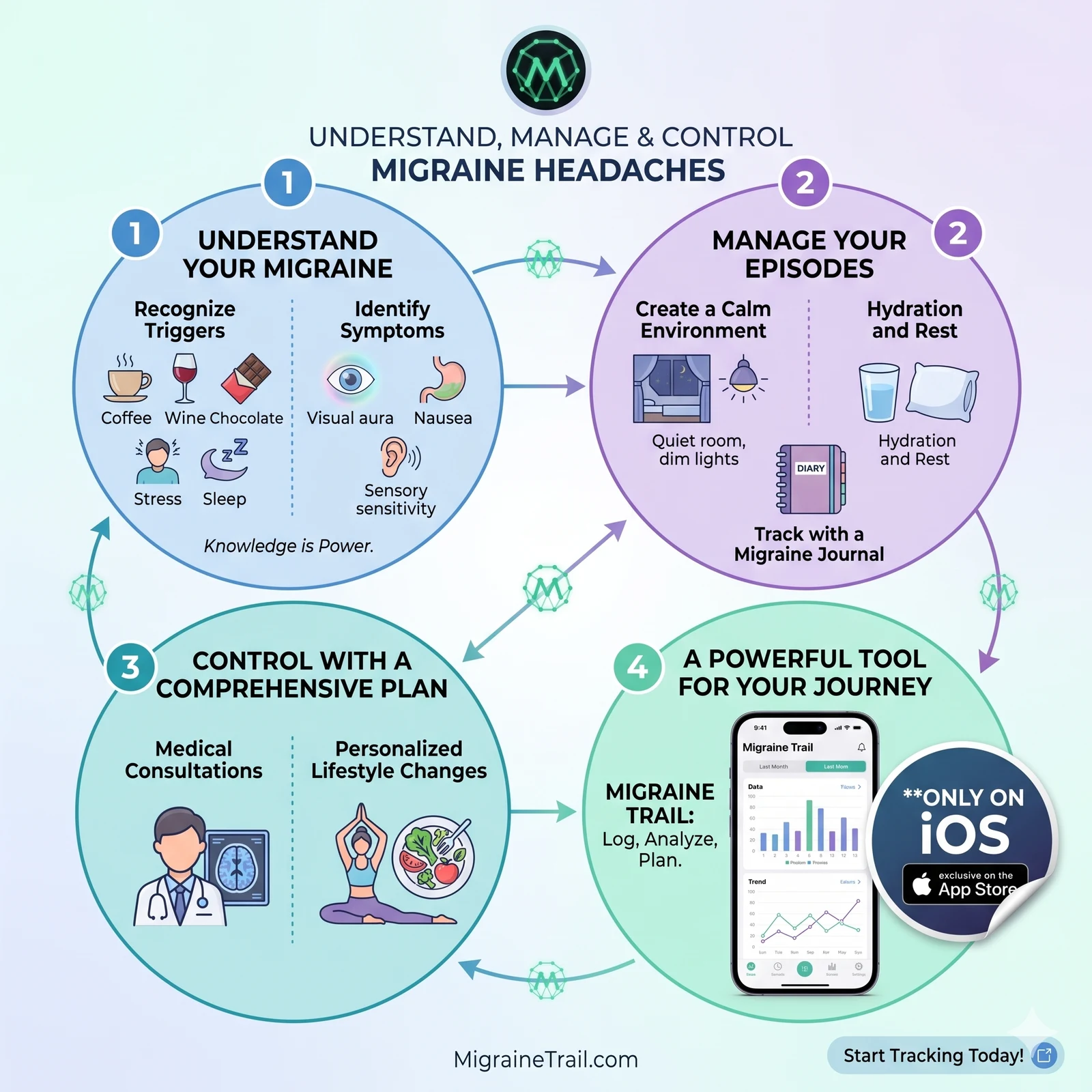
Key Takeaway: Migraine is a complex neurological condition, not "just a bad headache." Attacks typically move through four stages (premonitory, aura, headache, postdrome), are set off by personal triggers, and respond best to a combination of consistent daily habits, smart acute treatment, and accurate pattern tracking. The faster you can recognize your earliest warning signs and your unique triggers using a migraine tracker app, the more often you can shorten, soften, or even prevent an attack altogether.
If you live with migraine headaches, you already know the truth that the people around you sometimes miss: a migraine is not a tension headache that just needs a glass of water and a quick lie-down. It is a full-body neurological event. It can hijack your day, flatten your week, and quietly reshape your career, your relationships, and your sense of who you are.
This guide walks you through every part of that experience and, more importantly, what to do about it. You will learn the four stages of a migraine attack, the most common triggers, the daily habits that genuinely move the needle, the contents of a portable migraine emergency toolkit, and the warning signs that mean it is time to talk to a healthcare professional. Along the way, we will show how a structured migraine symptom tracker turns scattered, painful experiences into a clean pattern you and your neurologist can actually act on.
You are not alone. You are not imagining it. And you have far more leverage than the standard "just avoid your triggers" advice suggests.
Migraine Is More Than Just a Headache
The single most important sentence in this article is this: migraine is a neurological condition that can affect your whole day, your ability to work, connect, and enjoy life. It is not a personality flaw. It is not low pain tolerance. It is a disease of the brain and nervous system, with measurable changes in neurotransmitters, blood vessels, and pain-signaling pathways.
When we say "neurological," we mean that an attack can produce a long list of symptoms that have nothing to do with pain in the skull:
- Throbbing pain, often on one side of the head, though it can spread or switch sides.
- Nausea or vomiting, sometimes severe enough to prevent oral medication from working.
- Light sensitivity (photophobia) and sound sensitivity (phonophobia) that make everyday rooms feel hostile.
- Smell sensitivity (osmophobia), where perfumes, cooking smells, or cleaning products can deepen an attack.
- Brain fog and fatigue so heavy that simple tasks feel underwater.
- Mood changes, irritability, and emotional fragility before, during, and after the attack.
This wider symptom picture is why two people with the "same" diagnosis can have very different daily realities, and why a one-line description in your medical chart almost never captures what you are actually living with. We have a deeper companion piece on this in our explainer on the difference between a migraine and a regular headache, useful reading the next time someone tells you they "had a migraine yesterday" after a long meeting.
Reframing migraine as a neurological condition matters for one more practical reason: it changes the kind of help you look for. You stop looking only for stronger painkillers and start looking for preventive treatments for chronic migraine, lifestyle structure, accurate tracking, and a long-term relationship with a clinician who understands the disease.
What Happens During a Migraine? The Four Stages
A migraine is not a single event. For most people it is a sequence, a four-stage process that can stretch from hours to several days. Not everyone experiences every stage, and not every attack follows the same script. But once you can name the stages, you stop being ambushed by your own body.
Using a structured migraine tracking app is the single fastest way to recognize these stages in yourself, because the app surfaces the small repeating patterns you would otherwise dismiss as coincidence.
Stage 1: Premonitory (Prodrome), Hours to Days Before
The premonitory stage, sometimes called the prodrome, can begin one to two days before the headache itself. The symptoms are subtle and easy to miss, especially the first few times you experience them:
- Mood changes, irritability, low mood, sudden anxiety, or unusual elation.
- Food cravings, often for carbohydrates, chocolate, or salty foods.
- Neck stiffness and tension that is sometimes mistaken for "sleeping wrong."
- Brain fog and difficulty concentrating.
- Frequent yawning, sometimes dozens of times in an hour.
- Increased thirst and urination.
- Constipation or diarrhea.
The premonitory stage is the single highest-leverage window in the entire migraine cycle. If you can recognize it, you can hydrate, eat, rest, and consider early acute treatment before the pain phase arrives. Learning to spot these early warning signs of a migraine is one of the most underrated skills in self-management.
Stage 2: Aura, 5 to 60 Minutes
About one in four people with migraine experience an aura, usually right before or at the start of the headache. Auras are temporary, fully reversible neurological symptoms, most commonly visual:
- Visual disturbances, zig-zag lines, shimmering arcs, bright spots, or a blind patch that grows and then fades.
- Tingling or numbness in the face, arm, or leg, often spreading slowly.
- Speech difficulties, finding words slowly, mixing them up, or briefly losing them.
- Hearing changes, dizziness, or vertigo in less common forms of migraine.
If you have aura symptoms for the first time, or your usual aura suddenly changes, that is a reason to talk to your doctor, not all "auras" are migraine, and a new presentation deserves a careful look. Our deep-dive on understanding migraine aura explains the difference between typical visual aura, hemiplegic aura, and other rarer subtypes.
Stage 3: Headache (Attack), 4 to 72 Hours
This is the stage most people picture when they hear the word "migraine," but it is only one chapter of the story. A full attack untreated can last anywhere from four hours to three full days. During this stage you may experience:
- Throbbing or pulsing pain, usually moderate to severe.
- Sensitivity to light, sound, and smells, often forcing you into a dark, quiet room.
- Nausea and vomiting, which can make oral medication unreliable.
- Difficulty concentrating, making screens, conversation, and decisions feel impossible.
- Tenderness of the scalp, where even a hairbrush or pillow can hurt.
How you treat this stage depends on your personal plan. Many people benefit from a structured approach: a clear cutoff for when to take acute medication, a written rescue plan, and a portable kit you can reach for without thinking. Our piece on how to stop a migraine fast walks through the moves that consistently shorten attacks for most people.
Stage 4: Postdrome, Hours to Days After
The postdrome, sometimes called the "migraine hangover," is the most overlooked stage of the cycle. After the pain fades, many people are left feeling:
- Drained and washed out, as if recovering from the flu.
- Foggy and slow, with concentration that comes back in pieces.
- Emotionally fragile, sometimes weepy or unusually quiet.
- Mildly sore in the head, where any sudden movement can briefly bring back a ghost of the pain.
The postdrome is not weakness, and it is not in your head, it is a real neurological recovery phase. Building gentle reentry into your day (smaller meals, hydration, lighter workload, dim screens) tends to shorten it. Many people only realize how much postdrome time they were losing each month after they begin logging it in a free headache diary.
Every Migraine Is Different, That Is Why Tracking Wins
Two people with the same diagnosis can have wildly different stage durations, symptom patterns, and recovery curves. Even your own attacks vary from month to month based on hormones, sleep, weather, and stress load. Generic advice (drink more water, get more sleep) is true but blunt.
The way past that bluntness is personal pattern data. When you log enough attacks in a structured migraine journal app, with consistent fields for triggers, symptoms, treatments, and timing, you stop guessing. You can see, in your own data, that your attacks tend to start the evening after a poor night's sleep, that they last about 30% longer when you skip lunch, or that a barometric pressure drop predicts an attack roughly 18 hours out. That is the difference between living with the disease and living under it.
For a deeper look at how to extract clean patterns from your logs, read our guide on how to analyze migraine patterns from your app data and our walkthrough of identifying hidden migraine patterns.
Common Migraine Triggers and How to Spot Yours
Triggers vary from person to person. The goal is not to memorize every published trigger list, it is to identify your short list. Most people with migraine have three to seven personal triggers that, in combination, predict the majority of their attacks. A consistent migraine triggers tracker is what turns the list below into an actionable shortlist for you.
Poor Sleep
The single most consistent migraine trigger across the medical literature is disrupted sleep, both too little and too much. Late nights, jet lag, weekend lie-ins, and shift work all destabilize the same circadian system that regulates migraine thresholds. We explore the mechanism in more detail in our piece on how sleep patterns affect migraines and our broader look at the role of sleep in migraine prevention.
Skipped Meals and Low Blood Sugar
The brain is an energy-hungry organ. Skipped meals, long fasts, and crash dieting can all drop blood sugar low enough to nudge a susceptible brain into attack mode. The fix is not "more food", it is regular, balanced meals at predictable times. A short food log inside a migraine relief app quickly reveals whether your attacks correlate with meal gaps.
Bright and Flickering Lights
Fluorescent lighting, flickering screens, harsh sun, and stadium-style stage lighting are well-known migraine triggers. FL-41 tinted lenses and lower-glare screen settings help many people. Our health library entry on FL-41 migraine glasses explains how the tint works and where the evidence is strongest.
Weather Changes and Barometric Pressure
Sudden drops in atmospheric pressure, cold fronts, and thunderstorms are some of the most-reported environmental triggers. They are also one of the easiest patterns to confirm in app data, because weather is objective and time-stamped. Read our barometric pressure and migraines explainer and try a weather-aware migraine prediction tool to see whether you fit the pattern.
Stress (and Stress Letdown)
Stress is the most commonly reported trigger overall, but the surprise for many people is the letdown effect, attacks that arrive on Friday evenings, the first day of vacation, or the day after a major deadline. Tracking your perceived stress on a simple 1–5 scale alongside attacks usually reveals whether you are a stress-onset or a stress-letdown responder. We go deeper in how stress leads to migraines.
Alcohol
Red wine, dark spirits, and beer are commonly reported triggers, and even small amounts can be enough in sensitive people. Histamines, tannins, sulfites, and dehydration all play a role. If alcohol is on your list, it usually shows up in your tracker within the first month of consistent logging.
Strong Smells
Perfumes, cleaning products, gasoline, and certain cooking smells can either start an attack or worsen one already underway. Smell sensitivity also overlaps with the premonitory stage, where everyday odors suddenly feel sharper than usual. Logging smell sensitivity as a symptom, not just a trigger, gives you an early warning signal.
Certain Foods
The classic suspects include aged cheese (tyramine), cured meats (nitrates), chocolate, MSG, and artificial sweeteners. Personal sensitivities vary widely, so blanket elimination diets are usually a bad idea. Instead, log what you eat for two to four weeks alongside your attacks and let the data point you toward the small number of foods that actually matter. Our deep-dive on foods that may cause migraines is a good starting point.
Hormonal Changes
For many people with migraine, hormonal fluctuation is one of the most powerful triggers, particularly the estrogen drop in the days before menstruation. Our companion piece on hormones and migraines and the health library entry on menstrual migraine management walk through the patterns to look for and the treatment options that target this specific subtype.
Dehydration
Even mild dehydration is enough to lower the migraine threshold in many people. The simplest fix is also the easiest to forget: a consistent baseline of water through the day. Our piece on hydration and migraine frequency covers the realistic targets and the common myths.
A note on trigger language: "Trigger" is a useful but imperfect word. Most attacks are not caused by a single trigger, they are caused by threshold crossing, where several small inputs (a poor sleep, a missed meal, a stressful afternoon, a pressure drop) stack until your personal threshold is crossed. That is exactly why tracking multiple inputs at once outperforms tracking any single one in isolation.
What Can Help: A Combination of Strategies
The honest answer to "what works for migraine?" is: a combination of strategies, tuned to you. The infographic at the top of this guide groups them into five buckets, healthy habits, stress management, consistency, medication, and a support system. Each one matters, and the magic is in how they reinforce each other.
1. Healthy Habits
The basics are not glamorous, but they are the foundation everything else sits on:
- Stay hydrated with a consistent baseline of water through the day.
- Eat regular, balanced meals at predictable times, no skipped lunches, no late dinners.
- Prioritize sleep, aiming for the same wake time seven days a week.
These three habits, done consistently for a month, are enough to meaningfully reduce attack frequency for many people. Our piece on daily habits that help prevent migraines lays out a realistic starter routine.
2. Stress Management
Stress is not the enemy, unmanaged, unbroken stress is. Effective options that show up repeatedly in the migraine literature include:
- Mindfulness and meditation, even ten minutes a day.
- Diaphragmatic breathing, especially during the premonitory stage.
- Gentle yoga, with a focus on the neck, shoulders, and breath. See yoga and meditation for migraine relief.
- Regular, moderate movement, walking, swimming, easy cycling. The relationship between exercise and migraines is dose-dependent: too little and too much can both trigger attacks.
3. Consistency
Migraine brains reward boring routines. The single highest-yield intervention is consistency: same sleep, same meals, same hydration, same movement, every day of the week including weekends. A migraine tracker app with daily check-ins makes consistency easier because you can see streaks build and gaps stand out.
4. Medication
Acute and preventive medications are the part of the toolkit best handled with a clinician, but a few principles help everyone:
- Treat early. Acute medication taken in the first 30 minutes of pain works better than the same dose two hours in.
- Watch for medication overuse headache. Using acute medication more than 10–15 days per month can paradoxically worsen migraine. Track every dose and bring the log to appointments.
- Ask about preventive options if you have more than four migraine days a month. Newer CGRP inhibitors, beta blockers, anti-seizure drugs, and botulinum toxin all have evidence behind them.
Our overview of the best medications for migraine relief and our companion piece on preventive treatments for chronic migraine can help you arrive at appointments better prepared.
5. A Support System
Migraine is an invisible disease, and invisibility is exhausting. A support system, partners, friends, colleagues, a patient community, does not "cure" anything, but it lowers the daily cost of living with the disease. Practical reading:
What works for one person may not work for another. Be patient. Keep exploring. That sentence sits at the bottom of the infographic for a reason, it is the single most important reframe in chronic-illness self-management.
Daily Habits That Support a Migraine-Friendly Life
If you are starting from scratch, the six habits below are the highest-leverage daily moves for most people with migraine. Pick two to start with; add the rest one at a time over the following weeks.
Hydrate Consistently
Aim for a steady baseline through the day rather than a heroic bottle in the evening. Pair water with each meal and one between meals. Many people benefit from a pinch of electrolytes in hot weather or after exercise. See hydration and migraine frequency for realistic targets.
Eat Regular, Balanced Meals
Three meals at predictable times, with protein and complex carbohydrates in each, prevents the blood-sugar swings that destabilize migraine-prone brains. Avoid the common pattern of "coffee for breakfast, salad for lunch, big dinner", it stacks low blood sugar in the morning and a heavy meal at night.
Sleep Seven to Nine Hours Nightly
A fixed wake time matters more than a fixed bedtime. Get up at the same time seven days a week, including weekends, and let bedtime drift to whatever produces seven to nine hours of sleep. Our deep-dive on the role of sleep in migraine prevention explains why the wake-time anchor works so well.
Move Your Body Gently and Regularly
Aim for 20–30 minutes of moderate movement most days. Walking, swimming, easy cycling, and yoga are all well-tolerated. Avoid the trap of "all-or-nothing" workouts, a single brutal session in a sedentary week often triggers attacks. Our piece on exercise and migraines explains the dose-response curve.
Track Your Migraines
If you do nothing else from this list, do this one. A free migraine tracker app with daily check-ins, structured trigger and symptom fields, and a clean export gives you back the most important resource you can bring to a neurologist appointment: your own data. Voice-first logging matters here because attacks happen in dark rooms, see voice logging for migraine tracking and our overview of AI-powered migraine tracking.
Practice Self-Compassion
This is not soft advice, it is hard, structural advice. People with chronic illness who treat themselves with self-compassion (rather than self-blame) are more consistent with their habits, more likely to seek timely care, and less likely to spiral into the secondary depression that often shadows chronic migraine. Self-compassion is a skill; like sleep and hydration, it is built daily.
The Migraine Emergency Toolkit
When an attack hits, decision-making is the first thing to go. The fix is to take the decisions out of the moment and put them into a kit you can reach for without thinking. Build one for home, one for your bag, and ideally one for your desk or car.
Sunglasses
Polarized lenses for outside; FL-41 tinted glasses for indoor and screen use. Keep a spare pair in your bag, the morning you forget them is the morning you will need them most.
Water
A reusable bottle, refilled habitually. Dehydration during an attack worsens nausea and slows medication absorption. If oral intake is hard, electrolyte tablets or oral rehydration salts can help.
Quiet Space
Identify, in advance, a quiet, dark place at home and at work where you can lie down for 30–90 minutes. Tell the people in those spaces it exists and what it is for. The emotional labor of "explaining" mid-attack is a tax you do not need to pay.
Cold Pack
A reusable gel pack or a cold cap kept in the freezer. Cold therapy on the forehead, neck, or temples relieves pain for many people. Pair it with a soft cloth so you can leave it in place without skin burn.
Calming Sounds
Brown noise, rain sounds, or familiar quiet music through soft over-ear headphones can reduce sound sensitivity and ease the nervous system back down. Pre-download a playlist so you do not have to navigate apps mid-attack.
Rescue Medication
Your prescribed acute medication, kept in the same place every time, with a small written card that lists the dose, the cutoff, and the next allowed dose. Many people benefit from a "rescue plan" sheet they update with their neurologist. Our guide on how to present migraine data to your neurologist covers how to build and update this plan over time.
The kit is small, but the cognitive load it removes is enormous.
When to Seek Medical Help
Most migraine attacks, even severe ones, are not medical emergencies. But some symptoms genuinely are, and a few patterns deserve a same-week conversation with your doctor.
Talk to a healthcare professional if:
- Your headaches are getting worse or more frequent.
- Your migraine is interfering with daily life despite your current treatment plan.
- You are using acute medication more than 10–15 days per month, which raises the risk of medication overuse headache.
- You have new aura symptoms that you have not experienced before.
- You are pregnant, postpartum, or perimenopausal and your migraine pattern has shifted, see pregnancy and migraine management and menopause and migraines.
Seek urgent medical care if you experience:
- A sudden, severe headache, the so-called "worst headache of your life," especially if it peaks within seconds to a minute.
- A headache with fever, stiff neck, confusion, or new vision changes.
- A headache after a head injury, or one that wakes you from sleep with new neurological symptoms.
- Weakness or numbness on one side of the body that is new, does not resolve, or differs from your usual aura.
- A headache with difficulty speaking, walking, or maintaining consciousness.
These are signs that something other than migraine may be going on, and they warrant emergency evaluation rather than a wait-and-see approach. Your usual migraine pattern is reassuring information, but a sharp departure from it is not something to ride out at home.
If you do not yet have a clinician who understands migraine, our guide on preparing for your neurologist visit walks through how to find one and how to make the first appointment count.
Tracking: The Bridge Between Symptoms and Solutions
Almost every recommendation above gets sharper when you have data. A consistent headache diary app turns vague impressions into specific patterns, and specific patterns are what unlock specific treatments.
What to Track
A useful daily log captures, at minimum:
- Whether you had an attack (yes/no), and its start and end times.
- Pain intensity on a 0–10 scale, and pain location.
- Symptoms, nausea, light sensitivity, sound sensitivity, aura, brain fog.
- Potential triggers, sleep hours, meals, stress level, hydration, hormonal stage, weather.
- Medications used, including dose and time.
- Outcomes, what shortened the attack, what did not.
That sounds like a lot, but a well-designed migraine tracker app reduces it to a 30-second daily check-in with smart defaults and one-tap symptom logging.
Why Voice Logging Changes the Game
Most migraine attacks happen in dark, quiet rooms. The traditional "fill out the form on your phone" workflow asks you to do the one thing your nervous system is begging you not to do, stare at a bright screen. Voice-first logging removes that barrier. You speak; the app captures structured fields. See why voice logging makes migraine tracking easier and our explainer on tracking migraines without looking at a screen.
Bringing the Data to Your Doctor
A clean, exportable doctor report transforms appointments. Instead of trying to remember the last six weeks, you walk in with a one-page summary: attack frequency, average duration, top three triggers, medication use, and treatment response. Our guide on building a migraine doctor report and the companion piece on presenting migraine data to your neurologist show exactly what to bring.
Progress, Not Perfection
The closing message of the infographic, progress, not perfection, is not a slogan. It is the operating principle of effective chronic-illness self-management. Migraine is variable. Some weeks will be quiet; some will be hard. Some months you will hit every habit; some months you will not.
What matters is the long arc:
- Educate, understand the disease in your own words.
- Advocate, ask for the care, accommodations, and time you need.
- Empower, build the daily habits and the data that put you in charge of decisions.
- Connect, find the people, communities, and clinicians who treat migraine seriously.
You are stronger than your migraines. Keep showing up for yourself. Small steps. Big impact.
Common Migraine Myths, and What the Evidence Actually Says
A handful of stubborn myths shape how people with migraine are treated, both at home and in healthcare settings. Each of these is worth pushing back on, gently but firmly.
Myth 1: "It's just a bad headache."
Migraine is a primary neurological disorder. It involves measurable changes in cortical excitability, neurotransmitter release (including CGRP and serotonin), and vascular tone. Calling it "a bad headache" is roughly as accurate as calling asthma "noisy breathing." The implication, that you should be able to power through it, is the part that does the most damage.
Myth 2: "If you avoid your triggers, you won't get migraines."
Trigger avoidance helps, but very few people can avoid every trigger every day. Hormones cycle. Weather changes. Sleep gets disrupted by life. The realistic goal is to identify your top three to five highest-leverage triggers using a migraine triggers tracker and to raise your overall threshold with consistent habits, not to chase trigger purity.
Myth 3: "Painkillers fix migraines."
Acute medication, used early and correctly, can shorten or abort an attack. But using over-the-counter painkillers more than two or three times a week can lead to medication overuse headache, which feels like worsening migraine and is one of the most common reversible causes of chronic daily headache. Track every dose and review with your doctor.
Myth 4: "Migraines mean you're stressed or anxious."
Stress is a common trigger, but migraine is not caused by anxiety, and anxiety is not caused by being "weak." The relationship is bidirectional and biological. Anxiety and depression are more common in people with migraine, and migraine is more common in people with anxiety and depression, in part because of overlapping serotonin pathways. Treating both, when both are present, works better than treating either alone.
Myth 5: "There's nothing you can really do."
This is the most expensive myth of all, because it stops people from looking for help. The treatment landscape changed dramatically in the last decade, CGRP monoclonal antibodies, gepants, ditans, and neuromodulation devices are all real, accessible options now. A good neurologist plus a clean tracking history can change the trajectory of the disease. Our overview of the future of migraine technology captures how much has shifted.
Migraine and the Conditions That Travel With It
Migraine rarely shows up in isolation. The medical literature consistently finds higher rates of certain "comorbid" conditions in people with migraine, and recognizing these overlaps matters because treating one often helps the other.
Anxiety and Depression
People with migraine, particularly chronic migraine, have higher rates of anxiety and depression than the general population. The relationship is bidirectional: each condition raises the risk of the other. Treating mood and anxiety symptoms, whether with therapy, medication, or both, frequently reduces migraine burden as well. See our companion piece on mental health and migraines.
Sleep Disorders
Insomnia, sleep apnea, and circadian-rhythm disorders all show up more often in people with migraine. If your migraines cluster around poor sleep weeks, ask your doctor about a sleep evaluation. Treating an underlying sleep disorder is one of the most underrated migraine interventions.
Hormonal Conditions
Endometriosis, PCOS, and perimenopausal hormonal turbulence all interact with migraine. Many people see clear pre-menstrual migraine patterns in their tracking data within a single cycle. Our deep-dives on menstrual migraine management, perimenopause migraine changes, and the estrogen ache equation cover the biology.
Gastrointestinal Symptoms
Nausea is part of many attacks, but the gut-brain relationship goes further. People with migraine more often experience irritable bowel symptoms, reflux, and abdominal pain, and emerging research suggests the gut-brain axis plays a real role in attack frequency.
Cardiovascular Considerations
Migraine, particularly migraine with aura, is associated with a modestly increased risk of certain cardiovascular events. This matters for treatment choices (some acute medications are inappropriate for people with significant cardiovascular risk) and for lifestyle prioritization (blood pressure, lipids, smoking status). Discuss with your clinician, especially if you have aura.
Migraine Subtypes Worth Knowing About
Migraine is a family of conditions, not a single disease. Recognizing which subtype best fits your experience changes which treatments are most likely to help.
Migraine Without Aura (Common Migraine)
The most frequent subtype, moderate-to-severe headache with nausea, light sensitivity, and sound sensitivity, but without the reversible neurological symptoms of aura.
Migraine With Aura
Aura precedes or accompanies the headache. Visual aura is most common; sensory and language auras occur as well. Read more in understanding migraine aura and the companion guide on migraine with aura.
Chronic Migraine
Defined as 15 or more headache days per month, with at least 8 of those meeting migraine criteria, for more than three months. Chronic migraine often benefits from dedicated preventive treatment. Our overview of the chronic migraine experience in women's brains explains the neurological context.
Vestibular Migraine
Migraine where dizziness, vertigo, and balance disturbance dominate the symptom picture, sometimes without significant headache. Read the vestibular migraine guide and vestibular migraine treatment.
Hemiplegic Migraine
A rare subtype with temporary one-sided weakness as part of the aura. Because the symptoms overlap with stroke, new presentations require urgent evaluation. See the hemiplegic migraine explainer.
Retinal and Ocular Migraine
Migraine where the dominant aura is monocular visual loss or disturbance. See retinal migraine and ocular migraine guide.
Abdominal Migraine
A subtype seen most often in children, where the dominant symptom is recurrent abdominal pain rather than head pain. See abdominal migraine.
Silent Migraine
Migraine with aura and other neurological symptoms but without the headache phase. Often dismissed for years before being identified. See silent migraine.
Status Migrainosus
A debilitating migraine attack lasting more than 72 hours. Status migrainosus often requires medical intervention to break the cycle. See intractable migraine and status migrainosus.
A thorough types of migraines explained article goes deeper on each subtype.
How to Start Tracking This Week (A Realistic 7-Day Plan)
Knowing you "should track" is not the same as actually tracking. Here is a realistic week-long plan that produces useful data without overwhelming you.
Day 1, Set Up
Install a structured migraine tracker app with voice logging support. Spend ten minutes turning on weather data, choosing a daily check-in time (right after dinner works for many people), and entering your current medications. Skip the "perfect setup" instinct, you can refine the configuration once you have a week of real data.
Day 2, One-Tap Daily
Do the shortest possible daily check-in. Did you have an attack? Yes/no. How was your sleep? Stress level? That is it. Two minutes total. The point of the first week is to build the habit, not to capture every nuance.
Day 3, Add Symptoms
Today, log not just whether you had an attack but also which symptoms showed up. Light sensitivity, nausea, brain fog, neck stiffness. Use the symptom list in your app rather than free text.
Day 4, Add Triggers
Add the suspected trigger fields, meals, hydration, stress, weather. If you experience a hormonal cycle, log where you are in it. Do not edit yesterday's data; just go forward.
Day 5, Try Voice Logging
If you have not yet, try logging an attack or a daily check-in by voice. Once you have done it during a real attack, in a dark room, you will understand why voice-based migraine logging is genuinely different from tapping fields on a screen.
Day 6, Look at Your Data
Open the patterns view in your app. Do not expect breakthroughs yet, you only have six days. But notice what is visible: streaks, gaps, the first hints of correlation. Our piece on analyzing migraine patterns from your app data explains what to look for as your dataset grows.
Day 7, Plan the Next Month
Decide what you will keep doing, what you will adjust, and what you want to learn about yourself in the next 30 days. Most people need four to six weeks of consistent logging before patterns become statistically meaningful, but you will feel the benefit of structured awareness almost immediately.
What a Good Doctor's Visit Looks Like
A productive neurologist appointment usually shares a few features. If your current care does not have these, it is worth asking for them or seeking a second opinion.
- You bring data. A clean migraine doctor report, frequency, duration, top triggers, medications, and outcomes, sets the tone and saves clinical time.
- The clinician asks about your worst attack, your typical attack, and any new symptoms. Migraine evaluation is largely a story-listening exercise. A good neurologist will let you tell yours.
- You discuss both acute and preventive options. If you have more than four migraine days a month, preventive treatment is on the table. Our guides on preventive treatments for chronic migraine and CGRP inhibitors are useful preparation.
- You leave with a written plan. The acute rescue plan, the preventive plan, the follow-up timeline, and the red flags that should trigger an unplanned visit.
- You agree on a way to measure progress. Usually a return to the tracker, with a defined check-in at three months.
If you have never had a visit that looks like this, our piece on preparing for your neurologist visit lays out exactly how to ask for one.
A Short Word on Children, Teens, Pregnancy, and Menopause
Migraine looks different at different life stages, and so does the right treatment plan.
Children and Teens
Pediatric migraine often has shorter attacks, more bilateral pain, more abdominal symptoms, and more frequent dehydration as a contributor. Sleep and screen time are particularly leveraged drivers. Read migraines in children and teens for the patterns parents most often miss.
Pregnancy and Postpartum
Many people see migraine improve in the second and third trimesters and worsen postpartum, particularly with sleep deprivation and hormonal shifts. Medication choices are much narrower during pregnancy and breastfeeding, which makes non-pharmacological strategies (hydration, sleep, stress management, ice, dark rooms) especially important. See pregnancy and migraine management and our health library entries on pregnancy and headaches and natural approaches to postpartum migraines.
Perimenopause and Menopause
Hormonal turbulence in the years approaching menopause is one of the most common triggers for new or worsening migraine in midlife. The pattern often stabilizes after menopause, but the perimenopausal years can be hard. Our pieces on menopause and migraines and perimenopause migraine changes cover the evidence and the practical options.
The Role of Technology in Modern Migraine Care
Migraine care is in the middle of a quiet revolution. The combination of better preventive medications, structured patient-collected data, and AI-assisted pattern recognition is changing what is possible.
Smart Symptom Tracking
A modern AI-powered migraine tracker does not just store entries, it surfaces patterns you would not find by eye. Cross-referencing sleep, weather, hormonal stage, and medication response, the app can flag the small interactions (poor sleep plus a pressure drop plus skipped breakfast) that often predict your worst attacks.
Voice and Conversational Interfaces
Migraine attacks are notoriously bad moments for screen interaction. Voice-first interfaces, see voice logging to track migraines, let you capture structured data without a screen, in your own words.
Weather and Environmental Data
Apps that integrate live barometric pressure, temperature, and humidity data can surface weather-driven patterns within weeks. See our overview of the best migraine apps with weather tracking and the underlying piece on barometric pressure and migraines.
Doctor-Facing Reports
The same data that helps you also helps your clinician. A clean, exportable neurologist report compresses six weeks of lived experience into a single sheet, and dramatically improves what comes out of a 20-minute appointment.
Looking Ahead
Wearables that pair physiological signals (heart rate variability, skin conductance, sleep staging) with migraine logs are early but promising. Remote neuromodulation wearables are moving from research into mainstream use. And precision approaches that combine genetic risk with treatment-response data, see machine learning and precision genetics, are starting to inform first-line treatment choices.
Frequently Asked Questions
Q: What is the difference between a migraine and a regular headache?
A regular tension headache is typically a dull, band-like pressure across the head, without nausea, light sensitivity, or aura. A migraine is a neurological event with a four-stage pattern, often one-sided throbbing pain, and a wide range of non-pain symptoms. See our full migraine vs headache comparison.
Q: How long does a migraine attack last?
Untreated, the pain stage typically lasts 4 to 72 hours, with premonitory and postdrome stages adding hours or days on either side. Effective acute treatment, especially early in the attack, can shorten it significantly. Read how to stop a migraine fast for a practical playbook.
Q: Can migraines be cured?
There is no current cure for migraine, but the disease is highly treatable. Many people achieve significant reductions in frequency and severity through a combination of preventive medication, acute medication, lifestyle structure, and consistent tracking. Our overview of preventive migraine treatments covers the major options.
Q: What is the best migraine tracker app?
The best migraine tracker app for daily use offers fast logging (ideally voice-first), structured symptom and trigger fields, weather and hormonal context, and a clean doctor report you can hand to a neurologist. Our roundup of the best migraine tracker apps for 2026 compares the leading options.
Q: Are natural remedies effective for migraines?
Some have meaningful evidence behind them, magnesium, riboflavin, coenzyme Q10, and certain essential oils such as peppermint. See natural remedies for migraines and essential oils for migraine relief. Natural remedies are best used alongside, not instead of, a clinician-supervised plan.
Q: How can I tell if I have migraine with aura?
Aura is a reversible neurological symptom, most often visual disturbances such as zig-zag lines or blind spots, that occurs before or at the start of the headache. New aura symptoms should be discussed with a doctor. Our health library entry on understanding migraine aura is a good primer.
Q: Can children get migraines?
Yes. Migraine often begins in childhood or adolescence, and the symptom pattern can differ from adult migraine, shorter attacks, more abdominal symptoms, more bilateral pain. See migraines in children and teens for an overview.
Q: How does weather affect migraines?
Sudden drops in barometric pressure, cold fronts, and storms are commonly reported triggers. A weather-aware migraine prediction tool can help you confirm whether weather is a real driver in your data, rather than a coincidence.
Q: What should I bring to my first neurologist appointment?
A clean migraine diary covering at least the last four to six weeks, a list of every medication you have tried with dose and outcome, your family history, and a short written list of your top three questions. Our guide on preparing for your neurologist visit walks through it step by step.
Q: Is migraine the same as cluster headache?
No. Cluster headaches are a different primary headache disorder, with distinct timing patterns and symptoms, typically very short, very severe, and clustered in time. See our health library entry on cluster headaches explained.
Keep Reading
If this guide was useful, the articles below go deeper on specific parts of the journey. Pick the one that matches where you are this week.
Start here
Understand your triggers
Build the daily habits
Treatments and medications
Tracking and clinical work
Life with migraine
Deeper dives in the Health Library
Hard-Won Lessons From People Who Manage Migraine Well
If you talk to people who have lived with migraine for decades and built lives they are proud of around it, a few themes come up over and over. They are not glamorous, but they are real.
Lesson 1: Track Like It Is Your Job for the First Three Months
The single biggest difference between people who feel in control and people who do not is whether they have their own data. A consistent chronic headache diary for the first three months is the foundation everything else gets built on. After that, daily check-ins become almost effortless.
Lesson 2: Treat Early, Treat Decisively
Acute medication taken in the first 20–30 minutes of an attack is dramatically more effective than the same dose taken two hours in. People who hesitate, hoping it will go away, worried about "wasting" a dose, almost always pay for it with longer, harder attacks.
Lesson 3: Sleep Is the Cheapest Preventive Medicine You Have
A fixed wake time, seven days a week, is the most powerful and least expensive intervention in the entire migraine toolkit. People who protect their sleep window like a meeting on their calendar consistently report fewer attacks.
Lesson 4: Your "No" Is a Therapeutic Tool
Saying no to the late dinner, the third drink, the optional travel, the after-hours email, these are not failures of personality. They are migraine management. People who treat boundaries as part of their treatment plan, rather than as personality traits, live with the disease much more peacefully.
Lesson 5: Find a Clinician Who Believes You
This one is non-negotiable. If your current clinician minimizes your symptoms or tells you migraine is "just" stress, you are working with the wrong person. Migraine specialists exist; many primary care doctors are excellent partners; many neurologists deeply understand the condition. Keep looking until you find one who does.
Lesson 6: Build a Migraine-Friendly Environment Once
Set up the dark room, the cold pack, the rescue medications, the sunglasses, the noise-canceling headphones, the playlists. Tell the people in your home what they are for. The work is one-time; the payoff is every attack from then on.
Lesson 7: Be Patient With What Works for You
Most preventive medications take six to eight weeks of consistent use to reach their full effect. Most lifestyle changes take four to six weeks to show clearly in tracking data. People who expect immediate results often abandon strategies that would have helped them, two weeks before the data turns. Track, give it a fair trial, and decide.
Lesson 8: Reframe the Long Game
Migraine is, for most people, a lifelong condition. The goal is not "no more migraines ever", it is fewer, shorter, milder, better-managed attacks, and a life that is bigger than the disease. That reframe, more than any single medication or habit, is what separates resignation from real management.
A Quick Glossary of Migraine Terms
If you have ever sat in a neurologist's office and quietly wondered what half the words meant, you are not alone. A short glossary, in plain language.
- Abortive treatment, medication taken during an attack to stop it, as opposed to preventive medication taken regularly to reduce attack frequency. Often called "acute" or "rescue" treatment.
- Allodynia, pain from things that should not hurt, such as a light touch, brushing hair, or wearing glasses. A common sign that an attack is well underway.
- Aura, reversible neurological symptoms, most often visual, that precede or accompany a migraine attack.
- CGRP (calcitonin gene-related peptide), a neuropeptide central to migraine pain signaling. Several modern preventive and acute medications target the CGRP pathway. See CGRP inhibitors: what to know.
- Chronic migraine, 15 or more headache days per month, with at least 8 meeting migraine criteria, for more than three months.
- Episodic migraine, fewer than 15 migraine days per month. Most people with migraine fall in this category.
- Medication overuse headache, daily or near-daily headache caused by frequent use of acute pain medications. Reversible, but requires care to unwind.
- Photophobia, light sensitivity. One of the defining features of migraine.
- Phonophobia, sound sensitivity. Often as disruptive as the pain itself.
- Postdrome, the recovery phase after a migraine attack, sometimes called the "migraine hangover."
- Premonitory phase (prodrome), the early-warning phase, hours to days before the headache.
- Status migrainosus, an unrelenting migraine attack lasting more than 72 hours.
- Triptans, a class of acute migraine medications that have been the standard for decades.
- Gepants, a newer class of acute and preventive migraine medications that act on the CGRP pathway.
A more complete reference lives in our ultimate guide to migraine management.
At a Glance: 30-Second Summary
If you only remember a handful of things from this guide, make them these:
- Migraine is neurological, not a "bad headache", it deserves the same seriousness you would give any other chronic condition.
- Attacks move through four stages, premonitory, aura, headache, postdrome, and recognizing the early ones is the highest-leverage skill you can build.
- Triggers stack, most attacks come from several small inputs crossing a personal threshold, not from one bad food.
- Consistency beats intensity, same wake time, same meals, same hydration, every day.
- Track everything for the first three months, your own data is the most valuable thing you can bring to a clinician.
- Treat acute attacks early, the first 30 minutes is the highest-leverage window for acute medication.
- Build a kit, sunglasses, water, cold pack, quiet space, calming sounds, rescue medication, all in one place.
- Know when to escalate, sudden severe headache, new neurological symptoms, headache with fever or stiff neck all warrant urgent care.
- Find a clinician who believes you, it is non-negotiable.
A structured migraine tracker app is the connective tissue that makes all of the above easier to actually do.
A Short Note to Anyone Newly Diagnosed
If you have just been told you have migraine, or just realized, after years of dismissals, that what you have been living with has a name, a few things to hold on to.
You are not broken. Migraine is a recognized neurological disease, not a character problem. The pain is real, the fatigue is real, the brain fog is real, and the people who love you are slowly learning what you have always known.
The first few months are usually the hardest. There is a lot to learn, names of medications, names of stages, names of triggers, and the learning happens during attacks, which is the worst possible time to absorb anything. Give yourself a season of "I am new to this." Track patiently. Try treatments long enough to know whether they work. Ask questions, even the small ones.
There is a community of people who have walked this road and know its turns. There are clinicians who specialize in it. There is technology, including modern, voice-first, weather-aware migraine tracking apps, that did not exist five years ago. The next five years will bring more.
You have far more agency than the standard "avoid your triggers" advice suggests. The tools are real. The habits work. The data compounds. And the long arc, with patience, bends toward fewer attacks, milder attacks, and a life that is bigger than the disease.
Ready to Take Back Control?
Knowledge is power, and small changes can lead to fewer migraines and a better quality of life. The most useful first step is also the simplest: start logging. Whether you use a paper diary, a spreadsheet, or a structured migraine tracker app with voice logging and weather context, the act of capturing what is happening is what unlocks every other strategy in this guide.
If you are not sure where to begin, our step-by-step Migraine Trail guide walks you through the first attack you log, the first weekly review, and the first doctor's visit you bring data to. Our easy migraine tracker overview explains how the daily check-in is designed to take less than 30 seconds, and our free migraine tracker walkthrough shows what you can do without paying a cent.
You are not alone. You are not imagining it. And you have far more leverage than the standard advice suggests.
Educate. Advocate. Empower. Connect.
Better days are ahead. Keep going.
You are stronger than your migraines. Small steps. Big impact. You've got this.