Migraine TrailMigraine Trail
Features
BlogHealth LibraryMigraine Guide
Free ToolsCompareHelpPricingGet the App
FeaturesBlogHealth LibraryFree ToolsCompareMigraine GuideHelpPricingGet the AppContact
2026-01-17

The Role of Sleep in Migraine Prevention

By Migraine Trail Team
Share
The Role of Sleep in Migraine Prevention
Share
TM
The Migraine Trail Team
Editorial Team

A team of migraine patients, data scientists, and health writers dedicated to making migraine management accessible through data-driven insights.

Learn about our editorial process
Free PDF Guide

Get the free migraine tracking guide

A practical 12-page guide: which triggers to watch, how to log symptoms doctors actually use, and how to spot your patterns. Emailed free — no credit card.

Get the free guide

Medical Disclaimer

The content provided in this article is for general informational purposes only and does not constitute medical advice. Always check with a doctor or neurologist regarding any medical questions or treatment decisions. Never disregard professional medical advice or delay in seeking it because of something you have read on this website.

Continue Reading

2026-10-08

Altitude Migraine or Mountain Sickness?

Headache after ascent may be migraine, high-altitude headache, or acute mountain sickness. Know the timing, symptoms, ascent limits, and warning signs.

2026-10-06

Migraine Tracker for Sharing With Doctors: What to Export and How

Learn what a doctor-ready migraine report should include, from headache days and medication response to symptoms, patterns, and the questions you want answered.

2026-10-01

Migraine Medication Tracking: Dosage, Timing, and Headache Outcomes

Learn what to record when you take migraine medication, including dose, timing, repeat doses, side effects, and headache outcomes, so your diary supports a better treatment conversation.

From the Health Library

Triggers11 min read

Top 20 Migraine Triggers (and How to Identify Yours in 30 Days)

Triggers rarely act alone — most attacks happen when 2-3 stack within the same 48-hour window. The 20 most common triggers, the science behind why they fire, and the 30-day method for finding your personal pattern.

Ready to start tracking?

Download Migraine Trail free on the App Store.

Download Migraine Trail free on the App Store
Migraine TrailMigraine Trail

The AI-powered migraine tracker built by patients, for patients.

Download App

Product

  • Pricing
  • Compare
  • Best Apps 2026
  • Partners
  • Advertise with Us
  • Affiliates
  • Help
  • Send Feedback

Features

  • Everything included
  • Voice Logging
  • Weather Risk Prediction
  • Migraine Weather Forecast
  • Doctor-Ready Reports
  • Apple Watch App

About

  • About Migraine Trail
  • Migraine Tracker App
  • Free Migraine Tracker
  • Headache Diary
  • Migraine Journal
  • Symptom Tracker
  • Trigger Tracking
  • Track Without Typing
  • Easy Tracker
  • AI Tracking

Learn

  • Blog
  • Health Library
  • Migraine Guide
  • Free Tools
  • Editorial Policy

Legal

  • Privacy Policy
  • Terms of Service
  • Health Data Privacy
  • Cookies

Connect

  • Contact

© 2026 Migraine Trail

Migraine Trail is not a healthcare provider or medical device. Content and tools are educational only and do not provide diagnosis, treatment, or medical advice. Never delay care or change treatment based on this site. See our full Medical Disclaimer and Privacy Policy.

Key Takeaway: For the migraine brain, stability is the ultimate goal. Sleep is the primary regulator of our biological rhythms, and any disruption-whether it's insomnia or sleeping in on a Saturday-can trigger the migraine cascade. Using a best migraine tracker app to monitor your sleep hours alongside your attacks is the best way to determine your "sleep sweet spot."

Sleep and migraines are so closely linked that it's often difficult to tell which came first: the poor sleep or the impending attack. For many, a lack of deep, restorative sleep lowers their migraine threshold, making them more susceptible to other triggers like stress or weather changes.

1. Why Sleep Triggers Migraines

The relationship is bidirectional. Poor sleep is a trigger for migraines, and migraines can lead to sleep disorders like insomnia.

  • Sleep Deprivation: Not getting enough REM or deep sleep can leave the brain's pain pathways hyper-excitable.
  • Too Much Sleep: Sleeping in, even just for 2-3 hours on a weekend, causes a shift in the brain's neurochemicals (like dopamine and serotonin) that can lead to a "let-down" migraine.
  • Sleep Apnea: Snoring and interrupted breathing during sleep can cause low oxygen levels and high carbon dioxide levels, both of which are potent headache triggers.

2. Tips for Better Migraine-Friendly Sleep

To prevent migraines, you need to practice rigorous "sleep hygiene."

  1. Consistency is King: Go to bed and wake up at the same time every single day. This stabilizes your circadian rhythm.
  2. Wait for Sleep: Only go to bed when you are truly tired. If you haven't fallen asleep in 20 minutes, get out of bed and do a low-stimulation activity (like reading a paper book) in dim light.
  3. No Screens Before Bed: Limit blue light exposure for at least an hour before sleep. If you must use your phone during the night, use voice logging so you don't have to look at the bright screen.
  4. Cool, Dark, and Quiet: These are the optimal conditions for the migraine brain to recover. Use blackout curtains and a white noise machine if necessary.

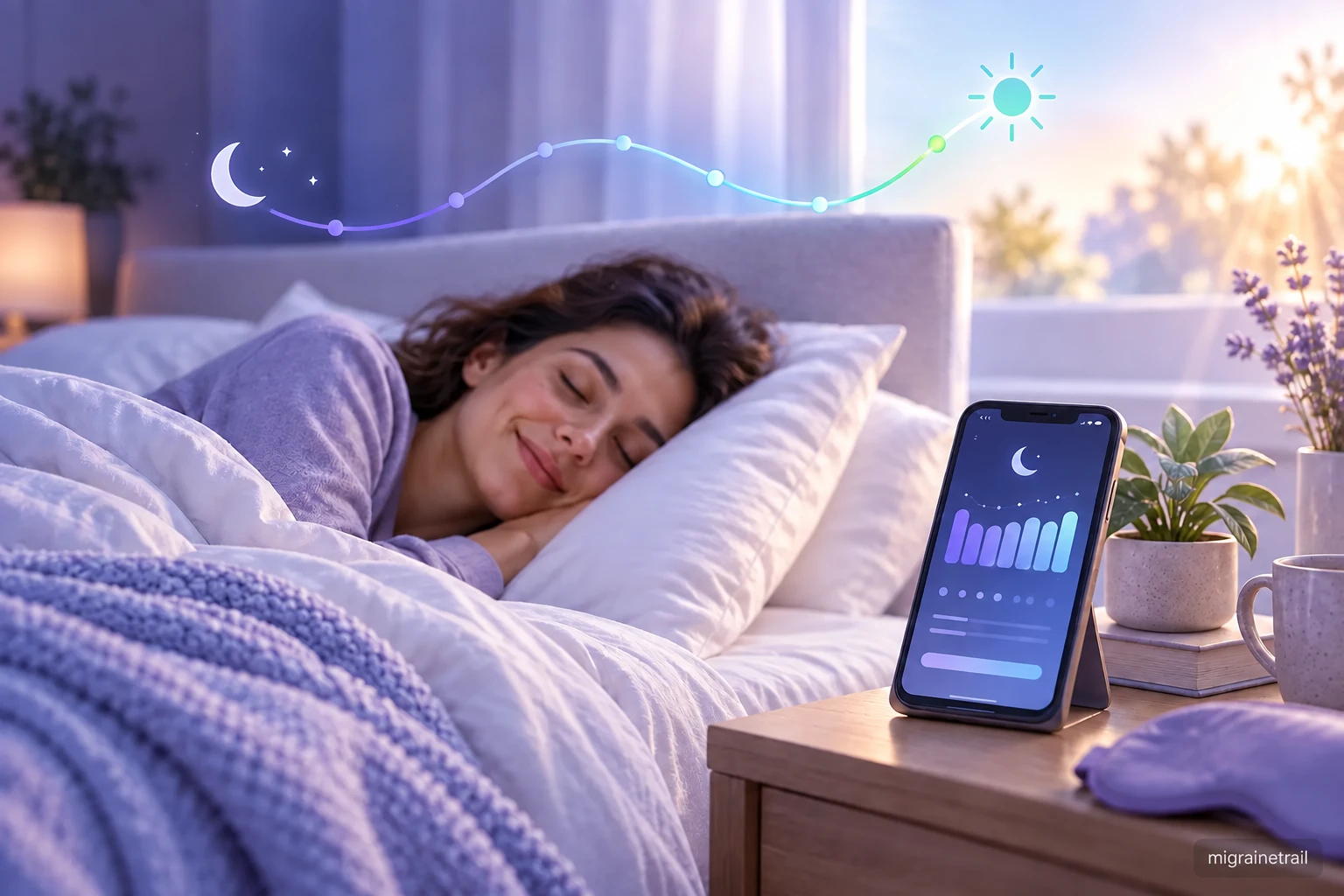
3. Tracking Sleep with Migraine Trail

How many hours of sleep did you get two nights before your last attack? Memory isn't enough to see the patterns.

By using the this migraine app for daily use, you can log your sleep duration and quality every morning in seconds. Our attack log of effort from typing allows you to simply say, "Slept 7 hours, great quality," via voice logging.

Over several months, Migraine Trail's AI will identify the correlation: "You tend to get a migraine 48 hours after you get less than 6 hours of sleep." This predictive power allows you to adjust your schedule and prioritize rest before the attack begins.

Frequently Asked Questions

Q: Are migraine tracker apps accurate for identifying sleep patterns?

A: Yes. By correlating your recorded sleep data with your attack history, a free migraine app can objectively define the link between your rest and your neurological health.

Q: Can apps help prevent migraines?

A: Absolutely. They act as an early-warning system by showing you when your life is drifting away from the stable patterns that keep your migraines at bay.

Q: How do I track my migraines effectively?

A: Start by logging every night's sleep and every attack's severity. Consistency is the key to actionable data.

Keep Reading
  • Learn about daily habits that can prevent migraines.
  • Understand how hydration affects migraine frequency.
  • Discover how to stop a migraine fast at home.
  • See how to track migraines effectively with a mobile app.