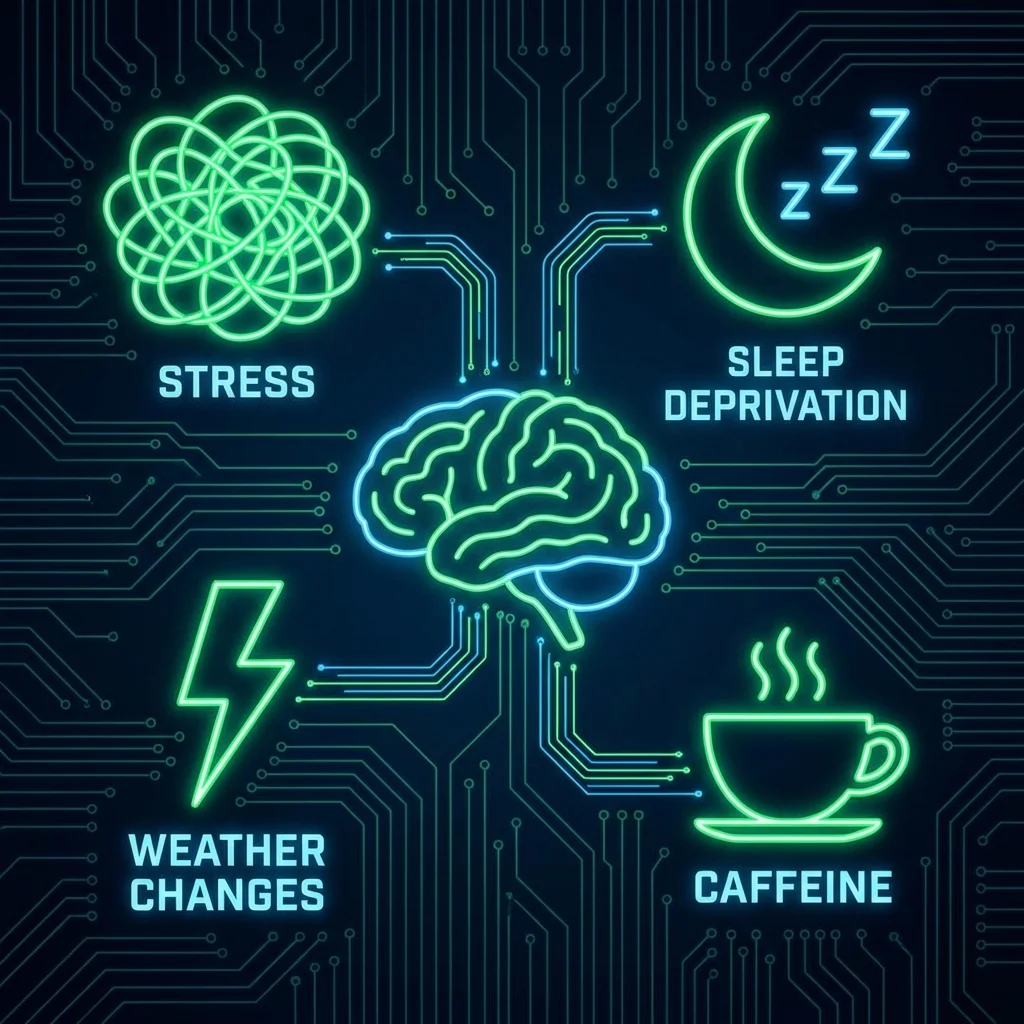
The 10 most common migraine triggers are: stress (especially the post-stress "let-down"), barometric pressure changes, sleep disruption, hormonal fluctuations, dehydration, certain foods and additives, bright or flickering light, strong odors, alcohol, and skipped meals. Most attacks are caused by multiple triggers stacking together rather than a single cause.
The reality is that migraine triggers are not always obvious. They are often subtle, stacking, and delayed by hours or even days. To truly gain control over your neurological condition, you need to become a detective of your own biochemistry. Based on statistical analysis of millions of patient logs and 2026 research data, here are the 10 most common, and often missed, triggers you should be tracking today.
1. Biometric Stress (The "Let-Down Effect")
It is a common misconception that stress itself causes the migraine during the stressful event. While high cortisol can be problematic, the real danger zone is the drop.
The Let-Down Effect occurs when you transition from a period of high acute stress (like a final exam or a deadline week) to a period of relaxation. The rapid plummet in cortisol and epinephrine causes a rebound dilation of blood vessels.
- What to Track: Log your "Stress Level" daily. If you see a migraine occurring 12-24 hours after your stress drops from a 9 to a 2, you have identified a Let-Down trigger.
- Strategy: "Taper" your relaxation. Don't go from 100 to 0. Keep your mind mildly engaged with light exercise or puzzles to smooth the neurochemical transition.
2. Barometric Pressure Velocity
We often blame the "rain," but the rain is just the visual outcome. The trigger is the invisible weight of the atmosphere. Read more about barometric pressure predicting attacks.
- The Mechanism: Your sinus cavities and inner ear are filled with air. When external pressure drops rapidly (Rapid Cyclogenesis), a pressure differential is created. This mechanical force excites the trigeminal nerve.
- The Nuance: It is the rate of change (Velocity) that matters more than the absolute low. A drop of 0.20 inHg over 6 hours is far more triggering than a drop of 0.50 inHg over 3 days.
3. High-Contrast Visual Patterns
Visual cortex hyperexcitability is a hallmark of the migraine brain.
- The Trigger: High-spatial-frequency patterns. This includes venetian blinds, striped shirts, escalators, and even text on a screen with too much contrast (pure black on pure white).
- The Reaction: These patterns cause "neural saturation," leading to Cortical Spreading Depression (CSD), the electrical wave that precedes an attack.
4. Tyramine-Rich Foods (The "Leftover" Problem)
Tyramine is an amino acid that naturally builds up in foods as they age or ferment.
- Foods: Aged cheeses (Cheddar, Swiss), cured meats (Salami), fermented vegetables (Kimchi), and even leftovers that have sat in the fridge for >48 hours. Our food triggers complete guide covers these dietary culprits in detail.
- Effect: Tyramine creates a specific vascular reaction. It initially causes vasoconstriction, followed by a painful rebound vasodilation.
5. Sleep Fragmentation (Architecture vs. Duration)
You might get 8 hours of sleep and still wake up with a migraine. Why? Sleep Architecture. The link between sleep deprivation and migraines runs deeper than most people realize.
- Fragmentation: Waking up every 90 minutes disrupts the REM cycle.
- The Glymphatic System: Your brain literally "washes" itself of toxins (like beta-amyloid) during deep sleep. If you don't hit deep sleep, the toxins remain, lowering your trigger threshold for the next day.
6. Electrolyte Imbalance (Not Just "Dehydration")
"Drink more water" is basic advice, but dehydration and electrolyte balance are far more nuanced than that. For a migraineur, drinking 3 liters of plain water can actually cause a migraine by flushing out your sodium.
- Bio-Chemistry: Neurons need a sodium-potassium pump to fire electrical signals. If your sodium is too low (Hyponatremia), the wires misfire.
- Fix: Track your intake of Sodium, Potassium, and Magnesium. Your hydration should be isotonic (balanced), not just plain water.
7. Artificial Sweeteners (Aspartame & Sucralose)
For a specific genetic subset of patients, Aspartame acts as a direct excitotoxin.
- Mechanism: It lowers the seizure threshold in the brain. While migraine is not a seizure, they share similar electrical properties. If you are drinking diet soda daily and suffering from chronic migraines, an elimination diet is the first step.
8. Estrogen Withdrawal (Catamenial Migraine)
This is the single most reliable trigger for ~60% of female migraineurs.
- The Window: It occurs not during the period itself, but in the 2-days before (the luteal phase drop).
- Strategy: Talk to your doctor about "Mini-Prophylaxis", taking a long-acting triptan specifically during this predictable 3-day window every month.
9. Osmophobia (Olfactory Overload)
The olfactory nerve has a direct highway to the brain's limbic system (emotion and pain).
- Triggers: Cigarette smoke, gasoline, heavy perfumes, and paint thinner.
- The Sign: "Osmophobia" (fear/aversion to smell) is often a prodrome symptom, but strong chemical odors can also be the primary instigator of the attack.
10. Cervicogenic Tension ("Tech Neck")
The Occipital Nerve runs from the base of your skull up over your head to your eye.
- The Chain: Posture (hunching) -> Tight Trapezius -> Compressed Occipital Nerve -> Pain behind the eye.
- Differentiation: If your migraine always starts at the base of the skull, it may have a cervicogenic (neck) trigger component.
The other 10 triggers: caffeine, dehydration, exercise, screens, and more
Beyond the headline list, watch for: caffeine withdrawal, dehydration, low blood sugar, exhaustive exercise, altitude changes, jet lag, neck strain (forward-head posture), tight ponytails or hats (allodynia), MSG and aspartame in some people, and medication overuse (taking acute meds more than 2-3 days per week). Each of these is well-documented in the medical literature.
Frequently asked questions
How do I know if something is really a trigger or just a coincidence?
Track everything — including triggers, time of onset, and the gap between exposure and attack — for at least 30-60 attacks. Real triggers show statistical patterns over time. A single "wine then migraine" incident proves nothing; 8 out of 10 incidents proves a lot.
Do triggers add up?
Yes. This is called trigger stacking, and it explains the inconsistency you've probably noticed. A glass of wine alone may not trigger an attack, but wine plus a poor night of sleep plus an incoming weather front often will. The "threshold theory" of migraine helps explain why.
How quickly does a trigger cause a migraine?
It varies by trigger. Bright light or strong smells can fire an attack in under an hour. Foods often have a 6-24 hour delay. Hormonal triggers and weather changes can cause attacks 24-72 hours later. That delay is exactly why memory-based trigger spotting fails — you cannot reliably link Tuesday's red wine to Thursday's attack from recall alone.
Should I avoid every possible trigger?
No. Aggressive avoidance often makes life worse without preventing many attacks, because you're guessing at triggers that may not be yours. A targeted approach — tracking, identifying your top 3-4 personal triggers, and managing those specifically — is more sustainable and more effective.
What this means for you
Pick a 30-day window. Log every attack with onset time, intensity, duration, and the 24 hours before it (sleep, food, stress, weather, hormones). At day 30, look for the 2-3 factors that show up most often before attacks. Those are your personal top triggers — and the ones worth managing first.
If you'd rather test a specific suspicion first, the migraine trigger stack checker will compare several possible triggers against a single attack in a couple of minutes. To find the pattern across months rather than one attack, Migraine Trail will track migraine triggers by voice and surface the combinations automatically.
Sources