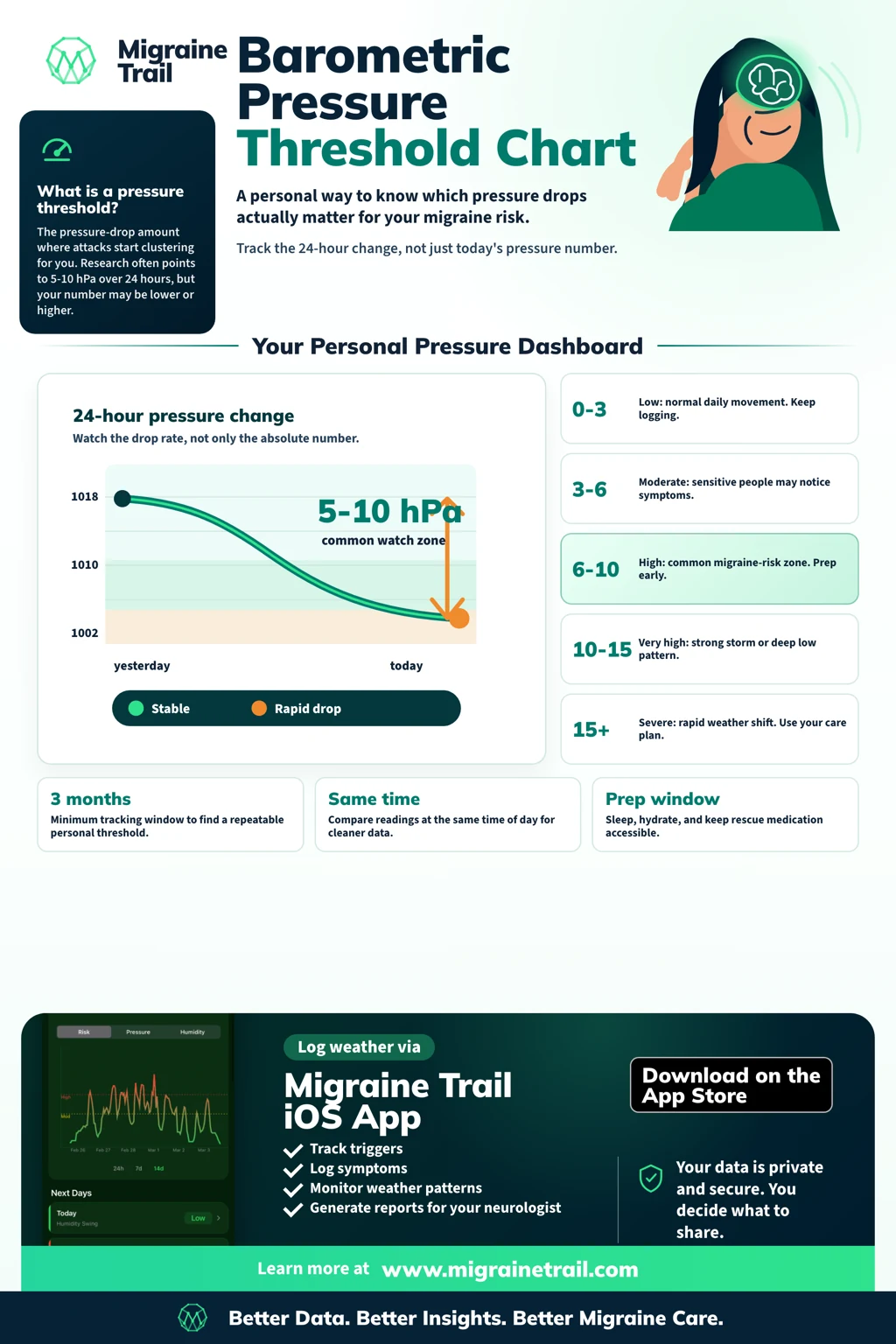
Barometric pressure changes — not just the absolute pressure level — are what trigger migraines. Research consistently points to pressure drops of 5–10 hPa (hectopascals) over 24 hours as the threshold at which migraine risk increases meaningfully for susceptible people. Your personal threshold may differ: some people respond to drops as small as 3 hPa; others only at 15+ hPa. The only way to find your number is to log attacks alongside daily pressure data over several months.
Understanding this is the difference between reacting to every storm warning and knowing which specific conditions actually affect you — and being able to prepare.
Pressure Change Risk Table
| Pressure Drop (24-hour) | Risk Level | What It Typically Signals |
|---|---|---|
| 0–3 hPa | Low | Normal daily variation; minimal trigger potential |
| 3–6 hPa | Moderate | Approaching frontal system; elevated risk for sensitive individuals |
| 6–10 hPa | High | Active weather system; peak risk window for most barometric migraineurs |
| 10–15 hPa | Very high | Strong storm system; high risk for most susceptible people |
| 15+ hPa | Severe | Rapid cyclone or deep low; extreme trigger potential |
Note: these are general research-based ranges. Individual thresholds vary.
Absolute Pressure vs. Rate of Change
Two separate variables matter:
Absolute pressure level: Standard sea-level pressure is approximately 1013 hPa. Low-pressure systems (below ~1000 hPa) are associated with storms and higher migraine risk. High-pressure systems (above ~1020 hPa) are associated with clear weather and lower risk. Some people are sensitive to high pressure too, particularly during hot, dry high-pressure domes.
Rate of change: The drop rate is often more important than the absolute level. A pressure at 1005 hPa that has been stable for three days is far less problematic than a pressure that drops from 1013 to 1003 hPa in 18 hours. The brain appears to respond to the rate of environmental change, not just the state.
This is consistent with how barometric pressure triggers migraine physiologically: pressure change affects the pressure differential across the meninges and sinus cavities, stimulating trigeminal nerve endings.
How to Find Your Personal Threshold
Step 1 — Log your attacks with timestamps. Use Migraine Trail to record onset time, duration, and severity for each attack.
Step 2 — Record daily pressure data. Most weather apps (Weather.com, Weather Underground, your phone's barometer widget) show barometric pressure. Check and log it at the same time each day, or use an app that records it automatically.
Step 3 — Calculate the 24-hour change on days you had an attack. Subtract yesterday's pressure from today's. A negative number means pressure dropped.
Step 4 — Look for a pattern after 3 months. You will likely see that attacks cluster at specific drop rates. That number is your personal threshold.
Threshold Chart: What to Do at Each Level
| Your threshold | Pre-attack prep window | Action |
|---|---|---|
| Sensitive (≤3 hPa drop) | 12–24 hours ahead | Sleep consistently, hydrate, avoid alcohol and dietary triggers |
| Moderate (4–8 hPa) | 6–18 hours ahead | Same as above + have rescue medication accessible |
| Less sensitive (>8 hPa) | Within 6 hours | Rescue medication at first symptom |
Frequently Asked Questions
Does rising pressure also trigger migraines?
For most people, the drop is the stronger trigger. However, some people do report attacks as pressure rapidly rises after a storm passes. This is less well-studied but is reported often enough in clinical practice to be real.
My pressure is 1008 hPa — is that dangerous?
The absolute number matters less than the change. A stable 1008 hPa may be fine; a pressure that dropped from 1018 to 1008 in 24 hours carries more trigger potential. Always calculate the rate of change.
How do altitude and travel affect this?
Flying and high-altitude travel involve significant and rapid pressure changes. Cabin pressure in aircraft is maintained around 750–800 hPa (equivalent to ~6,000–8,000 feet altitude). This pressure drop, occurring over hours, is a common trigger for in-flight and post-flight migraines. Hydration and pre-emptive medication use are the main strategies for air travel.
Can I use a weather app's "migraine forecast" instead of doing this myself?
Yes — apps that integrate pressure-change modeling with your personal trigger history (as Migraine Trail does) remove the manual calculation burden. But knowing your personal threshold helps you interpret any forecast and decide how aggressively to prepare.