Key Takeaway: A stress headache, clinically called a tension-type headache, is the most common kind of head pain. It shows up as a steady, dull band of pressure across the forehead and temples, not a one-sided throb. Most cases respond to a five-minute reset: a screen break, water, and a gentle neck stretch. Logging when it happens is the single best way to figure out why it keeps coming back.
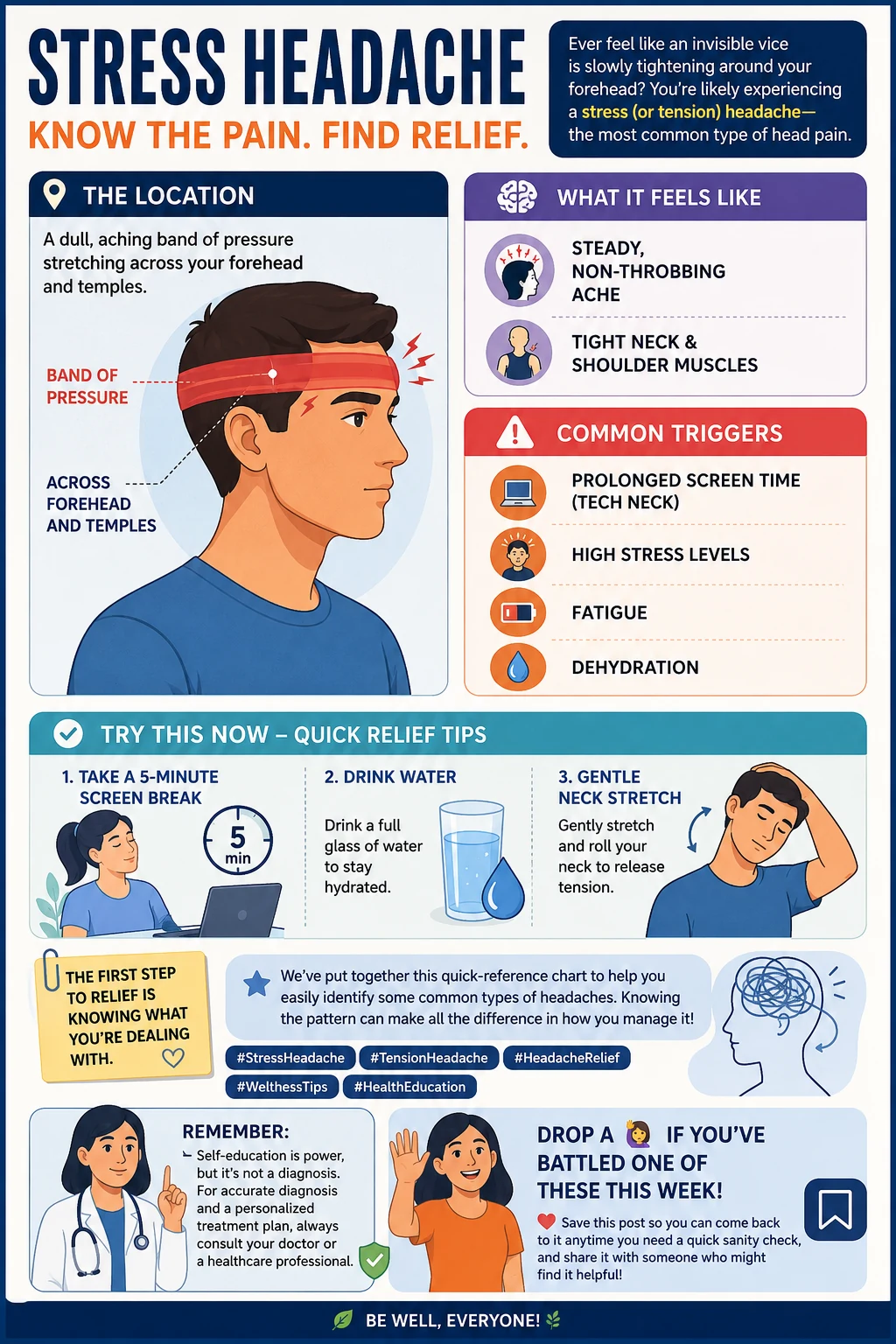
Ever feel like an invisible vice is slowly tightening around your forehead? If so, you are not imagining it, and you are very much not alone. What you are likely feeling is a stress (or tension) headache, the most common type of head pain. Roughly 80% of adults will have one at some point, and for many people they show up again and again without an obvious cause.
The good news: stress headaches are almost always treatable at home, and once you start paying attention to when yours appear, the pattern usually gives itself away.
📍 The Location
A stress headache lives in a very specific place: a dull, aching band of pressure stretching across your forehead and temples, often wrapping around to the back of the head. It usually sits on both sides at once, not the one-sided pattern you would expect from a migraine.
If you have ever taken off a hat and felt instant relief, that "imaginary tight hat" sensation is the giveaway.
🧠 What It Feels Like
Unlike a migraine, a stress headache is a steady, non-throbbing ache. The pain holds at a consistent dull-to-moderate intensity rather than pounding in time with your heartbeat. Two other signatures show up almost every time:
- Tight neck and shoulder muscles. The upper traps and the muscles at the base of your skull often feel knotted or tender to the touch.
- Pressure, not pain. Most people describe it as a tight cap, a snug headband, or a vise, rather than sharp or stabbing.
You can usually still get through your day. Walking around, climbing stairs, and routine activity do not make it dramatically worse. If movement makes the pain spike, or you feel nauseated, you may be dealing with a migraine instead. The tension headache vs. migraine guide walks through the differences side by side.
🛑 Common Triggers
Stress headaches rarely come out of nowhere. The usual suspects:
- Prolonged screen time (hello, tech neck). Hours looking down at a phone or forward at a monitor loads the cervical spine and tightens the muscles that refer pain into the head.
- High stress levels. Sustained worry keeps the muscles around the jaw, scalp, and neck contracted without you noticing.
- Fatigue and poor sleep. Both lower your pain threshold and add to muscle tension.
- Dehydration. Even mild dehydration is enough to set one off in susceptible people.
- Skipped meals and forward-head desk posture are the other two big offenders.
For a deeper look at how stress turns into head pain, read how stress leads to migraines and the health-library piece on stress and headaches.
✅ Try This Now: Quick Relief Tips
If you can feel one building, do all three of these in the next five minutes:
- Take a 5-minute screen break. Look at something at least 20 feet away. Close your eyes for the last minute.
- Drink a full glass of water. Cold water if you can. It does the rehydration job and also gives a small vagal-nerve nudge.
- Gentle neck stretch. Slowly roll your shoulders back five times. Then, with your right hand resting lightly on the left side of your head, tilt your right ear toward your right shoulder for 20 seconds. Repeat on the other side. No bouncing, no force.
If the pain is already established, a basic OTC pain reliever (acetaminophen or ibuprofen) taken early is usually enough. Try not to lean on them more than two or three days a week, since frequent use can cause its own kind of rebound headache.
📒 Log It While You Remember
Here is the quiet part most articles skip: the single most powerful thing you can do for a stress headache is write it down while it is happening, or right after.
When you note even a few details (what time it started, what you had been doing for the past hour, how much sleep you got, how much water you had, and how stressed you felt on a 1 to 5), you start to see the pattern that has been hiding in plain sight. Most people discover within a week or two that their headaches cluster around the same triggers (a long Zoom block, a poor night's sleep, a skipped lunch, a specific deadline). Once you can see the trigger, you can step in earlier.
This is exactly what Migraine Trail is built for. Voice logging takes about ten seconds, so you can do it even when your head is pounding and the last thing you want is to type. Over a few weeks the app surfaces your personal pattern, so you stop guessing.
If you would rather use paper, that works too. The point is the consistency, not the tool.
When to See a Doctor
A stress headache is almost always harmless and short-lived. Please get checked out promptly if any of these are true:
- The headache is the worst you have ever had, or came on suddenly like a thunderclap.
- It started after a head injury.
- It comes with fever, stiff neck, confusion, vision loss, or weakness on one side of the body.
- You have had headaches more than 15 days a month for the last three months. This can qualify as chronic tension-type headache and often responds well to preventive treatment.
- Over-the-counter painkillers are no longer working, or you find yourself reaching for them four or more days a week.
You Are Not Overreacting
If you have read this far, you probably get these regularly enough that they are affecting your day. That is reason enough to take them seriously. A headache that you have been quietly tolerating for years is still worth understanding and worth treating.
A gentle reminder: self-education is powerful, but it is not a diagnosis. For an accurate diagnosis and a treatment plan that fits you, please consult your doctor or another qualified healthcare professional. Be kind to yourself today. 🌿