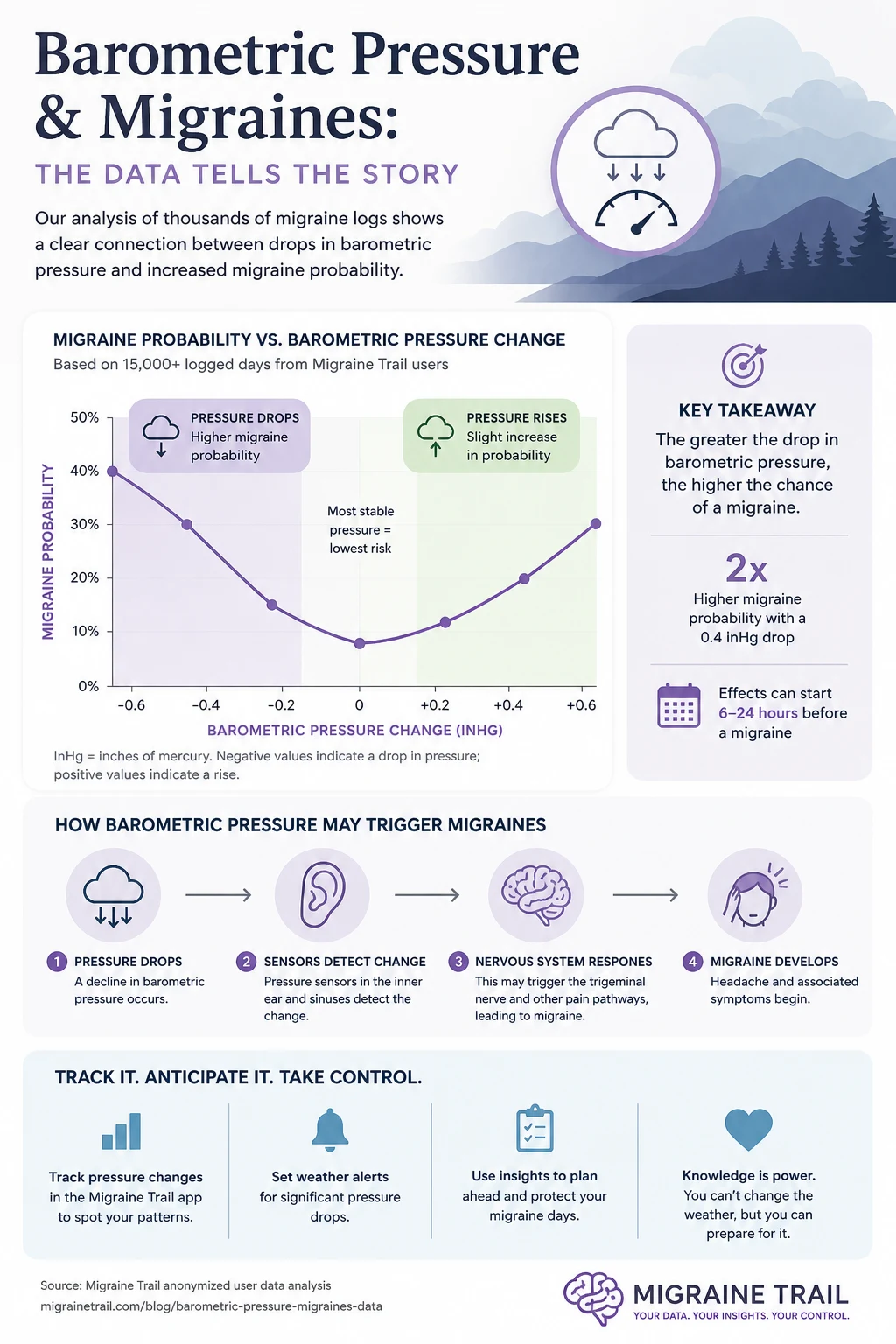
Around half of people with migraine are sensitive to barometric pressure changes, and barometric pressure is the single most-cited weather trigger across surveys of weather-sensitive migraineurs. The challenge has always been turning that knowledge into action. By the time you feel the pressure shift, the attack has often already started. A forecast-based plan, built on knowing the magnitudes and rates of change that matter for your nervous system, beats reaction every time.
If your migraines seem to track the weather, you are not imagining it. Multiple studies have found that 30 to 50% of people with migraine report weather as a trigger, and barometric (atmospheric) pressure is the most consistently cited factor. This guide explains what is actually happening in your body during a pressure shift, what magnitudes of change matter, and how forecasting tools have changed the game for pressure-sensitive migraineurs.
How does barometric pressure cause migraines?
Barometric pressure changes appear to trigger migraines by altering blood vessel diameter, sinus and inner-ear pressure, and the activity of pressure-sensitive nerve endings in the trigeminal system. Drops of as little as 5 to 10 millibars over 24 hours can be enough to set off attacks in sensitive individuals. Pre-storm pressure drops are the most common pattern, but rapid rises can also trigger attacks.
What is actually happening in your head
Your inner ear, sinuses, and the blood vessels around your brain all respond to changes in atmospheric pressure. In sensitive individuals, even modest shifts appear to activate the trigeminovascular system, the same network involved in migraine generation. Functional imaging studies show measurably altered brain activity in weather-sensitive migraineurs during pressure changes.
It is not about the absolute pressure. People with migraine get attacks at sea level and at altitude. It is the rate and magnitude of change that matters most. For the full neurochemistry, see how weather affects migraines.
How big a pressure change matters?
Research from Japan, the US, and Europe consistently shows that drops of 5 to 10 millibars (hPa) over 12 to 24 hours raise migraine risk noticeably. In a Japanese study tracking 34 people with migraine, attacks clustered when pressure fell 6 to 10 hPa below standard — a range most people would not consciously notice. Larger drops, 15+ millibars in 24 hours, typical of a strong cold front or storm, can trigger attacks even in people who do not usually consider themselves weather-sensitive.
Rate of change matters too. A slow 10 mb decline over 3 days is different from a 10 mb plunge in 6 hours. Faster shifts hit harder.
These are population averages, and your own cutoff may sit well above or below them. Working out your personal barometric pressure threshold takes a few weeks of paired pressure and attack data, and it is far more useful than any general figure.
| Pressure change | Time window | Typical impact |
|---|---|---|
| 5 to 10 mb drop | 12 to 24 hours | Triggers sensitive individuals |
| 10 to 15 mb drop | 24 hours | Triggers most weather-sensitive migraineurs |
| 15+ mb drop | 24 hours | Triggers attacks even in those who do not consider themselves weather-sensitive |
| Slow 10 mb decline | 3+ days | Easier to tolerate than the same drop over hours |
Why pre-storm migraines are so common
The classic pattern: a vague unease 24 to 36 hours before a storm, then a full migraine 6 to 12 hours before the rain actually starts. By the time the front passes and pressure stabilizes (often higher), many people feel relief. This is why your migraines may feel like storm warnings. They are tracking the pressure drop ahead of the weather you feel.
Some people are more sensitive to pre-storm low-pressure systems; others react to high-pressure systems sliding in afterward. Both patterns are documented. The science of weather triggers covers the mechanisms behind each pattern in more depth.
From reactive to predictive: forecasting your attacks
Until recently, the only thing pressure-sensitive migraineurs could do was react. Modern weather data, including the GFS and ECMWF models that power Migraine Trail's 14-day pressure forecast, make a different approach possible: spotting incoming pressure drops early enough to take preventive action.
Preventive action might mean:
- Adjusting medication timing. Taking your preventive on schedule and having acute medication accessible the moment symptoms start.
- Prioritizing sleep. Aim for a regular bedtime in the 48 hours before a forecast drop.
- Hydrating aggressively. Dehydration stacks with pressure sensitivity and raises attack risk substantially.
- Avoiding other triggers. No alcohol, no missed meals, no caffeine spikes on a day a pressure drop is forecast.
Stacking triggers makes pressure-driven attacks much worse. Removing the controllable ones on high-risk days is the single most effective lever you have.
Frequently asked questions
What barometric pressure is bad for migraines?
It is not the absolute pressure that matters, it is the change. Drops of 5 to 10 millibars in 24 hours are enough to trigger sensitive individuals; drops of 15+ millibars are reliably triggering for most weather-sensitive migraineurs. Rate of change matters: slow shifts are easier to tolerate than fast ones.
Can altitude changes trigger migraines the same way?
Yes. Flying, driving over mountain passes, and traveling between sea level and higher elevation cities all involve pressure shifts that can trigger attacks. Hydration, slow ascent, and timing your acute medication can all help.
Why do my migraines come before the rain?
Storm systems are characterized by falling pressure ahead of them. The pressure drop precedes the rain by hours or even a day. Your nervous system is registering the atmospheric shift before any visible weather arrives.
Does a barometer or weather app actually help?
Only if it shows the right metric. You need to see pressure trends (falling vs rising over hours and days) not just the current reading. A 14-day pressure forecast lets you prepare in advance, which is what migraine management really requires. You can check today's reading and 24-hour trend for your city with the free barometric pressure migraine calculator.
Can climate change make pressure-driven migraines worse?
Yes. More frequent and intense storm systems mean more frequent and steeper pressure shifts. See climate change and migraine for what the data says about rising attack frequency in weather-sensitive migraineurs.
What this means for you
Treat pressure forecasts the way a runner treats heat warnings: as actionable. On a day with a 10+ millibar pressure drop forecast, double down on the basics. Sleep, hydration, regular meals, no alcohol, and take preventive medication on schedule. Stacking your trigger threshold higher on those days dramatically reduces attacks.
See your 14-day barometric pressure forecast in Migraine Trail, built on GFS and ECMWF weather models.
Sources