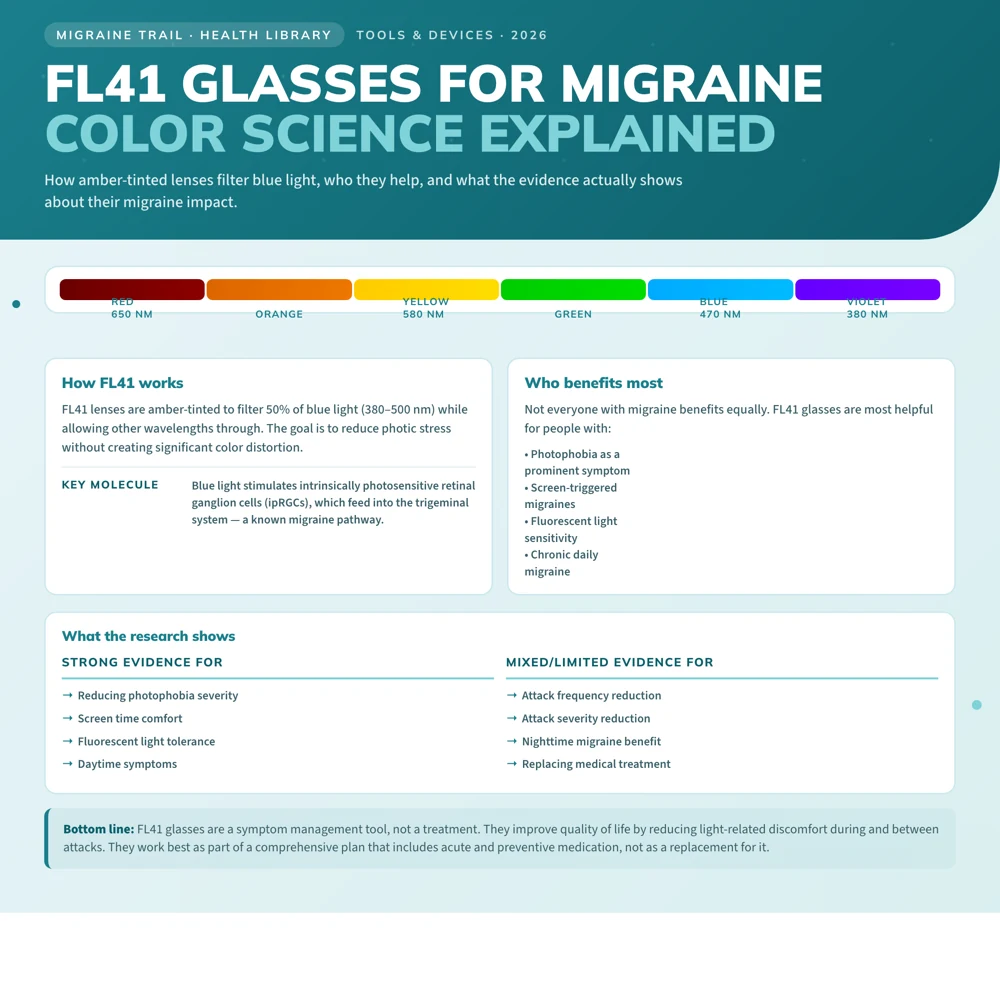
FL-41 tinted glasses are rose-colored lenses that filter wavelengths of blue-green light (480 to 520nm), which research identifies as the most painful for people with migraine and photophobia. Clinical trials show they reduce both the frequency and severity of light-triggered migraine attacks and significantly improve tolerance for bright light environments. They work best for people with photophobia as a prominent symptom, and are less likely to help if light is not a significant part of your trigger or symptom profile.
If you find yourself reaching for sunglasses indoors, dreading fluorescent-lit offices, or leaving shops and restaurants because the lighting is unbearable, photophobia is affecting your quality of life in ways that go far beyond headaches. It can restrict where you can go, what work you can do, and how long you can be around other people. FL-41 glasses were developed specifically to address this, and for many people with migraine and light sensitivity, they make a genuine difference.
Photophobia affects approximately 80 to 90% of people during migraine attacks and is one of the most functionally disabling symptoms. Many people are also sensitive to light between attacks, a state called interictal photophobia. Standard dark sunglasses can actually make this worse over time by dark-adapting the visual system. FL-41 lenses take a different approach.
What Is FL-41?
FL-41 is a rose-pink tint originally developed in the 1990s to reduce discomfort from fluorescent lighting, a common trigger in offices, hospitals, and supermarkets. The name comes from the fluorescent light study it was originally designed for.
The tint selectively filters a narrow band of the visible spectrum, roughly 480 to 520nm (blue-green light). This range has been identified by researchers at the University of Utah as particularly activating to the retinal pathway that drives photophobia. By filtering it out, FL-41 lenses reduce the neural signal driving light pain without significantly distorting color perception or darkening the visual field the way dark sunglasses do.
The Evidence
Pediatric study: In a controlled trial of 20 children with migraine, rose-tinted (FL-41 type) lenses reduced attack frequency from 6.2 to 1.6 per month over four months — roughly a 74% reduction — while a density-matched blue tint showed no sustained improvement. Notably, the tint reduced how often attacks came without improving their intensity or duration. It is a small study, and worth reading as encouraging rather than definitive.
Adult photophobia: Studies from the University of Utah (Dr. Bradley Katz's group) demonstrated that specific short-wavelength light, particularly around 480nm, is maximally painful for individuals with photophobia, and that filtered lenses attenuating this range consistently reduce discomfort scores.
Photophobia in standard light environments: Multiple smaller trials and observational studies report that FL-41 wearers tolerate fluorescent lighting, computer screens, and outdoor environments with significantly less discomfort compared to untinted or blue-tinted alternatives.
The evidence is most consistent for photophobia reduction and light-triggered attack prevention. FL-41 is not a migraine medication and will not address attacks driven primarily by hormonal, dietary, or sleep triggers. If light sensitivity is a significant part of your experience, there is genuine evidence that these glasses can help.
Who Benefits Most
FL-41 glasses are most likely to help if you:
- Experience photophobia during attacks (sensitivity to light is debilitating during migraines)
- Have interictal photophobia: light sensitivity between attacks, not just during them
- Find that fluorescent lights, computer screens, or bright outdoor light reliably trigger attacks
- Work in environments with unavoidable artificial lighting
- Have been diagnosed with blepharospasm: a condition that frequently co-occurs with photophobia and responds strongly to FL-41
They are less likely to provide meaningful benefit if light is not a significant part of your trigger or symptom profile. This matters because migraine management already involves a lot of trial and error, and it helps to know in advance whether a tool is likely to be relevant to your specific pattern.
FL-41 vs. Standard Sunglasses
Many people with migraine reach for dark sunglasses during and between attacks. This is completely understandable, but it is counterproductive as a long-term strategy:
- Dark lenses (especially Category 3 to 4 sunglasses) dark-adapt the visual system over time, making eyes progressively more sensitive to normal light levels
- Standard grey or brown tints darken broadly rather than filtering the specific problematic wavelength range
- Wearing dark indoor sunglasses creates a feedback loop of increasing light sensitivity
FL-41 lenses are designed to be worn indoors and in everyday conditions, not as an emergency measure during an attack, but as a preventive tool to reduce the ongoing photic burden on the trigeminal system. They look less dramatic than sunglasses worn inside, which for many people is a practical benefit for work and social situations.
Are There Different Brands?
FL-41 is a tint specification, not a brand name. Several companies manufacture lenses to this specification:
Theraspecs: the most widely researched consumer brand, developed with input from migraine researchers at the University of Utah. Available as indoor and outdoor variants with appropriate tint depth for each environment. Prescription versions available.
Axon Optics: another research-backed brand with indoor (FL-41 equivalent) and outdoor (darker) versions. Also offers clip-on and fit-over options for people who already wear prescription glasses, which removes the need to choose between vision correction and migraine management.
Generic FL-41: many online optical retailers sell FL-41-tinted frames at lower price points. Quality varies; ensure the lens material provides the correct tint depth.
Avulux: a newer lens technology using multi-band filtering targeting three specific wavelength ranges simultaneously. Some evidence suggests it may outperform standard FL-41, though it is significantly more expensive.
Price Range
- Generic FL-41 frames (non-prescription): $30 to $80
- Theraspecs or Axon Optics (non-prescription): $80 to $150
- Prescription FL-41 lenses: $150 to $400 or more depending on prescription complexity and lens type
- Avulux lenses: $300 to $500
Cost can be a barrier, and that is real and worth acknowledging. If cost is a concern, generic FL-41 frames at the lower end of the price range use the same tint specification and can be genuinely effective. Starting there before investing in a premium brand is a reasonable approach.
Practical Tips
Indoor vs. outdoor lenses: The indoor FL-41 tint is a light rose with approximately 20 to 30% light reduction. The outdoor version is darker for direct sunlight. Use indoor lenses at your desk and in fluorescent-lit environments; outdoor versions for driving or bright daylight.
Allow adaptation time: The rose tint is obvious at first. Most people adapt within a few days of regular use and stop noticing the color cast. Give it at least two weeks before deciding whether they feel right.
Do not replace dark glasses during acute attacks: During a severe attack with extreme photophobia, a dark room or very dark lenses may still be needed for comfort. FL-41 is a preventive and interictal tool, not a rescue treatment.
Track before and after: Wear the glasses consistently for 6 to 8 weeks and track your attack frequency and light sensitivity. Many people see gradual improvement rather than an immediate dramatic change. Patience and data both matter here.
Use Migraine Trail to track attack frequency, severity, and light sensitivity before and after starting FL-41 glasses. The data will tell you clearly whether they are making a difference for your specific pattern, and that clarity is worth having.