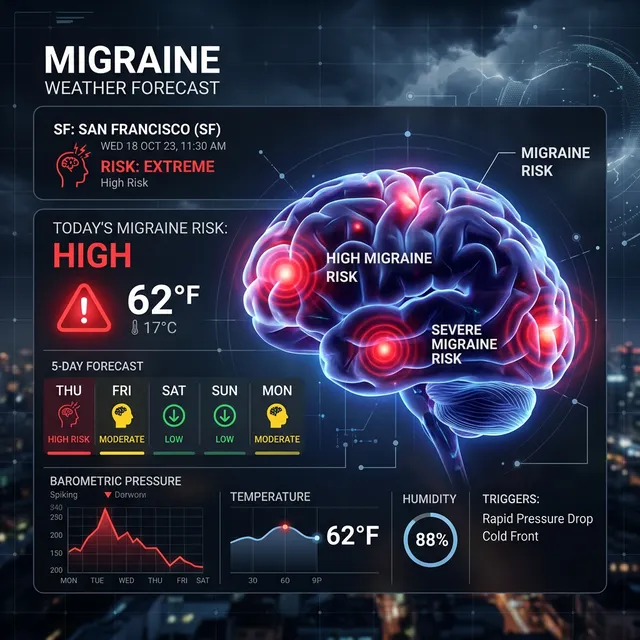
For millions of people living with chronic migraines, an incoming weather front isn't just an inconvenience. It's a neurological emergency. Research consistently shows that rapid barometric pressure drops are among the most potent and unavoidable migraine triggers on the planet. Unlike dietary triggers or stress, you simply cannot opt out of the atmosphere.
That is exactly why choosing a migraine tracker app with robust, built-in weather intelligence is no longer optional. It is clinically essential. In this guide, we compare the best migraine apps for weather tracking available in 2026 so you can find the right tool for proactive migraine management.
Why Weather Tracking Matters for Migraineurs
When barometric pressure drops rapidly (typically ahead of a storm front), the air inside your sinus cavities and inner ear expands relative to the environment. This expansion physically irritates the trigeminal nerve, triggering a cascade of neuro-inflammation that results in debilitating head pain, nausea, and light sensitivity. For a deep dive into the mechanics, read our article on barometric pressure and migraines explained.
Temperature drops compound the problem. Sudden cold snaps cause blood vessels in the brain to constrict and then rapidly dilate, a vascular response that frequently triggers attacks in susceptible individuals. Our guide on temperature drops and vascular headaches covers this in full detail.
The core issue is timing. Barometric pressure changes often precede visible weather shifts by 12 to 48 hours. If you only react once the rain starts falling, you are already too late. An effective weather-enabled migraine app must detect these invisible atmospheric changes and alert you before symptoms begin, giving you time for proactive migraine relief.
App Comparison: Weather-Enabled Migraine Trackers in 2026
1. Migraine Trail (Best Overall Weather Intelligence)
Download Migraine Trail on the App Store
Migraine Trail is the clear leader for weather-based migraine tracking in 2026. Its weather system does not simply report what the barometric pressure is right now. It provides a full 14-day migraine prediction forecast built on hyper-local meteorological data pulled via GPS-based APIs.
What sets it apart:
- Personalized Risk Scores: The app cross-references real-time barometric pressure, temperature, and humidity data against your personal attack history. Over time, it learns your specific sensitivity thresholds and produces a daily risk score calibrated to your body, not generic population averages.
- Proactive Push Alerts: Receive notifications 24 to 48 hours before a dangerous pressure drop reaches your area, giving you time to reduce your trigger load, hydrate, and take preemptive action.
- Automatic Weather Tagging: Every migraine you log is automatically stamped with the exact atmospheric conditions at the time, including barometric pressure variance from the prior 24 hours. No manual data entry required.
- Voice Logging: When a weather-triggered attack hits and you cannot tolerate screen brightness, simply speak to the app. The AI captures your pain level, location, and treatments hands-free. Learn more about why voice logging makes migraine tracking easier.
Migraine Trail is purpose-built for people who need to keep a trigger log with clinical precision. Visit the migraine tracker app page for the full feature breakdown.
2. WeatherX (Best for Barometric Alerts Only)
WeatherX is a single-purpose barometric pressure alert app. It monitors atmospheric pressure at your location and sends push notifications when a significant drop is detected.
Pros:
- Clean, simple interface focused entirely on pressure alerts.
- Customizable sensitivity thresholds for notifications.
Cons:
- WeatherX does not track migraines at all. There is no attack logging, no pattern analysis, and no clinical reports. It tells you when pressure drops, but it cannot correlate that data with your personal migraine history. You would need to pair it with a separate migraine diary, which means maintaining two apps and manually connecting the dots yourself.
- No temperature, humidity, or multi-variable weather analysis.
3. Migraine Buddy (Basic Weather Logging)
Migraine Buddy is a well-established migraine tracker with a large user community. It does include a weather logging feature that records general conditions (sunny, cloudy, rainy) at the time you log an attack.
Pros:
- Large community heatmaps showing active attacks across your region.
- Extensive manual trigger checklist.
Cons:
- Weather data is logged reactively after an attack, not predictively before one. There is no forward-looking barometric forecast or proactive risk scoring.
- The multi-screen logging flow requires significant tapping and scrolling, which is difficult during an active attack with light sensitivity.
- No personalized weather-to-attack correlation engine.
4. Generic Weather Apps (Apple Weather, AccuWeather, etc.)
Some migraineurs attempt to use standard weather apps by manually checking barometric pressure readings each day.
Pros:
- Free and already installed on most phones.
- Accurate raw meteorological data.
Cons:
- Zero migraine-specific intelligence. You are responsible for interpreting raw pressure numbers, remembering your personal sensitivity thresholds, and manually cross-referencing historical data with your attack log.
- No alerts, no risk scoring, no clinical reports, and no integration with your migraine management workflow.
What Makes Migraine Trail's Weather Feature Unique
The fundamental difference between Migraine Trail and every other option on this list is the closed-loop feedback system. Most apps treat weather data and migraine data as separate silos. Migraine Trail fuses them.
Every attack you log feeds the algorithm. Every weather event in your area is automatically recorded. Over weeks and months, the system identifies your precise barometric sensitivity profile. It learns whether you are triggered by a 6 hPa drop over 12 hours, or whether it takes a 10 hPa drop over 6 hours to push you over the edge. It factors in compounding variables like poor sleep or hormonal cycles. The result is a genuinely personalized prediction engine that gets more accurate the longer you use it.
This is the difference between passively checking a weather app and having an intelligent early-warning system that understands your specific neurology. For a closer look at the prediction system, read our full review of the weather migraine prediction tool.
Ready to stop reacting and start predicting? Download Migraine Trail from the App Store and experience the most advanced weather-based migraine tracking available today.
Keep Reading
If weather is a primary trigger for you, these articles will help you build a complete defense strategy:
Don't let the next storm catch you off guard. The right migraine tracker app turns invisible atmospheric shifts into visible, actionable warnings, giving you the time and data you need for real migraine relief.