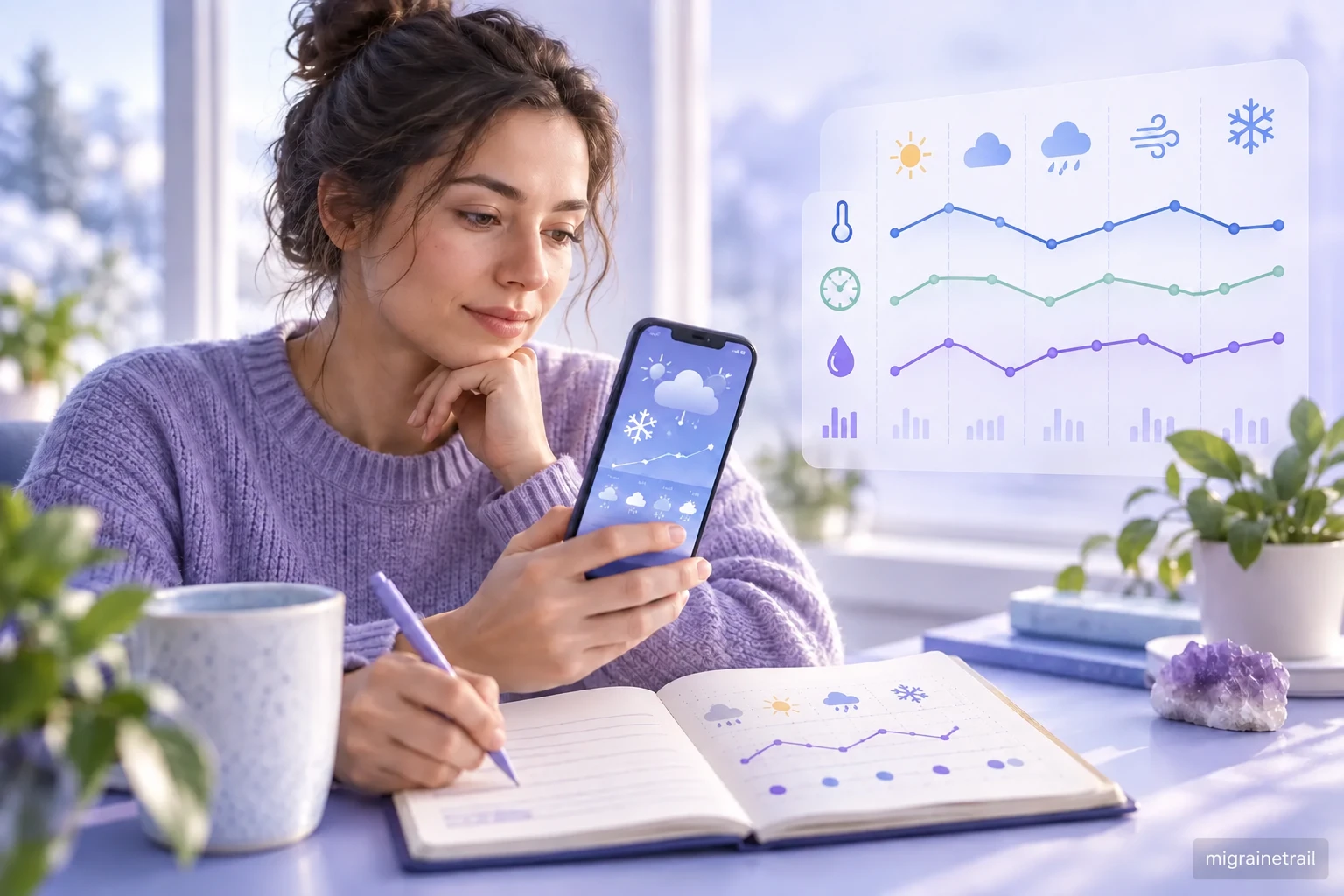
The reliable way to use a weather migraine forecast is to validate it against your own history. Track the weather conditions, compare them with headache-free and headache days, look for repeated timing, and treat a forecast as a planning signal—not proof that an attack will happen.
Weather is a real concern for some people with migraine, but it is not universal. Even for one person, a pressure change may matter in one season and not another, or only when it overlaps with poor sleep, dehydration, illness, stress, or a disrupted routine.
What a migraine weather feature actually does
A weather feature may display or compare:
- Barometric or atmospheric pressure.
- Pressure changes over time.
- Temperature.
- Humidity or dew point.
- Precipitation and storms.
- Wind or seasonal changes.
- The location selected in the app.
These are measurements and forecasts. They are not the same as a medical prediction. A weather app can be accurate about rain and still be unable to tell whether you will have a migraine.
The American Migraine Foundation describes changing barometric pressure as a possible weather-related factor for some people and emphasizes that triggers vary. That is a useful frame: possible, personal, and worth testing—not guaranteed.
Step 1: Record weather and migraine events together
For each headache, record:
- Where you were.
- When symptoms started.
- The weather conditions around that time.
- Whether pressure was rising, falling, or relatively stable.
- Temperature and humidity if those matter to your hypothesis.
- Sleep, meals, hydration, stress, illness, and other changes.
If you travel, record the city rather than assuming your home weather represents the conditions around the attack. If your app automatically adds weather, check which location and time zone it uses.
Step 2: Compare with headache-free weather days
A weather factor that appears before every migraine may feel compelling, but you also need to know how often it appears without a migraine. Compare:
| Question | Example |
|---|---|
| How many attacks followed a pressure drop? | 5 of 12 |
| How many pressure-drop days were headache-free? | 9 |
| Did the attacks happen during a particular season? | Mostly autumn |
| What other factors were present? | Short sleep on 4 of 5 attacks |
This does not produce a perfect personal forecast. It helps you judge whether the weather signal is strong enough to be useful in your routine.
Step 3: Look at timing windows
The weather change may happen before, during, or after symptoms begin. Review several windows rather than choosing the one that makes the pattern look strongest:
- The same day.
- The previous 6 to 12 hours.
- The previous 24 hours.
- The day after the change.
Also track early symptoms. Fatigue, neck discomfort, food cravings, or light sensitivity may begin before head pain. If the weather changes after those symptoms, it may be a companion to an attack already underway rather than the original cause.
Step 4: Separate weather from season and routine
Cold fronts, heat, storms, and humidity often arrive with changes in sleep, daylight, activity, indoor air, travel, allergies, and schedules. A pattern may be seasonal without being caused by one weather variable.
Ask:
- Is the signal present in more than one season?
- Does it appear on workdays but not weekends?
- Does it happen only when sleep is also disrupted?
- Do indoor conditions differ from outdoor conditions?
- Does the same weather occur without an attack?
These questions keep you from chasing one number while missing the broader context.
Step 5: Decide how to use a forecast
If your own data shows a repeatable association, a forecast may help you prepare in low-risk ways:
- Keep prescribed acute medication accessible.
- Plan regular meals, fluids, rest, and breaks.
- Reduce avoidable sensory load when possible.
- Tell a trusted person that you may need flexibility.
- Avoid scheduling an unnecessary high-demand task during a pattern you have observed.
Do not take extra medication, change a dose, or start preventive treatment solely because an app predicts a pressure change. Ask your clinician whether you should have a written plan for anticipated attacks.
How reliable is a migraine forecast app?
It depends on what “reliable” means:
- Weather reliability: How accurately does it describe conditions at your location?
- Personal association: How often do the displayed conditions occur before your attacks?
- Practical usefulness: Does the information help you prepare without increasing anxiety?
A good feature should explain its source and time window, avoid certainty language, and let you compare predictions with your actual entries. Your own pattern matters more than a generic percentage.
When weather tracking becomes unhelpful
Stop or simplify the feature if it makes you feel that every cloud is a threat, keeps you checking forecasts compulsively, or leads you to avoid normal activities without evidence that the change helps. The goal is more agency, not a smaller life.
You can keep weather as one field in your diary and review it once a week or at an appointment. That is enough for many people.
More weather and migraine guides
Frequently asked questions
Can changes in barometric pressure cause migraine?
Changing pressure may be associated with migraine for some people, but it does not affect everyone and does not explain every attack. Track pressure alongside headache-free days and other factors before treating it as a personal trigger.
Do humidity and temperature correlate with migraine?
They may be relevant for some people, but the relationship is individual and can overlap with season, hydration, sleep, and indoor conditions. Use your diary to test whether the relationship repeats for you.
Can a migraine forecast app predict my next attack?
No app can guarantee that an attack will or will not occur. A forecast can provide weather context and help you prepare, but it should not replace clinical care or a treatment plan.
How long should I track weather and migraines?
Track long enough to include both headache and headache-free examples across the conditions you want to compare. A clinician can help you choose a useful time window. Longer records are often more informative for seasonal patterns.
Sources