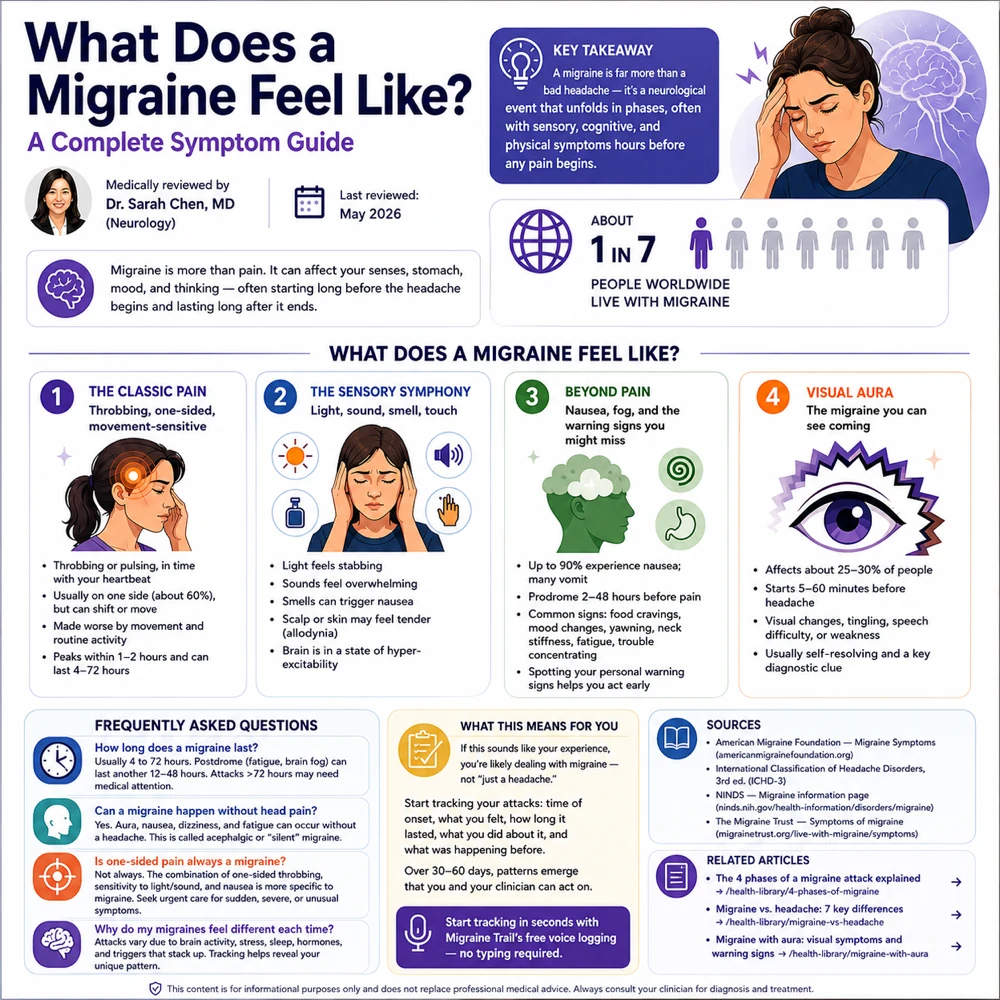
A migraine usually feels like throbbing or pulsing pain on one side of the head, often severe, made worse by movement, and accompanied by nausea, sensitivity to light and sound, and sometimes visual disturbances called aura. Attacks typically last 4 to 72 hours and can leave you exhausted for another day or two afterward. But the pain is only one piece of the picture: migraine is a neurological event that unfolds in phases, often with sensory, cognitive, and physical symptoms hours before any pain begins.
If you have ever wondered whether what you are experiencing is "just a headache" or something more, you are not alone. About 1 in 7 people worldwide live with migraine, and many go years before getting an accurate diagnosis. Part of the problem is that migraine does not look the same in everyone, and the pain itself is only one piece of a much bigger picture.
This guide walks you through what migraines actually feel like, from the subtle warning signs that show up a day in advance, to the throbbing pain that can sideline you for hours, to the foggy "migraine hangover" that follows. Use it to help name what you are going through and decide whether to talk to a clinician.
The Classic Pain: Throbbing, One-Sided, Movement-Sensitive
Migraine pain is most often described as throbbing or pulsing, in time with your heartbeat. About 60% of people feel it on one side of the head, though it can shift sides between attacks or move during a single attack. The intensity ranges from moderate to severe, and routine activity (walking up stairs, bending over, climbing into a car) almost always makes it worse.
Many people describe a sensation of pressure behind one eye, in the temple, or at the base of the skull. The pain often peaks within 1 to 2 hours of starting and can plateau there for hours before easing. The contrast with a tension headache, which tends to be dull, pressing, and on both sides, is one of the clearest diagnostic clues.
The Sensory Symphony: Light, Sound, Smell, Touch
What sets migraine apart from a tension headache is the way it hijacks your senses. During an attack, ordinary stimuli become overwhelming. Sunlight feels stabbing. Normal conversation sounds like shouting. The smell of perfume or food can trigger nausea. Even your scalp may feel tender to the touch, a phenomenon called allodynia, in which non-painful stimuli (brushing hair, wearing glasses, resting your head on a pillow) start to hurt.
This sensory amplification is part of why people with migraine retreat to a dark, quiet room. The brain is in a state of hyper-excitability, and reducing stimulation is one of the few things that helps. It is not a preference. It is a physiological response to a brain that has temporarily lost its ability to filter ordinary input.
Beyond Pain: Nausea, Fog, and the Warning Signs You Might Miss
Up to 90% of people with migraine experience nausea during attacks, and many vomit. But some of the most useful symptoms to recognize happen before the pain, in the prodrome phase. Common warning signs include:
- Unusual food cravings (often sweet or salty)
- Mood swings (irritability, sudden sadness, or unexpected euphoria)
- Excessive yawning
- Neck stiffness
- Fatigue and difficulty concentrating
- Increased thirst or frequent urination
- Sensitivity to light or sound starting hours before the pain
Prodrome can start 2 to 48 hours before the headache. People who learn to spot their personal warning signs gain a powerful window: there is evidence that taking abortive medication during prodrome works better than waiting for the pain to peak. This is why identifying hidden patterns in your symptoms can change the course of attacks.
Visual Aura: The Migraine You Can See Coming
Roughly 25 to 30% of people with migraine experience aura, temporary neurological symptoms that usually appear 5 to 60 minutes before the headache. The most common is visual aura: a small shimmering spot that grows into a zigzag arc, often with bright flashing edges. Some people lose part of their visual field temporarily.
Other aura types include:
- Sensory aura: tingling that spreads slowly up an arm, into the face, or across the tongue
- Language aura: difficulty finding words or putting a sentence together
- Motor aura: partial weakness on one side of the body, a rare and serious form called hemiplegic migraine
Aura is dramatic but usually self-resolving. It is caused by a wave of altered brain activity called cortical spreading depression, and it is a strong diagnostic clue when you are talking to a clinician. For a deeper look at the visual phenomena specifically, see visual migraine symptoms.
The Migraine Hangover: Postdrome
After the pain fades, most people are not done. The postdrome phase, sometimes called the "migraine hangover," can last 12 to 48 hours. It feels like:
- Mental fog and slowed thinking
- Body fatigue, as if you have just recovered from the flu
- A dull soreness in the same spot where the pain was
- Mild dizziness or a "wrung-out" feeling
- Sensitivity to sudden movement
Postdrome is real, and pretending it is not by pushing back into work or family demands tends to extend it. Give yourself permission to ease back in.
Frequently Asked Questions
How long does a migraine last?
An untreated migraine typically lasts between 4 and 72 hours. After the pain fades, many people experience a postdrome phase of fatigue, brain fog, and dull head soreness for an additional 12 to 48 hours. If your attacks regularly exceed 72 hours, talk to your clinician: that is called status migrainosus and may need intervention.
Can a migraine happen without head pain?
Yes. Some people experience aura, nausea, dizziness, and fatigue without ever developing a headache. This is sometimes called acephalgic or silent migraine. It is a real diagnosis and often runs in families. Tracking your full symptom set, not just pain, helps clinicians identify these patterns.
Is one-sided pain always a migraine?
Not always. Cluster headaches and certain other primary headache disorders can also cause one-sided pain. The combination of one-sided throbbing, sensitivity to light and sound, and nausea is more specifically migraine. Sudden "thunderclap" headaches, or one-sided pain accompanied by vision loss, weakness, or confusion, always warrant urgent medical evaluation.
Why do my migraines feel different each time?
Migraine attacks vary because they are shaped by which brain regions are most active during a given event, how rested or stressed you are, your hormonal state, and which triggers stacked up to set the attack off. Tracking attacks consistently helps your clinician (and you) understand your individual pattern.
What This Means for You
If what you have read here matches your experience, you are likely dealing with migraine, not "just a headache." The single most useful next step is to start tracking your attacks: time of onset, what you felt, how long it lasted, what you did about it, and what was happening before. Over 30 to 60 days, patterns emerge that you and your clinician can act on.
Start tracking your symptoms in seconds with Migraine Trail's free voice logging, no typing required, so you can capture what you feel in the moment it is happening, when memory is most accurate.
Sources
- American Migraine Foundation. Migraine Symptoms.
- Headache Classification Committee of the International Headache Society. International Classification of Headache Disorders, 3rd edition (ICHD-3).
- National Institute of Neurological Disorders and Stroke (NINDS). Migraine information page.
- The Migraine Trust. Symptoms of migraine.