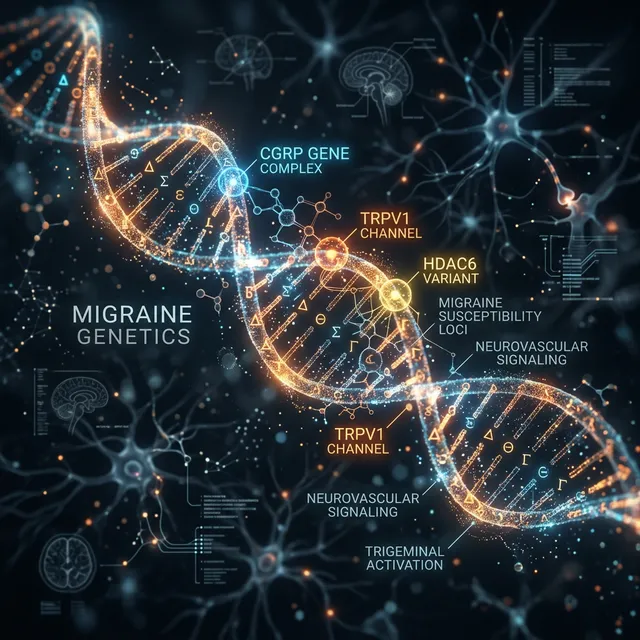
It can feel deeply unfair. You spend half your life in a dark room with an ice pack while your brother eats aged cheese, drinks red wine, and skips sleep without consequence. If migraine is supposed to be hereditary, why is the inheritance so uneven inside the same family? The short answer is genetic penetrance, the long answer involves hormones, gene dosage, and the tiny environmental differences that nudge an at-risk brain over the migraine threshold.
If this is your story, please know that your migraines are not a personal failure or proof that you are "more sensitive." You inherited a real neurological condition, and the science explains exactly why it hit you and not them.
What Genetic Penetrance Actually Means
In medical genetics, penetrance is the probability that someone carrying a risk gene will actually develop the trait. A condition with 100% penetrance (like Huntington's disease) shows up in every carrier. Migraine sits at the other end of the spectrum. According to the American Migraine Foundation, common migraine is polygenic and incompletely penetrant, which means:
- You can inherit migraine risk variants and never have a single attack.
- You can inherit fewer variants than your sibling and still get worse migraines.
- The same DNA can produce wildly different headache phenotypes inside one family.
Researchers using genome-wide association studies (GWAS) have so far identified over 120 migraine-associated genetic variants. Each one alone is almost meaningless. Their combined effect, called a polygenic risk score, is what loads the gun. Your environment pulls the trigger.
Why One Sibling Gets Hit and the Other Walks Free
1. You Did Not Inherit the Same Genes
People assume siblings share "the same genetics." They share, on average, 50% of their DNA, not 100%. Two siblings can inherit very different combinations of the same parental risk variants. One child can pick up the calcium channel variant, the serotonin transporter variant, and the CGRP pathway variant in one unlucky shuffle. The other can dodge all three.
This is why a parent with chronic migraine can have one daughter with vestibular migraine, one son with no headaches at all, and a third child with episodic migraine without aura.
2. Hormonal Penetrance: Estrogen Changes Everything
Even with identical risk genes, estrogen fluctuation acts as a penetrance amplifier. The NIH-funded research on hormonal migraine shows that estrogen withdrawal lowers the cortical threshold for migraine in genetically susceptible brains. If you are the sister in a sibling pair, your menstrual cycle, pregnancy, perimenopause, and oral contraceptive use will repeatedly stress that threshold. Your brother's testosterone-dominant biology rarely does.
This is one of the strongest explanations for why women inherit migraines at roughly three times the rate of men despite identical family genetics. We unpack this in detail in our guide on the estrogen ache equation.
3. Epigenetic Switches Run Independently in Each Body
DNA is the script. Epigenetics is who decides to read it out loud. Stress in childhood, sleep deprivation, gut microbiome composition, vitamin D status, and even maternal nutrition during pregnancy can switch migraine-related genes "on" through DNA methylation patterns. Siblings often live very different lives once they are out of the shared crib. Different schools, jobs, relationships, and sleep schedules mean different epigenetic signatures sit on top of the same DNA.
The Migraine Research Foundation notes that lifestyle factors can shift attack frequency by 40% or more, even in people with strong family histories.
4. The Trigger Stack Looks Different in Each Life
A genetic predisposition only becomes a migraine when triggers stack above your individual threshold. One sibling may live in a low-trigger environment (stable job, dark bedroom, consistent meals). The other may have a high-stress role, irregular sleep, hormonal contraceptive use, and a coffee habit. Same genes, different ceiling. See our breakdown of migraine trigger stacking for how this thresholding really works in practice.
5. Diagnostic Bias Hides "Migraine Siblings"
Sometimes the sibling has migraines but does not know it. Silent migraine, vestibular migraine, and abdominal migraine are commonly missed because they do not look like the textbook headache. Your brother's chronic "sinus headaches," your sister's mysterious car sickness, your dad's "weird dizzy spells" may all be unrecognized migraine phenotypes. Read more in our guides on silent migraine and vestibular migraine.
What This Means for Family Conversations
Telling a sibling "you don't understand, this runs in our family" can land badly when they have never had an attack. The truth is more nuanced and more useful:
- You both share risk, not destiny.
- They may still develop migraines later in life, especially during hormonal shifts, after head injury, or under sustained stress.
- Their children may inherit the same risk variants you did.
- Your shared family history is real, valid, and worth documenting for both of you.
Encouraging at-risk family members to learn the early warning signs of prodrome and aura is a kindness, not paranoia.
Should You Get Genetic Testing?
For common migraine, no commercial genetic test reliably predicts your personal risk. Polygenic risk scores are still mostly a research tool. The Genetic and Rare Diseases Information Center (GARD) recommends genetic testing only for rare monogenic migraine subtypes such as familial hemiplegic migraine, where mutations in CACNA1A, ATP1A2, or SCN1A are clinically actionable.
If you suspect a rare subtype runs in your family, ask your neurologist for a referral to a genetic counsellor rather than relying on direct-to-consumer kits.
What You Can Do, Even Without a Genetic Report
You cannot change your DNA, but you can change how loudly it gets read. The most consistent finding in modern migraine genetics is that environmental modification reduces attack frequency even in high-risk individuals. Sleep hygiene, hydration, identifying personal food triggers, and managing stress responses all turn down the epigenetic volume.
The most powerful tool you have is data about yourself. Use the free Migraine Trail app to track your migraine triggers, log attacks, and find the pattern your genes alone cannot explain. The day your sibling's child develops their first migraine, the trail of evidence you have built may be the single most useful thing in the family medical history.