A migraine attack unfolds in four distinct phases over hours or even days: prodrome (warning), aura (sensory disturbance), headache (peak pain), and postdrome (recovery). Most people only recognize the headache phase, but the brain begins generating the attack 24 to 48 hours before pain arrives. Learning to spot the earlier phases is the single most effective way to stop an attack before it peaks.
A migraine is not a headache. It is a full-body neurological event that follows a predictable arc, and that arc has a name in every clinical guideline: the four-phase migraine cycle. Recognizing where you are in the cycle changes everything about what works.
Use the free Migraine Attack Duration & Phase Calculator to measure the headache phase separately from the full prodrome-to-postdrome episode. It also flags a headache phase recorded beyond 72 hours for prompt medical advice.
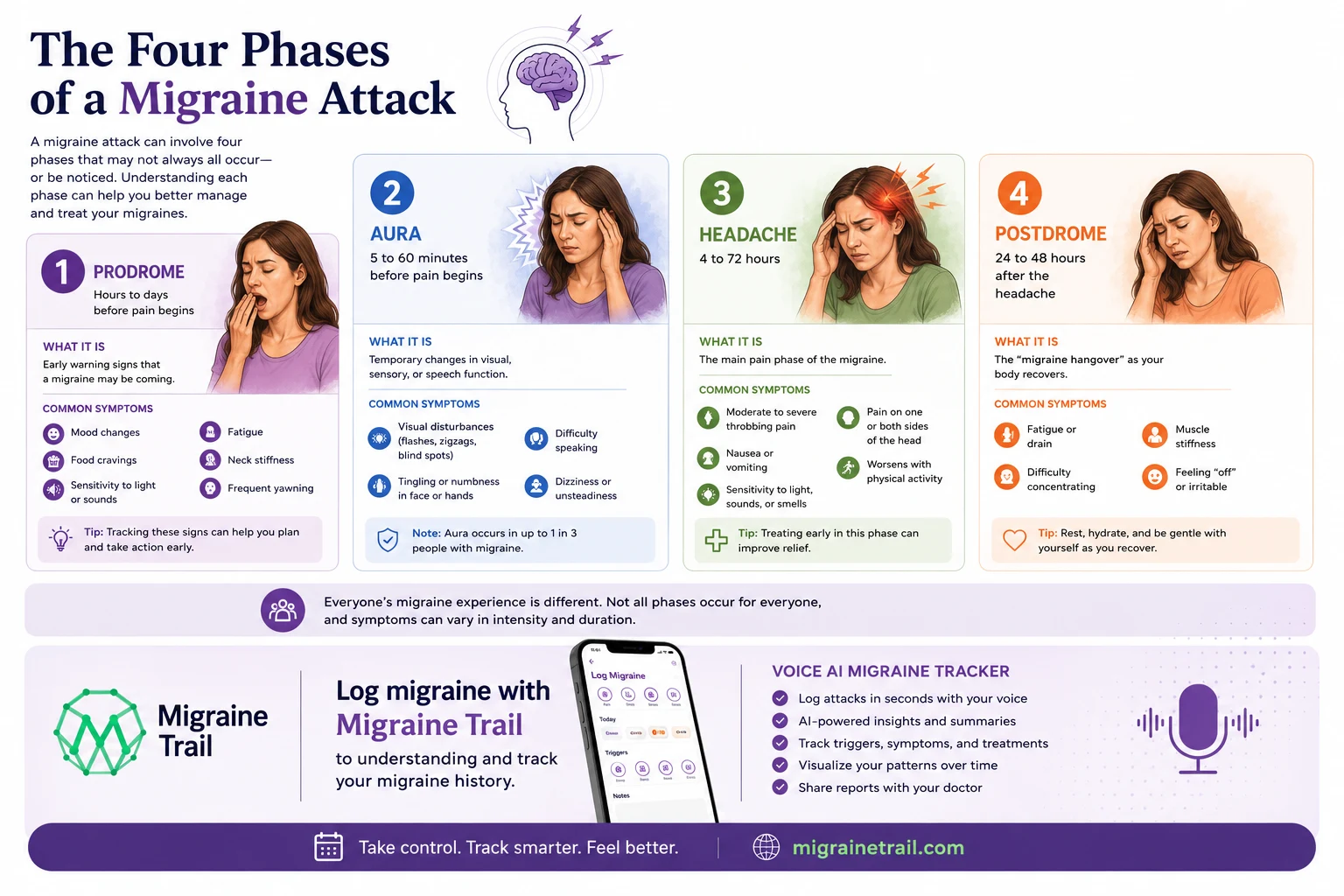
Phase 1: Prodrome (2 to 48 hours before pain)
The prodrome is your body's earliest warning system. It begins in the hypothalamus, often a full day or two before any pain. Roughly 70 to 80% of people with migraine have a recognizable prodrome once they learn what to look for.
Common prodrome signals:
- Sudden food cravings, especially for salty or sweet foods
- Frequent yawning, sometimes dozens of times in an hour
- Mood shifts including irritability, euphoria, or low-grade depression
- Stiff neck or jaw tension
- Increased thirst or urination
- Difficulty concentrating, slow reading, or word-finding trouble
- Light, sound, or smell sensitivity that is mild but rising
These are not vague feelings. They are measurable hypothalamic and brainstem activity, visible on functional MRI before the patient even realizes an attack is coming. This is the highest-value window to treat. Gepants such as rimegepant or ubrogepant taken in the prodrome can fully abort the attack in clinical trials.
For more on spotting these signals, see our early warning signs of migraine guide.
Phase 2: Aura (5 to 60 minutes, in roughly one-third of people)
Aura is a wave of cortical activity called cortical spreading depression, moving across the surface of the brain at about 3 millimeters per minute. Not everyone with migraine gets aura, but those who do often have it before most attacks.
The most common forms:
- Visual aura: zigzag lines, shimmering crescents, blind spots, or flashing lights
- Sensory aura: numbness or tingling spreading from fingertips up the arm or across one side of the face
- Language aura: temporary trouble finding words or forming sentences
- Motor aura: rare and serious, found in hemiplegic migraine
Aura is fully reversible and almost always lasts less than an hour per symptom. If you are over 50 and developing aura for the first time, or your aura lasts longer than an hour, get evaluated promptly. See our guide on migraine red flags.
Phase 3: Headache (4 to 72 hours)
The pain phase is what most people recognize as the migraine itself. Throbbing, usually one-sided, worsened by movement, and accompanied by nausea, light sensitivity, and sound sensitivity. Without treatment, this phase can last anywhere from 4 hours to 3 full days.
This is where acute treatment matters most. Triptans, gepants, NSAIDs, and combination drugs all work better the earlier they are taken in this phase. See our migraine medication ladder for what to try and when.
Phase 4: Postdrome (12 to 48 hours after pain ends)
The postdrome, sometimes called the "migraine hangover," is real and lasts up to two days. Most people describe it as feeling drained, foggy, mildly depressed, or strangely euphoric. Concentration is slower. Some people are still mildly nauseated.
The postdrome is the brain returning to baseline. Hydrate, sleep well, avoid strenuous exercise, and do not assume you are fully back to normal just because the pain has stopped.
Why phase awareness changes outcomes
People who track their attacks consistently learn to recognize their personal prodrome signature within a few months. That recognition is worth more than any single medication, because it expands the treatment window from minutes to hours. Voice logging makes prodrome capture realistic even when you feel awful. See identifying hidden migraine patterns.
 Related: The 28-Day Hormonal Migraine CalendarWhen estrogen drops, attacks begin. See the five-day danger window and how to treat it.
Sources
- Pathophysiology of migraine: a disorder of sensory processing — Goadsby, Holland, Martins-Oliveira, Hoffmann, Schankin & Akerman, Physiological Reviews, 2017;97(2):553-622
- Karsan N, Goadsby PJ. "Biological insights from the premonitory symptoms of migraine." Nature Reviews Neurology, 2018;14(12):699-710.
- Premonitory symptoms in migraine: an electronic diary study — Giffin, Ruggiero, Lipton, Silberstein, Tvedskov & Olesen, Neurology, 2003;60(6):935-940
- American Migraine Foundation. "Timeline of a Migraine Attack." 2023.