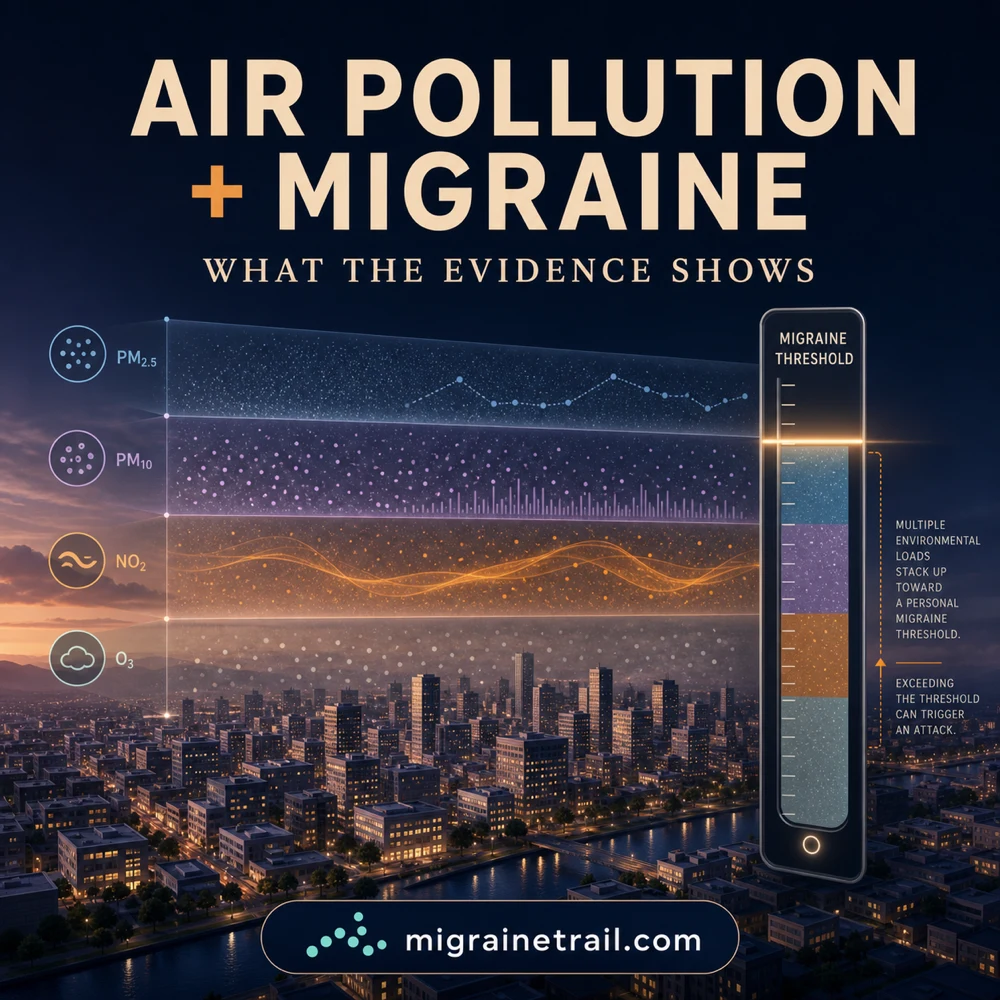
Air pollution is not the cause of migraine. Migraine is a genetically influenced neurological disorder — people are born with the underlying susceptibility, and no pollutant creates it. What the evidence now supports is narrower and still important: on dirty-air days, people who already have migraine appear to have more attacks, more severe attacks, and more visits for urgent care.
That distinction is worth holding onto, because it changes what you do. If pollution caused migraine, the goal would be avoidance. Because pollution appears to modulate migraine, the goal is threshold management — reducing one load among several so the others have less to stack on.
The study that moved this conversation
In April 2026, Neurology published the largest and longest analysis of this question to date. Researchers led by Dr. Ido Peles at Ben-Gurion University followed 7,032 people with migraine in Be'er Sheva, Israel, for an average of 10 years, matching each person's daily pollutant and weather exposure against their migraine-related clinic and hospital visits and their triptan prescriptions.
The headline findings:
| Exposure | Effect on migraine care visits |
|---|---|
| Short-term high nitrogen dioxide (NO2) | 41% more likely |
| Short-term high solar/UV radiation | 23% more likely |
| Cumulative NO2 exposure | 10% more likely to be a high medication user |
| Cumulative PM2.5 exposure | 9% more likely to be a high medication user |
On the peak-pollution days in the dataset, PM10 averaged 119.9 µg/m³ against a study-period average of 57.9 — roughly double, with PM2.5 and NO2 elevated alongside it.
The part most coverage skipped
The genuinely new idea in this paper is not any single number. It is the layered model: biological vulnerability sits underneath, intermediate-term environmental modulators (weeks to months of cumulative exposure) shift where your threshold sits, and acute triggers (a single bad-air day) push you over it.
That structure explains something people with migraine report constantly and rarely get validated: the same trigger produces an attack some weeks and nothing in others. Under this model, a high-NO2 Tuesday is not a fixed-strength trigger. Its effect depends on what the previous month of exposure did to your baseline.
Weather does not sit next to pollution — it multiplies it
The second finding worth internalizing is that pollutants and weather interacted rather than simply adding up:
- Heat plus low humidity amplified the NO2 effect. Hot, dry, still conditions are also the conditions under which traffic NO2 and ozone accumulate rather than disperse.
- Cold plus humidity amplified the PM2.5 effect. Cold snaps trap particulates near ground level under temperature inversions, and heating emissions rise at the same time.
This is why "weather trigger" and "pollution trigger" are hard to separate in a personal log, and why a single-variable answer usually fails. If you have been trying to correlate attacks with barometric pressure alone and getting noise, an unmeasured pollution variable is one plausible reason. See how weather affects migraines and barometric pressure migraines for the atmospheric half of the picture.
Pollutant by pollutant
Nitrogen dioxide (NO2)
The strongest signal in the 2026 data. NO2 comes overwhelmingly from combustion — vehicle exhaust, especially diesel, plus industrial and power generation sources. It is a near-road pollutant: concentrations drop sharply within a few hundred metres of a busy road, which means your commute and your street can matter more than your city's average. Gas stoves are a meaningful indoor source.
Deep dive: NO2, traffic fumes, and migraine.
Fine particulate matter (PM2.5)
Particles under 2.5 micrometres, small enough to reach deep lung tissue and enter the bloodstream. In this study PM2.5 showed up more in the cumulative exposure signal than the same-day one — consistent with a slow shift in threshold rather than an immediate trigger. PM2.5 is also the pollutant most responsive to action you personally control, because filtration works on it.
Deep dive: PM2.5, indoor air, and migraine.
Coarse particulate matter (PM10) and dust
Be'er Sheva sits at the edge of a desert, and dust storms drove many of the PM10 peaks. That is a real limitation on generalising the exact numbers — a Saharan or Middle Eastern dust event is a different exposure profile from London traffic or Delhi winter smog.
Ozone and solar radiation
The 23% figure attached to solar radiation, not to a pollutant. UV and bright light are established migraine triggers in their own right, and high-sunlight days are also high-ozone days, so these are difficult to separate. Practically, this argues for the boring interventions: sunglasses, shade, and not treating a bright day as neutral.
What this evidence does not establish
Being precise here matters, because the topic attracts overstatement:
- It is association, not causation. An observational cohort cannot prove pollution caused the attacks. The authors say so directly.
- There is no validated personal AQI threshold. No study has produced a number above which you should expect an attack. AQI is a public-health communication tool, not a migraine forecast.
- The effect sizes are population-level. A 41% increase in visits across 7,032 people does not mean your risk on a high-NO2 day rises by 41%. Some people in that cohort are almost certainly driving most of the signal and others none of it.
- One city, one climate. A decade of desert-adjacent data is strong internally and weaker as a guide to your specific city.
- Care-seeking is not the same as attacks. The outcome measured was clinic and hospital visits plus prescriptions — a proxy for severe attacks, not a count of all attacks.
A 2023 systematic review in Headache reached a compatible conclusion: the association between outdoor air pollution and migraine outcomes is consistent enough to take seriously and heterogeneous enough that no precise dose-response curve can yet be drawn.
What to actually do
Ranked by how much difference the action plausibly makes relative to its cost.
1. Fix your indoor air first. You spend most of your hours indoors, and it is the only air you control. A correctly sized HEPA air cleaner in the bedroom, run overnight, is the single highest-leverage intervention available. Avoid units that intentionally generate ozone.
2. Cut near-road exposure where it is cheap to do so. Walking or cycling one street back from an arterial road can meaningfully lower NO2 dose. Recirculate mode in the car in heavy traffic. If you have a choice of route, the quieter one is the cleaner one.
3. Check air quality the way you check the forecast. AirNow (US), your national equivalent, or a local monitor. On high-pollution days, move hard exercise indoors — exertion multiplies your inhaled dose several times over.
4. Treat bad-air days as budget days. This is the trigger-stacking principle applied. On a high-NO2, high-heat day, protect the variables you do control: sleep, meals, hydration, caffeine timing. See migraine trigger stacking.
5. Do not let it become another thing to fear. Vigilance about environmental triggers has its own cost. The goal is a few automatic habits, not daily anxiety about a number.
Full day-by-day version: an AQI action plan for migraine.
When smoke rather than traffic is driving the reading, use the wildfire smoke and migraine cleaner-air plan.
What to track if you want your own answer
Population data tells you a pattern exists. Only your own log tells you whether you are one of the people in it.
Log alongside each attack: the day's AQI category and dominant pollutant, hours spent outdoors, whether you exercised outside, commute mode, temperature, humidity, and whether respiratory symptoms (sinus pressure, throat irritation, cough) accompanied the head pain. That last one is the most useful discriminator — a pollution-linked attack more often arrives with irritation symptoms than a pure hormonal or sleep-driven one.
Then look for repetition. One bad-air day with an attack is a coincidence. The same pattern across a season, especially with a clean-air control period for comparison, is signal. The Migraine Trail app logs weather automatically and lets you add air quality as a custom factor, so the correlation work happens without daily spreadsheet effort.
Frequently asked questions
Is pollution the biggest cause of migraine?
No. Genetics is the dominant factor in whether you have migraine at all — heritability estimates run around 40 to 60%. Pollution belongs in the category of environmental modulators, alongside sleep, hormones, stress, and weather. It influences how often and how severely attacks happen in people who already have the disorder.
Can moving to a cleaner city cure my migraine?
It will not cure it. People who relocate to lower-pollution areas sometimes report improvement, which is consistent with removing one load from the stack, but migraine follows you. See best cities for migraine sufferers for what the geography argument can and cannot deliver.
Does an N95 mask help with pollution headaches?
A well-fitting NIOSH-approved N95 filters fine particles including PM2.5, so it helps with particulate exposure. It does not filter NO2 or ozone, which are gases. For gaseous pollutants, distance from the source and time indoors are what work.
What AQI level is dangerous for migraine?
There is no validated migraine-specific threshold. Follow the general public-health guidance for your AQI category and track your own repeated response rather than looking for a universal number.
Do gas stoves matter?
Gas cooking is a well-documented indoor NO2 source, and concentrations in a small unventilated kitchen during cooking can exceed outdoor levels. Using the extractor fan every time you cook, vented outside where possible, is a low-cost step with an evidence base behind it.
When to see a doctor
Environmental management is not a substitute for treatment. Talk to a clinician if attacks are increasing in frequency, if you are using acute medication on 10 or more days a month (see rebound headache symptoms), or if your current plan is not holding.
Seek emergency care for sudden severe "worst ever" headache, new weakness or speech difficulty, seizure, fever with a stiff neck, new vision loss, or head pain after an injury.
Sources