Migraine TrailMigraine Trail
Features
BlogHealth LibraryMigraine Guide
Free ToolsCompareHelpPricingGet the App
FeaturesBlogHealth LibraryFree ToolsCompareMigraine GuideHelpPricingGet the AppContact
2026-10-20

Cold Weather Migraine: Pressure, Temperature, Routine

By Migraine Trail TeamReviewed by Rita S
Share
Cold Weather Migraine: Pressure, Temperature, Routine
Share
TM
The Migraine Trail Team
Editorial Team

A team of migraine patients, data scientists, and health writers dedicated to making migraine management accessible through data-driven insights.

Learn about our editorial process
Free PDF Guide

Get the free migraine tracking guide

A practical 12-page guide: which triggers to watch, how to log symptoms doctors actually use, and how to spot your patterns. Emailed free — no credit card.

Get the free guide

Medical Disclaimer

The content provided in this article is for general informational purposes only and does not constitute medical advice. Always check with a doctor or neurologist regarding any medical questions or treatment decisions. Never disregard professional medical advice or delay in seeking it because of something you have read on this website.

Continue Reading

2026-10-21

AI Headache Classification: What Your Entries May Map To

AI can organize free-text headache entries into symptom categories, but it cannot diagnose you. Learn how classification works, what it may miss, and how to review the result.

2026-10-16

Intermittent Fasting and Migraine: What to Know

Intermittent fasting may worsen migraine through meal, caffeine, sleep, and hydration changes. Evidence is limited, so test carefully and know who needs advice.

2026-10-16

Migraine Tracker Data Portability: CSV, JSON, Backup, and Restore

Your migraine history should not be trapped in one app. Learn the difference between export, backup, and restore, and use this checklist to protect your tracking data.

From the Health Library

Triggers8 min read

The Science of Weather Migraines: A 2026 Deep Dive

It is not in your head, it is in the atmosphere. We analyze the 2026 findings connecting barometric pressure, NO2 pollution, and temperature flux to trigeminal nerve activation.

Triggers8 min read

Barometric Pressure Migraines: The Complete 2026 Guide

Around half of people with migraine are sensitive to barometric pressure changes. Drops of 5 to 10 millibars over 24 hours are enough to trigger sensitive individuals, and a forecast-based plan beats reaction every time.

Triggers7 min read

Migraine Trigger Stacking: Why Small Triggers Combine Into Big Attacks

Most migraine attacks are not caused by one trigger. They are caused by 2 to 5 small triggers stacking up and crossing your personal threshold within the same 24 to 48 hours. Understanding the stacking effect explains why the same food, weather, or stressor sometimes triggers you and sometimes does not.

Ready to start tracking?

Download Migraine Trail free on the App Store.

Download Migraine Trail free on the App Store
Migraine TrailMigraine Trail

The AI-powered migraine tracker built by patients, for patients.

Download App

Product

  • Pricing
  • Compare
  • Best Apps 2026
  • Partners
  • Advertise with Us
  • Affiliates
  • Help
  • Send Feedback

Features

  • Everything included
  • Voice Logging
  • Weather Risk Prediction
  • Migraine Weather Forecast
  • Doctor-Ready Reports
  • Apple Watch App

About

  • About Migraine Trail
  • Migraine Tracker App
  • Free Migraine Tracker
  • Headache Diary
  • Migraine Journal
  • Symptom Tracker
  • Trigger Tracking
  • Track Without Typing
  • Easy Tracker
  • AI Tracking

Learn

  • Blog
  • Health Library
  • Migraine Guide
  • Free Tools
  • Editorial Policy

Legal

  • Privacy Policy
  • Terms of Service
  • Health Data Privacy
  • Cookies

Connect

  • Contact

© 2026 Migraine Trail

Migraine Trail is not a healthcare provider or medical device. Content and tools are educational only and do not provide diagnosis, treatment, or medical advice. Never delay care or change treatment based on this site. See our full Medical Disclaimer and Privacy Policy.

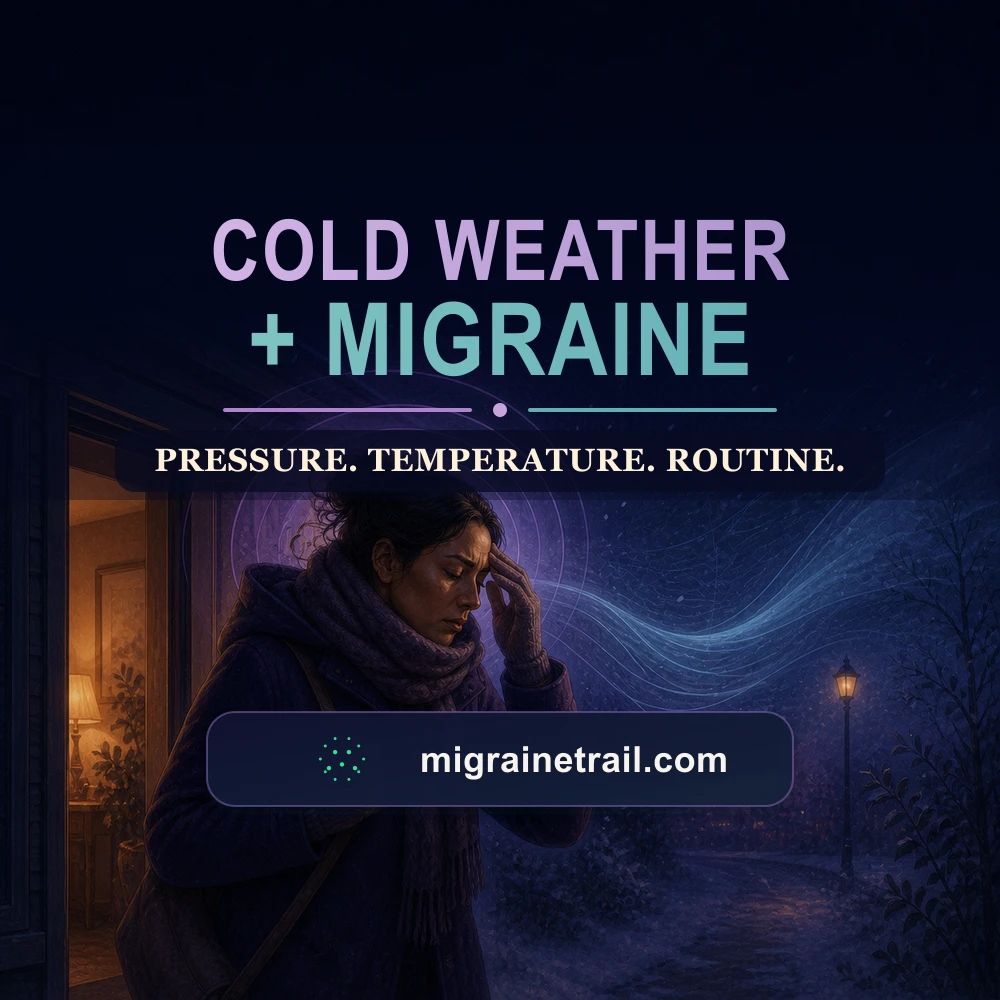
Cold-weather migraine is rarely about temperature alone. A winter attack may coincide with pressure change, dry air, bright snow glare, indoor heating, poorer sleep, respiratory illness, less activity, or more time around fragrance and combustion pollutants.

Cold exposure is not one variable

Separate:

  • Outdoor temperature.
  • Size and speed of the temperature change.
  • Barometric pressure trend.
  • Humidity and indoor dryness.
  • Wind and time outdoors.
  • Air quality and indoor heating source.
  • Sleep, illness, meals, caffeine, and activity.

Research on migraine seasonality and weather is mixed. A systematic review found substantial variation: some studies reported seasonal peaks, while others found none. That makes personal date-matched tracking more useful than a rule such as “cold always triggers migraine.”

Cold-stimulus headache is different

Brief pain after very cold food, drink, or direct cold exposure is classified separately from migraine. People with migraine may be more susceptible, but a short “brain freeze” is not the same as a multi-hour migraine attack.

Build a winter comparison

For each attack, record start time, outdoor exposure, temperature transition, pressure, humidity, sleep, illness symptoms, and indoor environment. Also select comparable cold days without migraine.

The historical weather trigger checker retrieves conditions for past dates so you do not need to rely on memory. Compare multiple attacks and control days before deciding which weather feature matters.

Practical winter adjustments

  • Warm up gradually after prolonged cold exposure.
  • Protect your face and head from painful wind when comfortable.
  • Keep sleep, meals, caffeine, and hydration consistent.
  • Reduce glare with appropriate eyewear.
  • Vent combustion sources safely and maintain carbon-monoxide detectors.
  • Avoid assuming a humidifier is always beneficial; keep it clean and follow manufacturer guidance.

Carbon monoxide warning

Headache, dizziness, nausea, weakness, chest pain, or confusion around fuel-burning heaters, generators, fireplaces, or vehicles can indicate carbon monoxide exposure. Move to fresh air and call emergency services. Do not re-enter until authorities say it is safe. Carbon monoxide has no reliable warning smell.

Frequently asked questions

Can cold wind trigger migraine?

Some people report it, but wind also changes temperature exposure, sensory discomfort, and pressure context. Track repeated exposures and non-attack days.

Why are my migraines worse in winter?

Possible contributors include light-cycle change, sleep, illness, indoor air, reduced activity, routine change, and weather. There may not be one cause.

Does a cold pack help migraine?

Some evidence suggests short-term pain relief from cold interventions, but response varies. Protect skin and stop if cold worsens pain or causes numbness or injury.

Sources
  • The chronobiology of migraine: a systematic review — The Journal of Headache and Pain, 2021
  • Weather, ambient air pollution, and risk of migraine onset — Headache, 2019