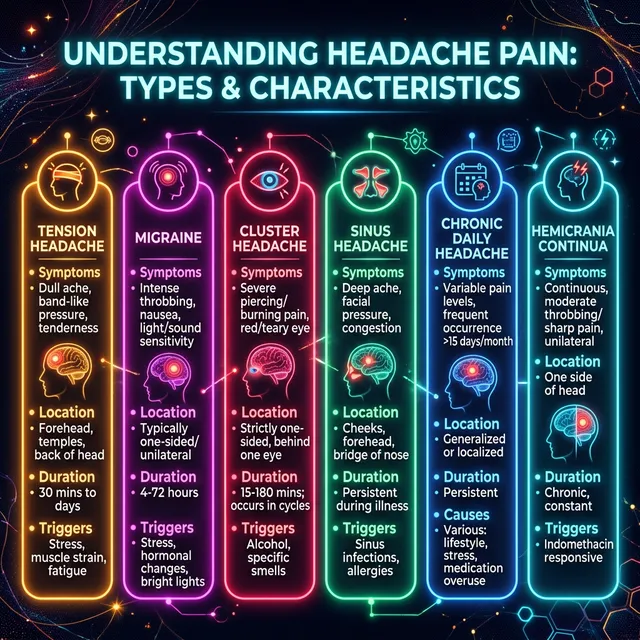
AI headache classification can turn a spoken or free-text entry into organized fields such as pain severity, symptoms, timing, and possible headache categories. It is a documentation aid, not a diagnosis. The safest workflow shows you what the system extracted, lets you correct it, and keeps the original words available for your clinician.
That distinction matters. A person can have migraine without describing it in textbook language, and more than one headache disorder can share symptoms. The goal of classification is to make your record easier to review—not to put your experience in a box.
How AI may map a headache entry
An AI-enabled tracker may process an entry in stages:
- Input: You type or say what happened.
- Transcription: Speech becomes text, if voice is used.
- Extraction: The system identifies time, severity, symptoms, medication, and context.
- Normalization: Different words may be grouped together, such as “sick to my stomach” and “nausea.”
- Classification: The entry may be mapped to a category or set of possible patterns.
- Review: You confirm, edit, or reject the structured fields.
Every step can introduce an error. A good tracker should make the transformation visible enough that you can correct it.
What an entry might be mapped to
Depending on the app, your words may be organized into:
- Headache or headache-free day.
- Possible migraine-like pattern.
- Tension-type-like pattern.
- Aura or other neurological symptoms.
- Light, sound, or smell sensitivity.
- Nausea or vomiting.
- Neck pain, dizziness, fatigue, or brain fog.
- Attack phase, such as early symptoms, headache, or postdrome.
- Acute medication use and response.
For example, “pressure on both sides, no nausea, worse after a long day at the computer” could be stored as a structured symptom entry. That does not prove the headache is tension-type. It simply preserves the details for comparison.
The American Headache Society and American Migraine Foundation describe symptom patterns that clinicians consider when evaluating migraine and other headache disorders. An AI tool may use similar language to organize records, but only a qualified healthcare professional can interpret your full history and diagnose you.
Migraine versus tension-type headache: why tracking is not diagnosis
People often search for a simple way to classify migraine versus tension headache. Symptoms can overlap, and a single entry rarely contains enough context.
Instead of forcing a label, track:
- Pain quality and location.
- Severity and duration.
- Whether routine activity makes it worse.
- Light, sound, or smell sensitivity.
- Nausea or vomiting.
- Aura or other neurological symptoms.
- What happened before the attack.
- What treatment helped.
An app may show that certain features tend to occur together. Bring the original description and the pattern to your clinician rather than treating the label as final.
How to review an AI-generated entry
Before you save it, check:
- Did it capture the correct time?
- Did it confuse pain severity with a medication dose?
- Did it identify the right medication and amount?
- Did it miss a negation, such as “no nausea”?
- Did it turn a possibility into a certainty?
- Did it treat an early symptom as a trigger?
- Can you edit the field in plain language?
Numbers, medication names, and “not” are especially important. If you say, “I did not vomit, but I felt nauseated,” the record needs to preserve that difference.
What makes AI classification more trustworthy
Look for an app that:
- Shows the original note or transcript.
- Separates extracted facts from suggestions.
- Uses confidence or uncertainty language.
- Lets you edit every structured field.
- Records when the entry was created and when it was corrected.
- Explains whether audio is retained or deleted.
- Explains whether data is used to improve a model.
- Does not market classification as diagnosis or guaranteed prediction.
Structured data is most useful when it remains connected to the human account behind it.
What AI may miss
AI can miss sarcasm, shorthand, accents, background noise, mixed languages, and the difference between a past event and a current symptom. It may also overvalue familiar symptom patterns and underrepresent what is unusual for you.
It cannot reliably understand everything that matters in a clinical visit, including family history, pregnancy status, a neurological examination, previous diagnoses, or the meaning of a symptom in your broader health context. Keep those details for your healthcare team.
Red flags should not wait for classification
Do not use an AI label to decide whether a new or severe headache is safe to ignore. Seek urgent medical care for a sudden severe headache, a new neurological symptom, fainting, fever with concerning symptoms, head injury, or any symptom that feels like an emergency. Your local emergency guidance and clinician should take priority over an app.
More on AI and structured migraine tracking
Frequently asked questions
Can AI diagnose migraine from my diary?
No. AI may organize symptoms or show an association with a pattern. Diagnosis requires clinical judgment and the broader history of your symptoms, health, and examination.
What does structured symptom logging mean?
It means turning a narrative entry into consistent fields, such as start time, severity, symptoms, medication, and outcome. Structured fields make it easier to count, compare, and share entries.
How can AI tell migraine from tension headache?
It may compare words and symptom combinations in your entry with categories used by the app. That result is only a classification suggestion. Migraine and tension-type headache can overlap, so a clinician must interpret the pattern.
Should I correct an AI-generated migraine entry?
Yes. Review medication names, doses, times, symptoms, and negations before saving. Corrections make your own record more accurate and reduce the chance that a misleading label follows you into a report.
Sources