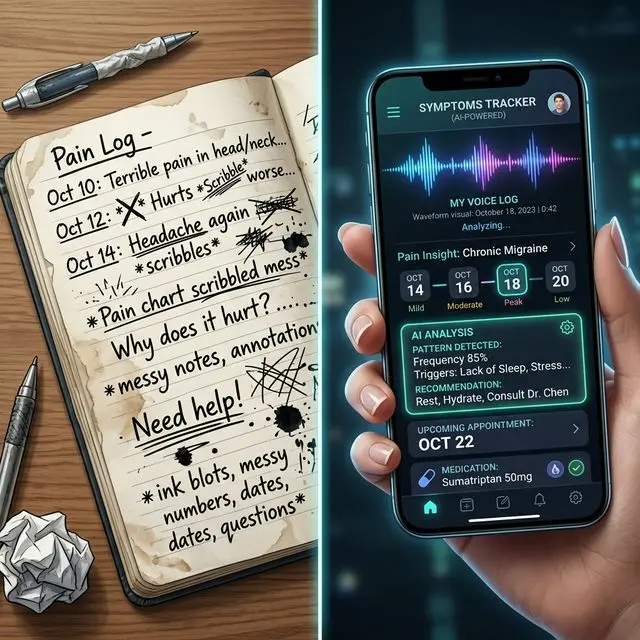
The quintessential image of tracking head pain for the last fifty years has been a physical notebook resting on a bedside table. You might vaguely remember your neurologist handing you a photocopied "Headache Diary" grid during your first visit, instructing you to mark down the dates, severity (on a 1 to 10 scale), and potential triggers. For episodic, mild headaches, this method was somewhat acceptable. However, for those suffering from chronic migraines, the manual journal is not just outdated. It is profoundly inaccurate and can actively hinder proper diagnosis and treatment.
Living with migraines requires a sophisticated understanding of an invisible enemy. Relying on human memory, particularly when a migraine attack fundamentally alters cognitive function, is a massive liability. Let’s explore precisely why an AI migraine tracker is infinitely more accurate than your old spiral notebook, and why embracing this technology is the most powerful step you can take toward reclaiming control of your health.
1. The Fallibility of Human Memory During Pain
When a migraine strikes, your brain is under physiological siege. Blood flow shifts, neurotransmitters like serotonin fluctuate wildly, and the trigeminal nerve is hyperactive. During the postdrome phase-often referred to as the "migraine hangover"-patients routinely experience profound brain fog, lethargy, and an inability to concentrate.
If you are relying on a manual journal, you are attempting to accurately recall intricate details (What exact time did the aura start? Did the neck stiffness precede the nausea, or vice versa? Did I eat aged cheese 24 hours prior or 36 hours prior?) while your cognitive abilities are drastically compromised. Studies consistently show that retrospective medical logging is highly skewed. Patients routinely overestimate the intensity of recent pain and completely forget crucial, subtle prodrome symptoms like yawning or mood shifts. An AI migraine tracker, especially one equipped with voice logging via a voice diary, allows you to capture symptoms passively and instantaneously as they happen, completely bypassing the flawed filter of pain-hazed memory.
2. Uncovering Invisible Environmental Triggers
A manual journal entirely fails to capture the invisible world vibrating around you. If a powerful low-pressure weather system sweeps into your city while you are sleeping, your notebook cannot log that 15 hPa drop. Yet, barometric pressure fluctuations are one of the most widely reported and potent migraine triggers globally.
A modern AI tracker does not rely exclusively on your subjective input. Instead, it acts as an environmental sensor network. It silently runs in the background of your smartphone, constantly pinging highly accurate meteorological APIs. When an attack begins, the AI doesn't just note your pain level; it permanently tags the precise temperature, humidity percentage, and barometric pressure at that exact geographic coordinate. No notebook, no matter how meticulously kept, can establish the subtle correlation between a 3% shift in humidity and the onset of visual aura. Only machine learning algorithms processing thousands of data points can reveal these definitive, invisible patterns. To learn how to review and act on the data your tracker collects, see our guide to smart data habits.
3. Passive Biometric Correlation
The human body sends out distress signals long before the physical pain of a migraine materializes. Wearable technology, such as the Apple Watch, Oura Ring, or Google Pixel Watch, constantly monitors these micro-fluctuations.
An AI migraine tracker directly syncs with these devices to analyze passive biometric data. Consider Heart Rate Variability (HRV), a critical indicator of physiological stress and autonomic nervous system health. Your notebook cannot track your HRV overnight. An AI tracker, however, will notice if your HRV plummeted during your REM sleep cycle-a massive red flag for an impending attack. It will seamlessly correlate a bad night of sleep, marked by frequent wake-ups, directly with your next-day attack frequency. You don't have to manually enter anything; the AI connects the dots automatically, providing an irrefutable, data-driven narrative to your neurologist.
4. Predicting the Attack Before it Starts
Perhaps the most revolutionary advantage of AI over paper is the shift from reactive tracking to proactive prediction. A manual journal is inherently retrospective-it is a record of failure, a log of the times the pain was already victorious.
By contrast, an AI tracker uses longitudinal data modeling to predict future attacks. After a few months of use, the algorithms learn your specific, highly individual trigger combinations. The AI isn't just looking for single causes; it detects complex equations like: Low REM sleep + incoming thunderstorms + high stress = 85% probability of a severe migraine. This predictive capability allows you to act defensively. When the AI issues a high-risk alert, you can preemptively hydrate, adjust your schedule to avoid taxing activities, or even take a preventative dose of medication as advised by your doctor, successfully aborting the attack before it ever begins.
5. Clinically Relevant, Professional Reporting
When you finally secure that 15-minute appointment with a specialized headache neurologist, handing them a battered, handwritten notebook forces them to spend 10 minutes trying to decipher your chronological notes. They want data, not stories.
An AI tracker instantly translates your chaotic pain into pristine, actionable data. With the tap of a button, it generates comprehensive PDF reports detailing your MIDAS (Migraine Disability Assessment) score, precise medication efficacy percentages (e.g., "Sumatriptan was effective within 2 hours in 72% of episodes"), and a ranked list of statistically proven triggers. This level of clarity fundamentally transforms the doctor-patient relationship, shifting the conversation directly from diagnosis to advanced, targeted treatment strategies.
The Verdict
Continuing to use a manual journal when AI technology is readily available is like fighting a modern war with a musket. An AI migraine tracker eliminates the subjective errors of human memory, uncovers invisible migraine triggers, and ultimately provides the predictive power necessary for real migraine relief and smarter migraine management. It is time to retire the notebook and embrace the incredible, life-changing precision of artificial intelligence. Tools like the Migraine Trail app combine AI-powered pattern detection with effortless voice logging, making it simple to log what sets off your attacks without any screen time. Even if you are not yet ready for an AI tool, research shows that simply keeping a consistent journal reduces chronic pain - so the most important step is to start tracking in some form today.
Ready to upgrade? Try our migraine tracker app. Learn more about migraine tracking with AI and what it can do for your pattern analysis today. You can also compare the best migraine tracker apps of 2026, learn how to analyze patterns from your app data, and discover why traditional journals fail and voice logging is the future.
Before treating an AI label as an answer, read what AI headache classification can and cannot tell you.