Migraine TrailMigraine Trail
Features
BlogHealth LibraryMigraine Guide
Free ToolsCompareHelpPricingGet the App
FeaturesBlogHealth LibraryFree ToolsCompareMigraine GuideHelpPricingGet the AppContact
2026-09-11

Wildfire Smoke and Migraine: A Cleaner-Air Plan

By Migraine Trail TeamReviewed by Rita S
Share
Wildfire Smoke and Migraine: A Cleaner-Air Plan
Share
TM
The Migraine Trail Team
Editorial Team

A team of migraine patients, data scientists, and health writers dedicated to making migraine management accessible through data-driven insights.

Learn about our editorial process
Free PDF Guide

Get the free migraine tracking guide

A practical 12-page guide: which triggers to watch, how to log symptoms doctors actually use, and how to spot your patterns. Emailed free — no credit card.

Get the free guide

Medical Disclaimer

The content provided in this article is for general informational purposes only and does not constitute medical advice. Always check with a doctor or neurologist regarding any medical questions or treatment decisions. Never disregard professional medical advice or delay in seeking it because of something you have read on this website.

Continue Reading

2026-09-14

Migraine After Flying: Pressure or Travel Changes?

Migraine after flying may follow sleep, meal, caffeine, stress, or pressure changes. Learn how it differs from severe headache linked to ascent or landing.

2026-09-08

Heat Migraine: Attack or Heat Illness?

Heat can coincide with migraine, dehydration, and dangerous heat illness. Learn what to track, how to lower exposure, and which symptoms need urgent care.

2026-09-05

Headache After Crying: Migraine or Trigger Stack?

A headache after crying may be migraine, tension-type pain, sinus pressure, or several changes arriving together. Compare the pattern and warning signs.

From the Health Library

Triggers8 min read

The Science of Weather Migraines: A 2026 Deep Dive

It is not in your head, it is in the atmosphere. We analyze the 2026 findings connecting barometric pressure, NO2 pollution, and temperature flux to trigeminal nerve activation.

Triggers7 min read

Weather Migraines & Climate Change: What to Know

New research in 2026 links global warming to increased migraine frequency. How extreme heat and pollution are lowering your threshold.

Triggers7 min read

Migraine Trigger Stacking: Why Small Triggers Combine Into Big Attacks

Most migraine attacks are not caused by one trigger. They are caused by 2 to 5 small triggers stacking up and crossing your personal threshold within the same 24 to 48 hours. Understanding the stacking effect explains why the same food, weather, or stressor sometimes triggers you and sometimes does not.

Ready to start tracking?

Download Migraine Trail free on the App Store.

Download Migraine Trail free on the App Store
Migraine TrailMigraine Trail

The AI-powered migraine tracker built by patients, for patients.

Download App

Product

  • Pricing
  • Compare
  • Best Apps 2026
  • Partners
  • Advertise with Us
  • Affiliates
  • Help
  • Send Feedback

Features

  • Everything included
  • Voice Logging
  • Weather Risk Prediction
  • Doctor-Ready Reports
  • Apple Watch App

About

  • About Migraine Trail
  • Migraine Tracker App
  • Headache Diary
  • Migraine Journal
  • Symptom Tracker
  • Trigger Tracking
  • Track Without Typing
  • Easy Tracker
  • AI Tracking

Learn

  • Blog
  • Health Library
  • Migraine Guide
  • Free Tools
  • Editorial Policy

Legal

  • Privacy Policy
  • Terms of Service
  • Health Data Privacy
  • Cookies

Connect

  • Contact

© 2026 Migraine Trail

Migraine Trail is not a healthcare provider or medical device. Content and tools are educational only and do not provide diagnosis, treatment, or medical advice. Never delay care or change treatment based on this site. See our full Medical Disclaimer and Privacy Policy.

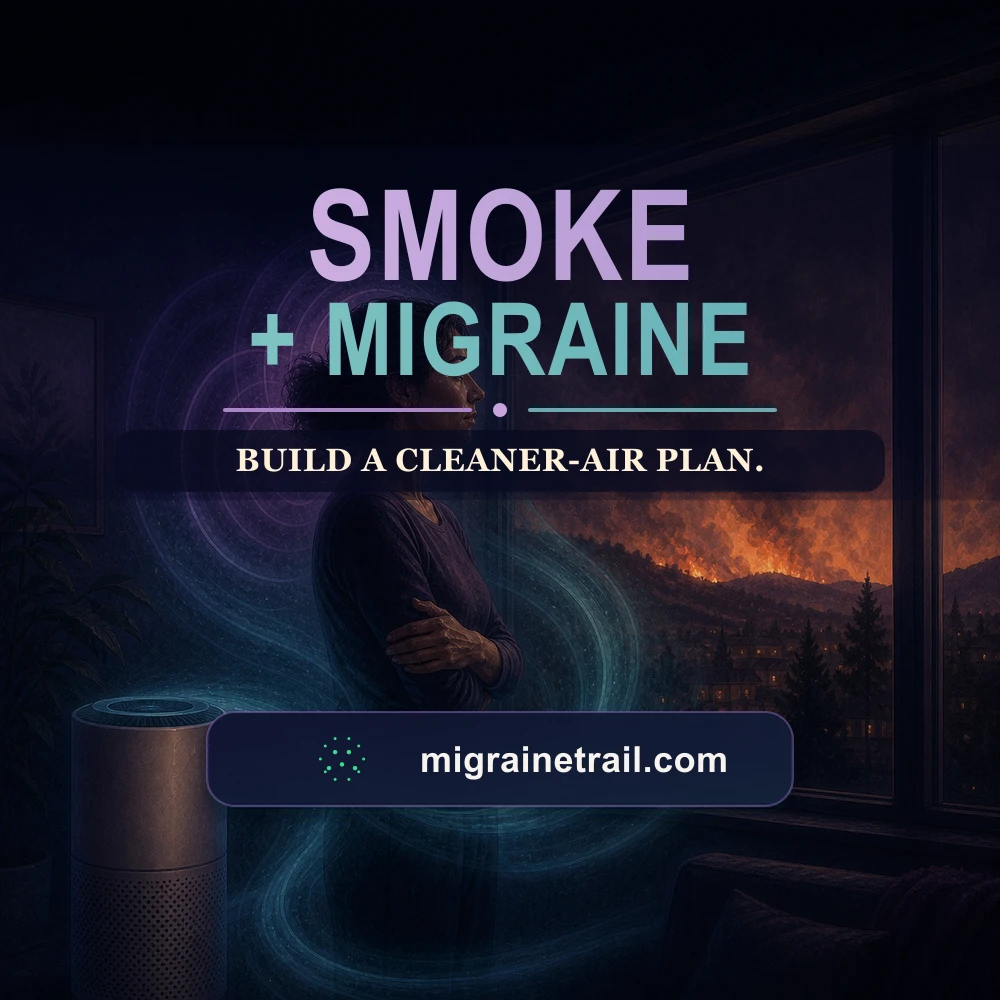
Wildfire smoke can cause headache, eye and sinus irritation, fatigue, cough, and breathing symptoms. Air pollution may also be associated with migraine, but a smoky-day headache is not automatically a migraine attack. Exposure reduction comes first; trigger analysis comes later.

Why smoke days are complicated

Wildfire smoke contains gases and fine particles, including PM2.5. At the same time, smoke events often bring heat, disrupted sleep, evacuation stress, reduced outdoor activity, and changes in medication access. Those co-exposures make it difficult to isolate one cause from a single day.

A systematic review found evidence consistent with an association between outdoor air pollution and migraine outcomes, but the included studies differed in pollutants, exposure measures, and methods. That supports caution, not a precise personal AQI threshold. For the broader evidence on pollutants and migraine — including the 2026 Neurology cohort — see climate change, air quality, and migraine, and for a broader weather-trigger overview, how weather affects migraines.

The cleaner-air plan

1. Follow official alerts

Use AirNow or your local air-quality authority rather than sight or smell alone. Smoke can travel far from the fire.

2. Create a cleaner indoor space

Close windows and doors when advised, set HVAC systems to recirculate when appropriate, and use a portable air cleaner sized for the room. EPA recommends avoiding units that intentionally produce ozone. A high-efficiency HVAC filter can help if your system supports it.

3. Reduce indoor particle sources

During heavy smoke, avoid smoking, vaping, candles, incense, aerosol sprays, and cooking methods that produce many particles. Vacuum only with appropriate filtration.

4. Use the right respiratory protection outdoors

A well-fitting NIOSH-approved N95 respirator can reduce inhaled particles when you must be outside. Cloth masks, bandanas, and loose surgical masks do not provide the same particle protection. Respirators do not filter all gases, and fit matters.

5. Follow evacuation instructions

Cleaner-air planning never overrides a fire evacuation order. Leave immediately when authorities tell you to do so.

What to track after safety is handled

Record the AQI category, time outdoors, respirator use, indoor filtration, heat, sleep, symptoms, and whether breathing or irritation symptoms accompanied head pain. Use the historical weather trigger checker for date comparison, while noting that standard weather variables do not fully capture personal PM2.5 exposure.

Compare smoky days with and without migraine. A pattern becomes more useful when it repeats and when exposure reduction appears to change the outcome.

When smoke symptoms need medical help

Seek urgent care for severe trouble breathing, chest pain, blue or gray lips, fainting, severe confusion, or rapidly worsening symptoms. People with asthma, COPD, heart disease, pregnancy, older age, or young children may need a personalized smoke plan. Follow your asthma or medical action plan and contact a clinician for worsening symptoms.

For headache, emergency warning signs remain the same: sudden extreme pain, new weakness or speech trouble, seizure, fever with stiff neck, or new vision loss.

Frequently asked questions

What AQI triggers migraine?

There is no validated universal migraine threshold. AQI is designed for public-health exposure guidance, not personal migraine prediction. Follow official precautions and track your own repeated pattern.

Will an air purifier stop wildfire migraine?

Filtration can reduce indoor particles but cannot guarantee that an attack will not occur, especially when heat, stress, and sleep are also changing.

Is wildfire headache always from migraine?

No. Smoke exposure itself can cause headache, and heat illness, dehydration, respiratory irritation, and migraine can overlap.

Sources
  • CDC: How wildfire smoke affects your body
  • Migraine and air pollution: a systematic review — Headache, 2023
  • EPA: Wildfires and indoor air quality