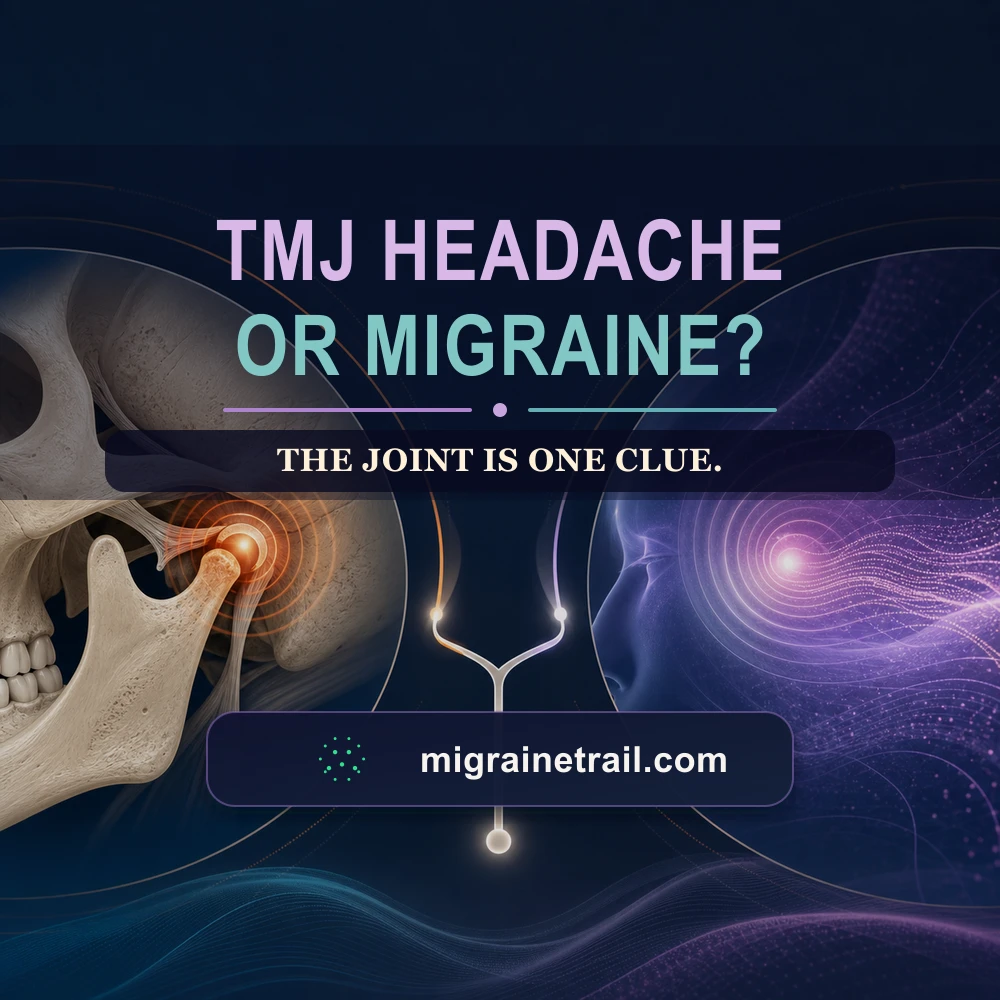
If your headaches come with jaw pain, the honest answer is often "both, and they are feeding each other." Temporomandibular disorder (TMD) and migraine are strongly associated in the research — people with migraine are markedly more likely to have TMD, and vice versa — and having both is linked to more frequent attacks and higher medication use. So the useful question is usually not which one is it, but how much of my pain is coming from each, because they respond to different treatment.
The Association Is Strong and Runs Both Ways
A longitudinal study using a national health screening cohort found an increased risk of migraine in people with temporomandibular disorder. Meta-analytic work has put the relationship at roughly a sixfold increased likelihood of TMD among people with migraine, and around a 2.6-fold increased likelihood of migraine among people with TMD.
Two refinements matter clinically:
- A controlled study of TMD and headache diagnoses found the association is differential — it is not that jaw problems accompany all headaches equally.
- The link is strongest for painful muscular TMD rather than joint-related TMD. Muscle involvement seems to be what matters.
And having both is not neutral: TMD comorbidity in migraine is associated with higher attack frequency, longer attacks, greater average pain intensity, and more allodynia.
Seven Differences Worth Tracking
None of these is individually diagnostic. Together, over several episodes, they separate the two reasonably well.
| # | Feature | Points toward TMD | Points toward migraine |
|---|---|---|---|
| 1 | What starts it | Chewing, wide yawning, prolonged talking | Sleep change, hormones, weather, stress let-down |
| 2 | Where it sits | In front of the ear, over the jaw joint, temple | One-sided, often temple or behind the eye |
| 3 | Noises | Clicking, popping or grating on opening | None related to the jaw |
| 4 | Jaw function | Limited opening, locking, deviation to one side | Unaffected |
| 5 | Associated symptoms | Ear fullness, jaw fatigue, tooth sensitivity | Nausea, light and sound sensitivity, aura |
| 6 | Effect of movement | Worse with jaw use specifically | Worse with general physical activity |
| 7 | How it resolves | Eases with jaw rest, soft diet | Runs a phased course, often with a postdrome |
Point 7 is the one people most often overlook. Migraine tends to follow a recognisable arc — our guide to the four phases of an attack describes it. Jaw pain from TMD tracks much more directly with what the jaw has been doing.
Why the Distinction Changes What You Do
TMD is generally managed through dental and physical approaches — jaw physiotherapy, habit change, occlusal splints where indicated, treating clenching and bruxism. Migraine is managed pharmacologically and behaviourally. Treating one when the driver is the other is a common reason people conclude "nothing works."
If you have both — which is common — treating the TMD component can reduce the burden of the migraine component, given the association with attack frequency and intensity. That is worth raising with both your doctor and your dentist, ideally so they are aware of each other.
When Jaw and Head Pain Need Prompt Assessment
Seek urgent same-day assessment for new jaw pain on chewing in someone over 50, especially with scalp tenderness, vision changes, or feeling generally unwell — this combination can indicate giant cell arteritis, which is sight-threatening if untreated. Seek emergency care for jaw or facial pain with chest pain, breathlessness or arm pain, which can be a heart attack presenting atypically, particularly in women. Get prompt review for a jaw that locks and will not open, facial swelling with fever, or new facial numbness or weakness.
This article is educational and is not a substitute for individual medical advice.
What to Track
For the next 10 painful episodes:
| Field | Why |
|---|---|
| Jaw used heavily beforehand? | Chewing, gum, dental work, a long day of talking |
| Jaw noises or restricted opening | Distinctive to TMD; migraine does not cause these |
| Where pain started | Jaw joint versus temple or behind the eye |
| Migraine features present? | Nausea, light/sound sensitivity, aura |
| Woke with a sore jaw? | Points at overnight clenching |
| What helped | Jaw rest versus migraine medication |
That last row is the most informative single line. If migraine medication reliably helps and jaw rest does not, the driver is likely migraine — and the reverse holds too.
The headache location checker walks through pain location and associated symptoms together, which is the fastest way to see which pattern your episodes fit. If both patterns show up, tracking them separately over time is what makes a combined dental-and-neurology conversation productive rather than guesswork.
Sources