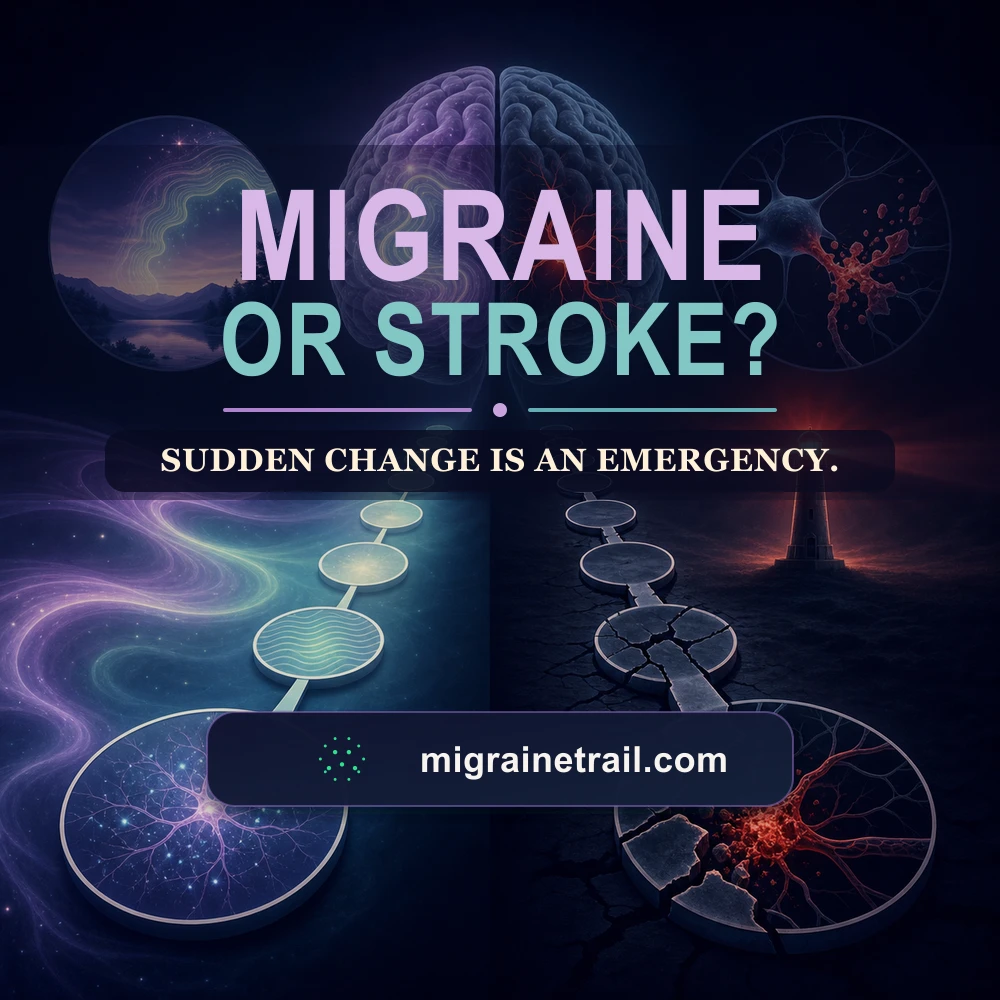
Migraine and stroke can both cause sudden vision changes, one-sided weakness, speech difficulties, and severe headache. The critical difference is onset speed: migraine aura symptoms build gradually over 5–20 minutes and fully resolve; stroke symptoms appear in seconds and do not resolve on their own. If you cannot tell the difference — or if symptoms are new, unusually severe, or don't match your typical migraine — call 911 immediately. Do not wait.
The stakes here are real. Every minute of untreated stroke causes the death of approximately 1.9 million neurons. Getting this wrong by assuming it's "just a migraine" is one of the most dangerous mistakes a person can make.
Medical Quick Facts
| Feature | Migraine Aura | Stroke |
|---|---|---|
| Onset speed | Gradual — builds over 5–20 min | Sudden — seconds to a minute |
| Visual symptoms | Spreading zigzag or blind spot that moves | Fixed blind spot or sudden total vision loss |
| Weakness/numbness | Spreads slowly (hand → arm → face) | Appears all at once, one side of body |
| Speech problems | Occasional, usually transient | Sudden, may be severe |
| Headache | Usually follows aura | May be absent, or a sudden "thunderclap" |
| Recovery | Fully resolves in 20–60 min | Does not resolve without treatment |
| Action | Monitor; follow your migraine plan | Call 911 immediately |
The Key Difference: How Symptoms Spread
In migraine with aura, the visual disturbance typically begins as a small flickering point near the center of vision, then slowly expands outward over 20–30 minutes into a crescent-shaped arc (the classic "fortification spectrum"). It then drifts to the edge of vision and disappears. This slow march is caused by cortical spreading depression — a wave of electrical activity moving across the visual cortex at about 3mm per minute.
In stroke, blood flow is interrupted immediately. Vision loss is sudden and fixed, not slowly expanding. A stroke affecting the visual cortex causes loss in the same region of both eyes simultaneously — which is different from migraine, where the disturbance moves and resolves.
For numbness or weakness: migraine aura that involves the limbs tends to spread slowly, like pins-and-needles moving from the fingertips up the arm over several minutes. Stroke weakness arrives all at once.
Warning Signs That Always Mean Call 911
Even if you have a diagnosed migraine disorder, call emergency services immediately if:
- Symptoms appeared in seconds, not minutes
- Weakness or numbness is on one side and does not improve
- You suddenly cannot understand speech or form words
- Vision loss is in a fixed area and is not slowly moving or resolving
- This headache is the worst of your life and came on suddenly (thunderclap headache)
- You have never had aura before and are now having neurological symptoms
- Symptoms last longer than 60 minutes
The FAST test — Face drooping, Arm weakness, Speech difficulty, Time to call 911 — is the standard emergency reminder. It applies even when a person has known migraine.
Migraine with Aura and Stroke Risk
There is also a genuine connection between the two conditions. People who experience migraine with aura have approximately twice the risk of ischemic stroke compared to people without migraine. That risk is higher in women who smoke and use combined hormonal contraceptives. This is why doctors who treat migraine take cardiovascular risk factors seriously and why the combination of migraine with aura, estrogen-containing birth control, and smoking is particularly discouraged.
Frequently Asked Questions
Can a migraine cause a stroke?
Rarely — so-called "migrainous infarction" where a stroke occurs during a migraine aura — but this is uncommon. What is more established is that migraine with aura is an independent risk factor for ischemic stroke, particularly in women under 45.
My aura lasted longer than an hour — should I go to the ER?
Yes. Aura symptoms that persist beyond 60 minutes warrant urgent evaluation to rule out stroke, even in people with established migraine.
Can you have both a migraine and a stroke at the same time?
Yes, which is exactly why "it's probably just my migraine" is a dangerous assumption when symptoms feel unusual, more severe, or are not resolving on the expected timeline.
Track your typical aura pattern with Migraine Trail so you have a baseline — knowing what your normal aura looks and feels like makes it far easier to recognize when something is different.