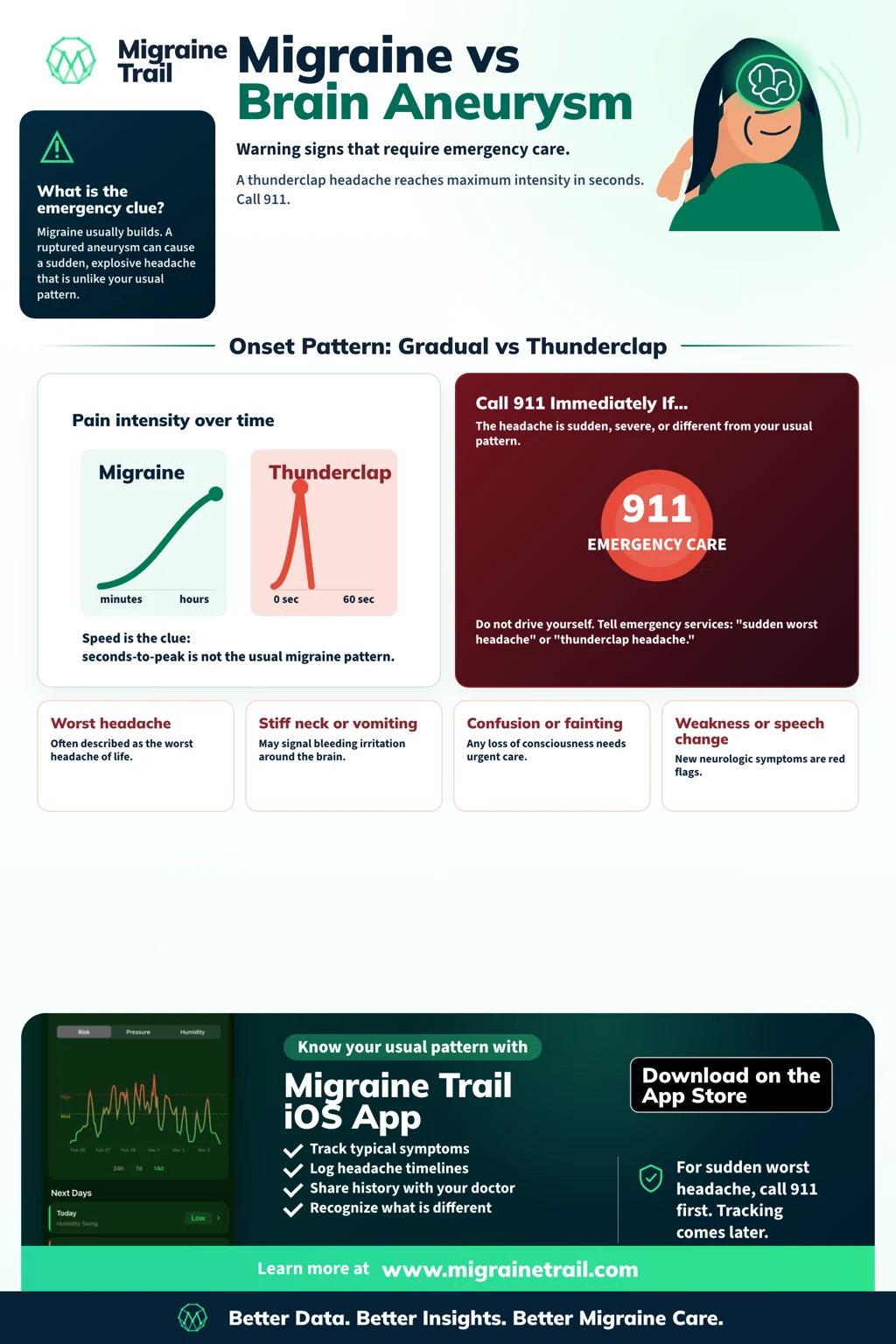
A ruptured brain aneurysm causes a "thunderclap headache" — an excruciating headache that reaches maximum intensity within seconds, often described as the worst headache of the person's life. Migraine builds gradually over minutes to hours and matches a prior pattern. The thunderclap onset is the critical distinguishing feature: if a headache reaches its peak in under a minute, treat it as a medical emergency and call 911 regardless of prior migraine history.
This distinction matters because subarachnoid hemorrhage (bleeding from a ruptured aneurysm) is fatal in approximately 40% of cases. Rapid treatment dramatically improves survival. A person with migraine who also develops a thunderclap headache — even if they assume it is "just a bad migraine" — cannot afford to wait.
Medical Quick Facts
| Feature | Migraine | Ruptured Aneurysm |
|---|---|---|
| Onset speed | Gradual — peaks over 30 min to hours | Sudden — peaks within seconds |
| Pain description | Throbbing, pulsating, one-sided | "Worst headache of my life," may be bilateral |
| Onset trigger | Stress, hormones, weather, sleep | Often during exertion, straining, sex |
| Accompanying symptoms | Nausea, light/sound sensitivity, aura | Stiff neck, vomiting, loss of consciousness, confusion |
| Pattern match | Matches prior migraines | Unlike any headache before |
| Action | Follow migraine plan | Call 911 immediately |
The Thunderclap Headache
The cardinal sign of aneurysm rupture is the thunderclap headache: it comes on in 1 second to 1 minute and is immediately severe. This is categorically different from migraine, which typically builds.
Many patients describe the aneurysm headache as "a bat hit my head" or "a gun went off." Some lose consciousness. Many experience nausea and vomiting from the meningeal irritation. A stiff neck that develops in the hours after the headache onset is a sign of blood in the cerebrospinal fluid.
An unruptured aneurysm — one that has not burst — usually causes no headache at all. It is typically found incidentally on imaging. A sudden onset headache behind one eye, or a drooping eyelid, can occasionally signal an enlarging aneurysm pressing on nearby cranial nerves, and is also an emergency.
The "Sentinel Headache"
About 10–40% of people who have a rupture report a severe, unusual headache in the days or weeks before — called a "sentinel headache" or "warning leak." This may represent a small leak before the major rupture.
If you experience a headache that is sudden, severe, and different from your usual migraines — even if it resolves — that warrants urgent evaluation. Do not assume it was a bad migraine without ruling out a sentinel bleed.
When to Call 911
Call emergency services if any of these apply:
- Headache reached maximum severity in under 1 minute
- It is the worst headache you have ever had
- Sudden onset during exertion, sex, or straining
- Stiff neck alongside the headache
- Confusion, altered consciousness, or sudden vision loss
- One-sided facial drooping or a newly drooping eyelid
- This headache is completely unlike your usual migraines
Having a prior migraine diagnosis does not change this. People with established migraine can also have aneurysms. The rule is: thunderclap = 911, every time.
Frequently Asked Questions
Can an aneurysm headache feel like a migraine?
An unruptured aneurysm rarely causes a headache that could be confused with migraine. The rupture headache is typically so sudden and severe that most patients describe it as unmistakably different from anything they've experienced — including previous migraines.
Are migraine sufferers more likely to have aneurysms?
Migraine is not a cause of aneurysm. However, the two conditions can coexist, and a person with migraine who develops a thunderclap headache should never attribute it to migraine without evaluation.
Can I take my triptan while waiting for the ambulance?
No. If you suspect a thunderclap headache or aneurysm rupture, call 911 first. Triptans constrict blood vessels and are not appropriate in the context of a possible hemorrhagic emergency.
Know your typical migraine red flags and track your baseline attack pattern with Migraine Trail — having a clear picture of your "normal" migraine makes it much easier to recognize when something is dangerously different.