If words go missing during a migraine, that is a measured effect of the attack rather than an impression. Formal testing during attacks shows reduced performance in processing speed, attention, executive function and verbal memory — and cognitive symptoms have been ranked second only to pain for how much they contribute to attack-related disability. The reassuring part is that this looks like a reversible brain state tied to the attack, not damage accumulating over time.
What Testing Actually Shows
A study of cognitive dysfunction during migraine attacks in migraine without aura found reduced performance during attacks and concluded there is a reversible brain dysfunction during them. A broader review of cognitive dysfunction and migraine sets out which domains are affected:
- Information processing speed
- Basic attention
- Executive function
- Verbal and non-verbal memory
- Verbal skills — the word-finding problem people describe most
Two mechanisms are proposed and they are not mutually exclusive: something specific to migraine itself, and the ordinary cost of the brain processing significant acute pain. Pain and cognition share real estate — the prefrontal cortex and midcingulate gyrus among other regions — so heavy demand on one plausibly degrades the other.
Why "Second Only to Pain" Matters
That ranking is worth sitting with, because it rarely reaches the consultation. People describe the pain and omit the fog, then get treatment aimed only at pain. If cognitive symptoms are a major part of your disability, saying so explicitly changes what your clinician is treating.
How Long It Lasts
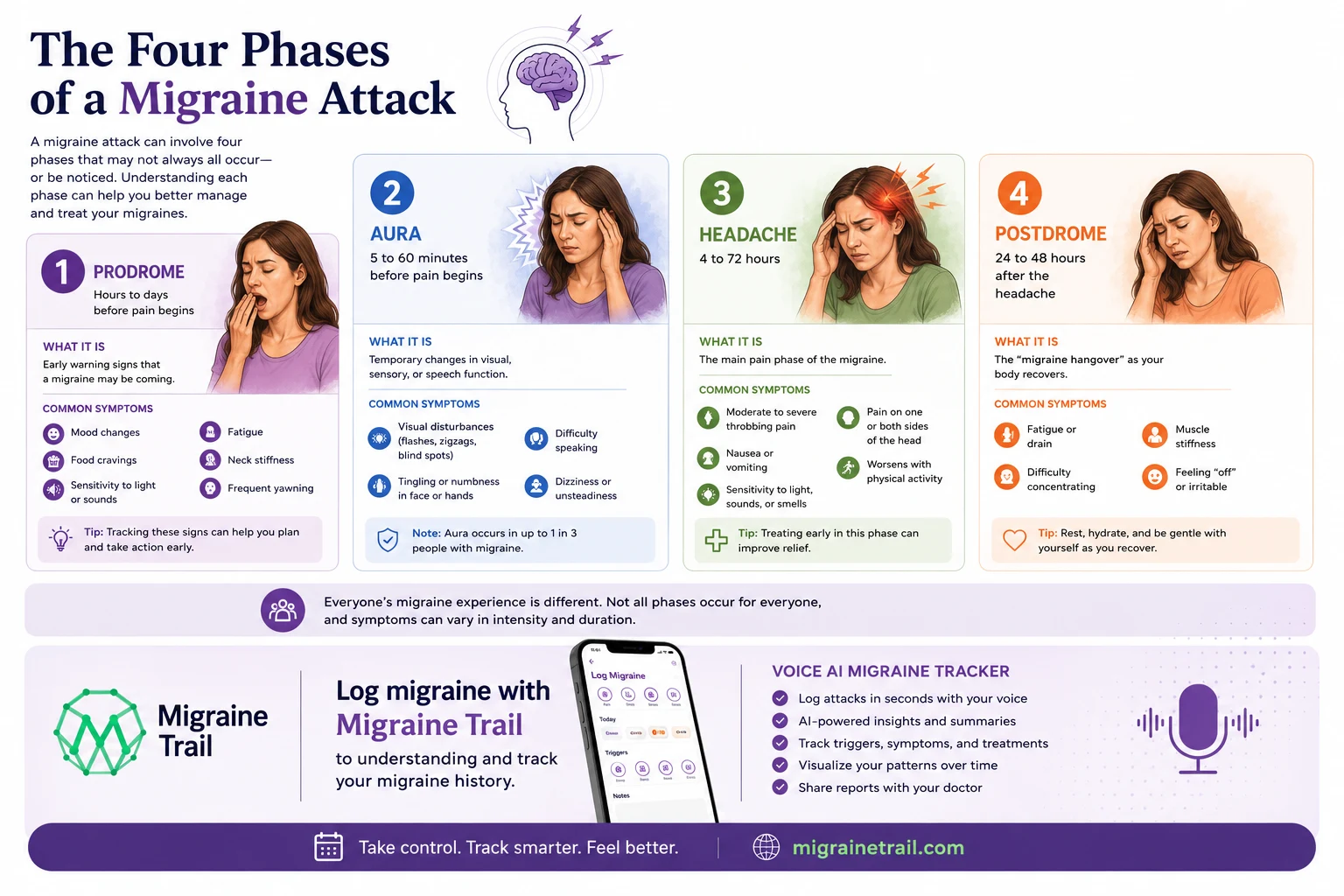
Fog is not confined to the painful phase. It appears in the premonitory phase before the pain, and prominently afterwards: in diary research on the postdrome, difficulty concentrating was among the most common symptoms after the pain resolved, with 93% of attacks returning to normal within 24 hours of pain ending.
So the realistic arc is fog before, during, and for up to a day after — which is why an attack recorded as "6 hours" can cost most of two days. Our guide to the migraine postdrome covers the recovery phase specifically.
A Note on the Longer Term
You will find research suggesting migraine is associated with cognitive differences between attacks too. Be careful how much weight you give it: findings are mixed, associations are not causation, and confounders like sleep disruption, medication and mood are hard to separate. The well-supported statement is the narrower one — cognitive performance drops during attacks and recovers afterwards. If your fog is not recovering between attacks, that is a reason to raise it, not to assume the worst.
When Cognitive Symptoms Need Assessment
Seek emergency care for sudden confusion, difficulty speaking or understanding speech, facial droop, or weakness on one side — these can indicate a stroke, and speech difficulty from migraine should never be assumed without assessment, especially the first time it happens. Seek prompt review for cognitive symptoms that do not fully resolve between attacks, worsen progressively, or occur with fever, new severe headache, head injury, or seizure. A first episode of speech disturbance needs medical evaluation.
This article is educational and is not a substitute for individual medical advice.
What to Track
| Field | Why |
|---|---|
| Fog present before pain? | Premonitory fog is a treatment-window signal |
| Specific difficulty | Word-finding, concentration, or memory behave differently |
| Time pain resolved | Reference point for the postdrome |
| Time thinking felt normal | The gap is your true cognitive recovery time |
| Work or tasks affected | Converts fog into the disability language clinicians use |
If fog reliably precedes your pain, it may be your earliest treatable signal — which is exactly what the symptom checker is designed to surface. Because fog is the symptom least likely to be accurately recalled later, voice-logging it as it happens captures what a retrospective diary misses.
Brain fog can also appear in overlapping conditions such as ADHD, long COVID, or POTS. Timing, associated symptoms, and clinician review matter because a diary can show patterns but cannot diagnose the cause.
Sources