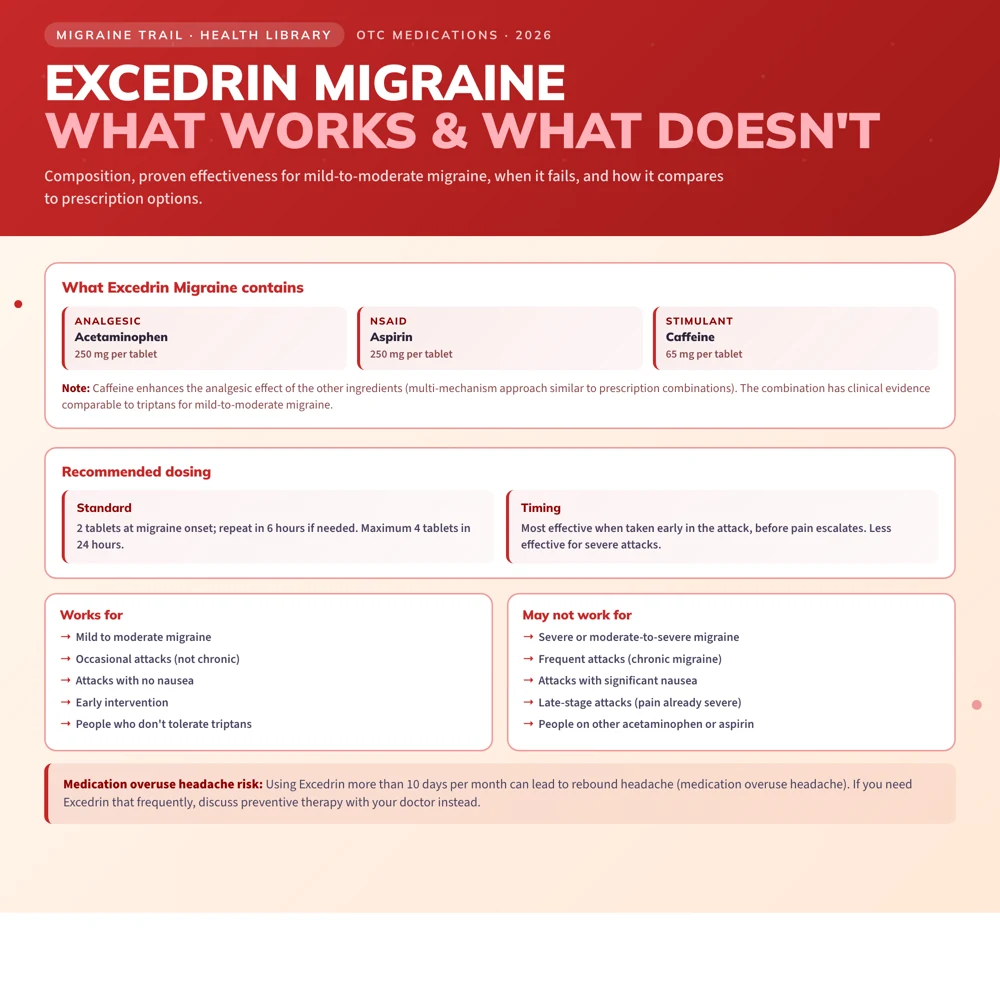
Excedrin Migraine is an over-the-counter combination analgesic containing acetaminophen (250mg), aspirin (250mg), and caffeine (65mg) per tablet. The three-ingredient combination is clinically proven to be more effective for migraine than any single ingredient alone. It works best for mild-to-moderate attacks taken at the first sign of symptoms. The standard adult dose is 2 tablets (500mg acetaminophen, 500mg aspirin, 130mg caffeine), with no more than 2 tablets in 24 hours. Do not use it more than 10 days per month, as this can lead to medication overuse headache.
When a migraine begins building, you want something that actually works. Excedrin Migraine is one of the few over-the-counter treatments specifically studied and FDA-approved for migraine, not just general pain. For many people with mild to moderate attacks, it can make the difference between a manageable day and losing one entirely.
Excedrin Migraine Ingredients
Each tablet of Excedrin Migraine contains:
| Ingredient | Amount per tablet | Role |
|---|---|---|
| Acetaminophen | 250mg | Analgesic and antipyretic: reduces the pain signal |
| Aspirin | 250mg | NSAID: reduces neurogenic inflammation |
| Caffeine | 65mg | Adjuvant: enhances analgesic absorption and constricts dilated blood vessels |
At the standard 2-tablet dose, you are taking:
- 500mg acetaminophen (the same as one regular Tylenol tablet)
- 500mg aspirin (the same as one regular aspirin tablet)
- 130mg caffeine (roughly equivalent to a 12oz cup of coffee)
Why the Combination Works Better Than Individual Ingredients
Clinical trials showed that the three-ingredient combination produced significantly better 2-hour pain relief and pain-free outcomes than any two ingredients combined, and far better than any single ingredient on its own.
How each component contributes:
Acetaminophen works centrally, inhibiting prostaglandin synthesis in the brain and spinal cord. It has a different mechanism from aspirin, and the two work together on different parts of the pain pathway.
Aspirin is an NSAID that blocks COX-1 and COX-2 enzymes, reducing the production of prostaglandins involved in migraine neuroinflammation. It also inhibits platelet aggregation and affects serotonin levels.
Caffeine plays two roles: it enhances the absorption and analgesic potency of both acetaminophen and aspirin by around 40% (this is why the FDA recognizes caffeine as an analgesic adjuvant), and it constricts blood vessels, directly counteracting the vascular dilation that contributes to migraine pain.
How Effective Is Excedrin Migraine?
The pivotal clinical trials showed:
- 59.3% of patients had meaningful pain relief at 6 hours (vs 32.8% with placebo)
- Approximately 20% achieved complete pain freedom at 2 hours
- Significantly better results than either acetaminophen alone or aspirin alone
These numbers are lower than prescription triptans (which achieve pain freedom in 30 to 40% at 2 hours), which is why Excedrin Migraine is most appropriate for mild-to-moderate attacks. For more severe or disabling attacks, triptans or other prescription options are typically more effective.
Who Should Use Excedrin Migraine
Good candidates:
- Adults with confirmed migraine, mild to moderate severity
- People whose attacks respond to over-the-counter treatment (many do)
- Those without cardiovascular disease, aspirin sensitivity, or bleeding concerns
- People who want to avoid prescription medication for less severe attacks
Not appropriate for:
- Children under 12 (aspirin carries a risk of Reye's syndrome)
- Teenagers and children with a viral illness
- People with aspirin allergy or NSAID sensitivity
- People with active peptic ulcer or a history of gastrointestinal bleeding
- People on blood thinners (warfarin, NOACs, heparin)
- Pregnant women (aspirin in the third trimester especially)
- People who cannot tolerate caffeine
- Attacks that are already moderate-to-severe at onset (a triptan is a better fit)
If you are unsure whether Excedrin Migraine is safe for you, your pharmacist can help, and it is always worth checking before a bad attack leaves you without options.
Dosage and How to Take It
Standard adult dose: 2 tablets at the first sign of migraine
Maximum: 2 tablets in any 24-hour period
Timing: Take as early as possible in the attack. Excedrin Migraine, like all acute migraine treatments, works significantly better when taken during the mild phase or even during the prodrome, rather than waiting until the pain is severe. Pain sensitization that develops as an attack progresses makes all medications less effective.
With food: Take with a full glass of water. Food can slow absorption slightly but reduces stomach irritation from the aspirin.
Do not exceed: 2 tablets in 24 hours or more than 10 days per month (see the important warning below).
Excedrin Migraine vs. Regular Excedrin
Regular Excedrin (Extra Strength) contains identical active ingredients in identical amounts: 250mg acetaminophen, 250mg aspirin, 65mg caffeine per tablet. The differences are only in labeling and marketing. Excedrin Migraine is FDA-approved and labeled specifically for migraine; Excedrin Extra Strength is labeled for general pain.
In practice, they are interchangeable for migraine. The migraine-specific labeling is meaningful because it reflects actual migraine trial data, but chemically the pills are the same.
The Medication Overuse Warning
This is the most important thing to understand about Excedrin Migraine, and it's worth reading even if you've been taking it for years.
Taking acute migraine treatments, including over-the-counter options, more than 10 days per month can cause medication overuse headache (MOH), sometimes called rebound headache.
In MOH, the brain adapts to frequent analgesic use by upregulating pain receptors, effectively lowering the pain threshold. The result is that headaches become more frequent, often daily, and the medication that used to work stops working. The headache now partly exists because of the medication.
This is not your fault. It is a well-documented neurological process, and it is surprisingly easy to fall into when you are just trying to manage each day.
Signs you may be developing MOH:
- Headaches occurring more days per month than they used to
- Headaches starting to appear in the morning when you wake up
- Your usual Excedrin dose not working as well as it once did
- Taking Excedrin pre-emptively "just in case"
If you are using Excedrin Migraine more than 10 days a month, please talk to your doctor about preventive migraine therapy. Getting out of the MOH cycle is difficult but completely possible with the right support.
When Excedrin Migraine Is Not Enough
There is no shame in needing something stronger. Consider moving to prescription options when:
- Attacks are moderate-to-severe from the start. Triptans have much stronger evidence for these attacks.
- Excedrin is not providing meaningful relief. If the 2-hour response is insufficient, a different approach is needed.
- You are hitting the 10-day-per-month limit. This is a signal that preventive therapy is the right next step.
- Nausea prevents you from keeping oral medication down. Nasal spray or subcutaneous triptans bypass this issue.
- Attacks are lasting 24 to 72 hours. Over-the-counter options are not designed for attacks of this length.
Triptans (sumatriptan, rizatriptan, eletriptan) target the specific pathway involved in migraine, the CGRP and trigeminal activation, rather than treating pain generally. For many people, using a triptan for significant attacks and reserving Excedrin for mild ones is the most effective overall approach. You deserve access to the treatment that actually works for your attacks.
Alternatives to Excedrin Migraine
Other over-the-counter options:
- Ibuprofen 400 to 600mg: evidence-based for migraine; less than the combination but useful when aspirin is contraindicated
- Naproxen 220mg (Aleve): a longer-acting NSAID; useful for attacks that build slowly or tend to relapse
- Aspirin 900mg: high-dose aspirin alone has good evidence in migraine
Prescription options when over-the-counter fails:
- Triptans (sumatriptan, rizatriptan, eletriptan, zolmitriptan, almotriptan, frovatriptan, naratriptan)
- Gepants (ubrogepant/Ubrelvy, rimegepant/Nurtec): newer CGRP antagonists, particularly useful in cardiovascular-contraindicated patients
- Lasmiditan (Reyvow): effective but causes sedation
- Antiemetics alongside analgesics when nausea is significant
Tracking Medication Use
Because the risk of medication overuse headache depends directly on how often you are taking acute treatments, keeping count matters. It is genuinely easy to lose track across a busy month.
Use Migraine Trail to log every attack and every medication taken. The app automatically tracks your monthly medication use days so you can see at a glance whether you are approaching the 10-day threshold before it becomes a problem. Catching it early is so much easier than treating MOH after the fact.