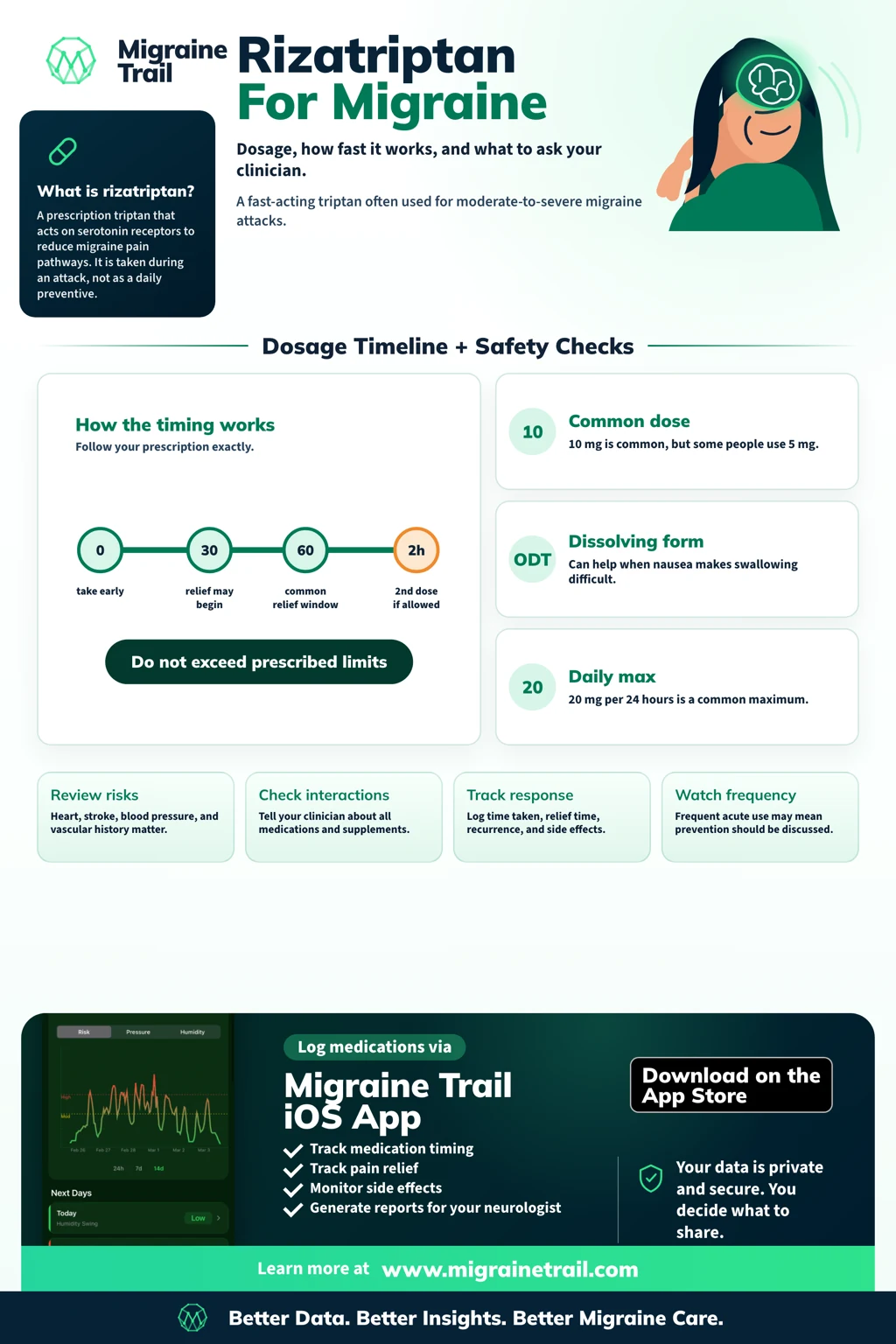
Rizatriptan (brand name Maxalt) is a second-generation triptan used to treat moderate-to-severe migraine attacks. It works by activating serotonin 5-HT₁B/₁D receptors to constrict blood vessels and block pain signals in the trigeminal nerve. The standard dose is 10mg at the onset of head pain; a second dose can be taken after 2 hours if needed. It acts faster than most oral triptans, with many people experiencing pain relief within 30–60 minutes. It is also available as a dissolving tablet (Maxalt-MLT) for people with nausea.
Rizatriptan is a prescription triptan used for the acute treatment of migraine. If sumatriptan has not worked well for you, ask your clinician whether rizatriptan or another option is appropriate for your medical history.
Medical Quick Facts
| Fact | Answer |
|---|---|
| Drug class | Triptan (serotonin 5-HT₁B/₁D agonist) |
| Brand name | Maxalt (tablet), Maxalt-MLT (orally disintegrating) |
| Standard dose | 10mg at onset |
| Maximum per 24 hours | 20mg (two doses, 2 hours apart) |
| Onset of relief | 30–60 minutes (faster than most oral triptans) |
| Available forms | Standard tablet, orally disintegrating tablet (ODT) |
| Do not exceed | 9–10 use days per month |
How Rizatriptan Compares to Sumatriptan
Both are triptans and share the same mechanism. The practical differences:
- Onset: Rizatriptan tends to produce relief slightly faster — 30–60 minutes vs sumatriptan's ~2 hours
- Dose flexibility: Sumatriptan comes in more forms (nasal spray, injection) — useful for severe nausea or rapid escalation; rizatriptan's ODT dissolves without water and is easier for nausea
- Propranolol interaction: Rizatriptan dose should be reduced to 5mg (and maximum 10mg per day) if you take propranolol; the blood pressure medication significantly increases rizatriptan blood levels
- Individual response: Neither triptan works for everyone; head-to-head trials show that some patients respond clearly better to one versus the other, which is why trying both is worthwhile
The Orally Disintegrating Tablet (Maxalt-MLT)
The MLT formulation dissolves on the tongue in about 30 seconds without water. It contains the same 10mg of rizatriptan as the standard tablet — it is absorbed the same way (through the gut, not sublingually) — but it's far easier to take when:
- Nausea makes swallowing hard
- You're caught without water
- You need to take it discreetly
The MLT contains phenylalanine, which matters only for people with phenylketonuria (PKU).
Side Effects
Common:
- Dizziness or drowsiness
- Tingling or warmth ("triptan sensations")
- Dry mouth, nausea
- Chest or throat tightness or pressure (usually benign, but always worth checking the first time)
The chest sensations are common across all triptans and are typically not cardiac in origin — but any new chest symptom in a new triptan user warrants a conversation with your doctor before continuing.
Who Should Not Use Rizatriptan
- Coronary artery disease, prior heart attack or stroke
- Hemiplegic or basilar migraine
- Severe uncontrolled hypertension
- Use within 24 hours of another triptan or ergotamine
- Use within 2 weeks of an MAOI
- People on propranolol should take the reduced 5mg dose, not 10mg
Frequently Asked Questions
Is rizatriptan better than sumatriptan?
Clinical trials show rizatriptan 10mg consistently produces slightly faster and more complete pain relief at 2 hours than sumatriptan 50mg. However, individual responses vary — the best triptan is the one that works for you consistently.
Can I take rizatriptan on an empty stomach?
Yes. Food doesn't affect how well it works, though it may slightly delay absorption. If your attacks start with nausea that makes eating impossible, the MLT tablet is useful.
Can rizatriptan cause rebound headaches?
Yes — like all acute migraine treatments, using it more than 9–10 days per month can lead to medication overuse headache. Track your monthly medication use days in Migraine Trail to stay well under that limit.
What if rizatriptan stops working mid-attack?
Taking a second dose after 2 hours is appropriate if there was initial improvement. If there was no response at all to the first dose, a second dose is unlikely to help — contact your doctor about alternative rescue strategies.