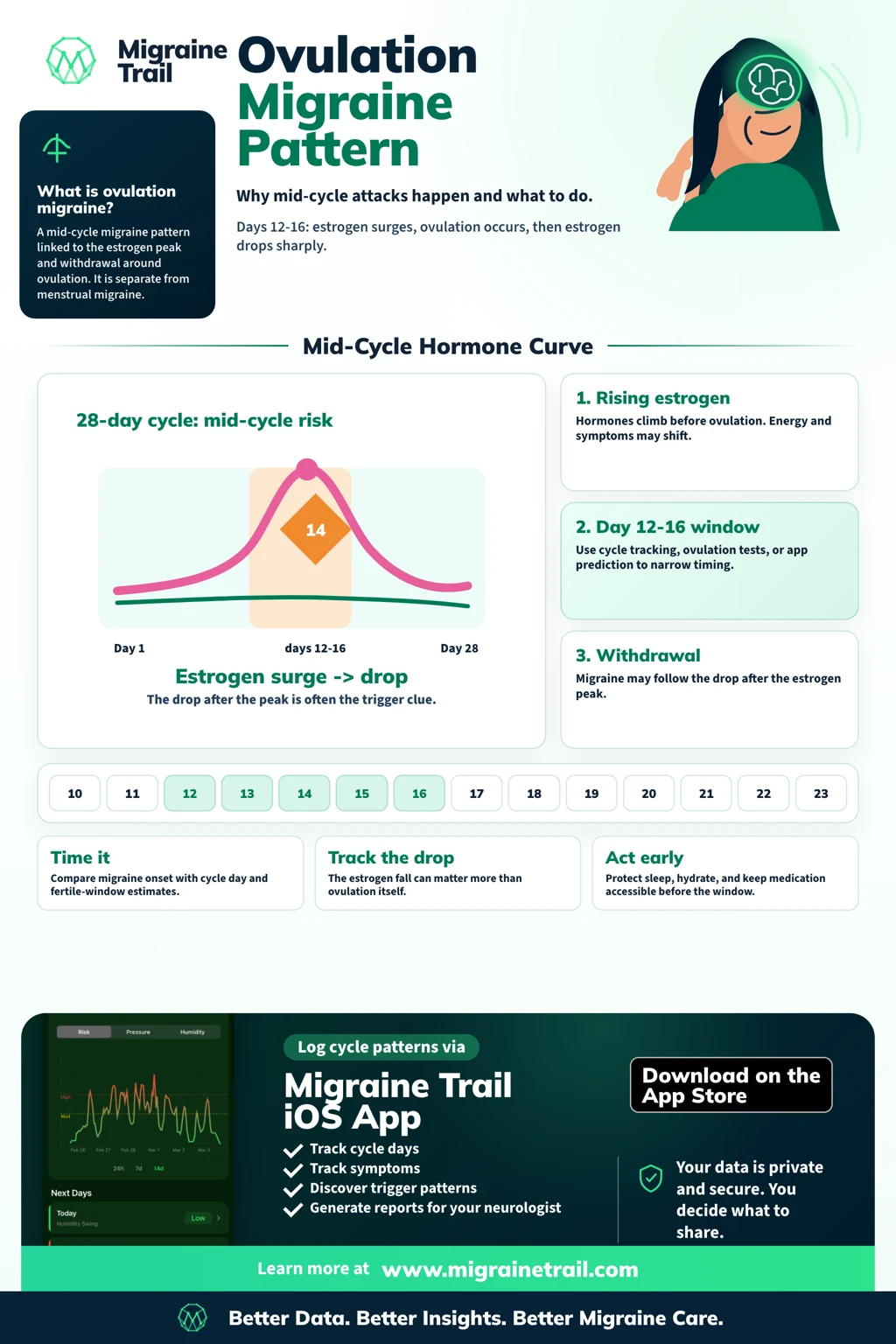
Ovulation migraines are attacks triggered by the sharp rise and subsequent drop in estrogen that occurs mid-cycle, typically between days 12 and 16 of a 28-day cycle. They are distinct from menstrual migraines, which occur just before or during the period. Both are driven by estrogen withdrawal, but at different points in the cycle. Tracking your cycle alongside your migraine log is the fastest way to confirm the pattern and find targeted relief.
If you have noticed that headaches seem to cluster mid-month — not just around your period — ovulation may be the driver. This is a genuinely underrecognized pattern, and many people go years attributing it to stress or random bad luck before connecting it to their cycle.
Medical Quick Facts
| Fact | Answer |
|---|---|
| Cycle timing | Days 12–16 (mid-cycle) |
| Hormone involved | Estrogen — surges then drops sharply at ovulation |
| Duration | Typically 4–24 hours |
| Frequency | Once per cycle in each ovulatory cycle |
| Who it affects | Most common in people with hormonal migraine sensitivity |
| Distinguishes from | Menstrual migraine (days -2 to +3 of period) |
Why Estrogen Triggers Migraines at Ovulation
The cycle has two major estrogen peaks. The first — and sharper — occurs just before ovulation. The brain rapidly sensitizes to this surge. When ovulation occurs and estrogen drops quickly afterward, that withdrawal is what triggers the migraine in susceptible people.
The same mechanism drives menstrual migraines: it is always the drop, not the high level, that causes the attack. At ovulation, that drop is steeper and more sudden than many people realize.
Progesterone begins rising immediately after ovulation. This is important because progesterone has a mild protective effect on migraine — which is why the luteal phase (days 15–28) often feels somewhat better than expected, even though estrogen is lower.
Confirming the Pattern
Ovulation migraines are easily confused with stress-related attacks because mid-cycle often coincides with mid-week work peaks. The way to separate them:
- Track your migraine dates alongside your cycle for at least 3 months
- Note ovulation using a basal body temperature app, LH strips, or a cycle tracker
- If attacks cluster within 2–3 days of confirmed ovulation, the pattern is hormonal
Migraine Trail lets you log attacks with cycle-day context, which makes this pattern visible in your data rather than relying on memory.
What Helps
Acute treatment: Standard acute migraine medications — triptans, NSAIDs, or the newer gepants — work for ovulation migraines just as they do for other attacks. Take at first sign of pain.
Short-term prevention (mini-prophylaxis): If the pattern is confirmed and consistent, a doctor may recommend taking a preventive agent (typically an NSAID like naproxen, or supplemental estrogen) for 4–5 days around predicted ovulation. This strategy is the same used for menstrual migraine prevention — applied mid-cycle instead.
Lifestyle support: During the 2–3 days around ovulation, prioritize consistent sleep, stay well hydrated, avoid known dietary triggers, and reduce alcohol. Small trigger stacks can tip an already sensitized brain into an attack.
Frequently Asked Questions
How do I know if my mid-cycle headache is an ovulation migraine or just a regular headache?
If it has migraine features — throbbing, light or sound sensitivity, nausea, lasting 4+ hours — and recurs predictably mid-cycle in multiple months, it is very likely hormonally driven. A cycle-attack log over 3 months is the most useful diagnostic tool.
Will birth control stop ovulation migraines?
Hormonal contraceptives that suppress ovulation (combined pill, patch, ring, implant, hormonal IUD) can reduce or eliminate ovulation-related attacks because the estrogen fluctuation is blunted or removed. However, some people find that the pill's own hormone-free interval triggers its own migraine. This is discussed in depth in our migraine and birth control guide.
Do ovulation migraines get worse with age?
They can shift as cycles change. Perimenopause introduces more erratic ovulation and larger estrogen swings, which often worsens hormonal migraine sensitivity. Tracking becomes even more valuable during this transition.