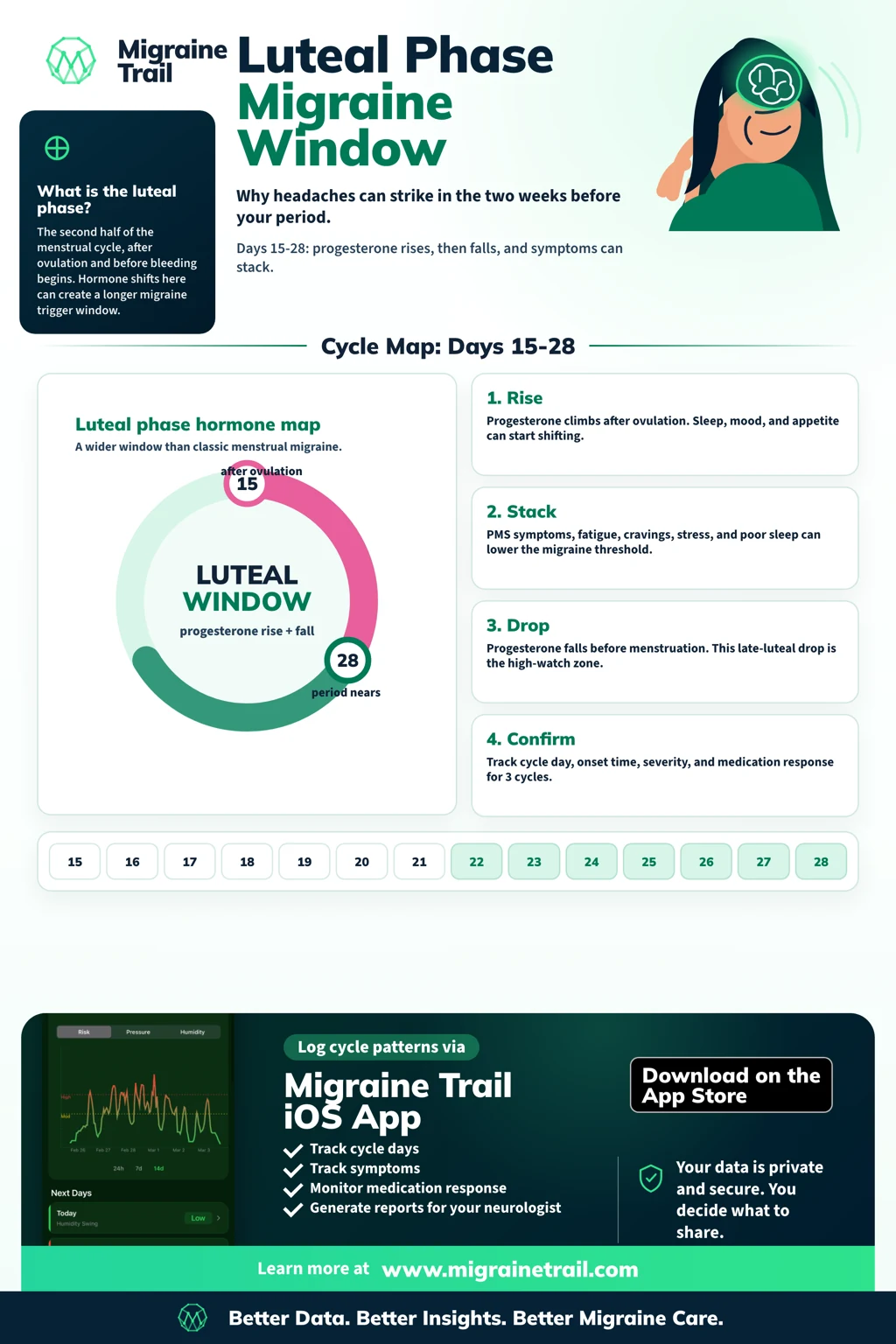
Luteal phase migraines occur in the second half of the menstrual cycle — days 15 to 28 — when progesterone peaks and then begins to decline in the days before menstruation. Unlike true menstrual migraines (which occur right around the period itself), luteal migraines can appear anywhere in the two-week window after ovulation. The progesterone drop, combined with associated sleep disruption and mood changes, creates a multi-factor trigger environment that is often mistaken for premenstrual syndrome.
If you notice that your worst migraine days are in the week or so before your period starts — not during it — luteal phase sensitivity is the likely explanation. This is distinct from menstrual migraine and often needs a different management approach.
Medical Quick Facts
| Fact | Answer |
|---|---|
| Cycle timing | Days 15–28 (after ovulation, before period) |
| Key hormones | Progesterone rises then falls; estrogen secondary drop |
| Duration of window | Up to 14 days (vs 3–5 days for menstrual migraine) |
| Associated symptoms | PMS, sleep disruption, mood changes, bloating |
| Confirms with | 3+ months of cycle-attack logging |
| Distinct from | Menstrual migraine (days -2 to +3 of period) |
The Hormone Dynamics of the Luteal Phase
After ovulation, the corpus luteum (the structure left behind after the egg is released) produces progesterone. Progesterone levels peak around day 21, then fall sharply if pregnancy does not occur. Estrogen also has a secondary, smaller drop in this phase.
Progesterone has complex effects on the brain. It is metabolized into allopregnanolone, a compound that modulates GABA receptors and generally has a calming effect. When progesterone drops sharply, this calming effect is withdrawn — increasing neurological excitability, which raises migraine risk. This is compounded by:
- Sleep disruption: Progesterone affects sleep architecture, and poor sleep is one of the most reliable migraine triggers
- Mood changes: Serotonin sensitivity fluctuates with progesterone, overlapping with PMS
- Dehydration and bloating: Hormonal fluid shifts affect electrolyte balance
The result is a brain that is simultaneously more excitable and facing multiple additional triggers.
Distinguishing Luteal Migraine from Menstrual Migraine
| | Luteal Phase Migraine | Menstrual Migraine |
|---|---|---|
| When | Days 15–28, unpredictably within that window | Days -2 to +3 of period start |
| Hormonal driver | Progesterone decline | Estrogen withdrawal |
| Duration of risk window | Up to 14 days | 5–6 days |
| Predictability | Less predictable within the window | Highly predictable |
Because the luteal window is wide and the triggers are multiple, these migraines can feel "random" compared to menstrual migraines, which are tightly time-locked to the period.
What Helps
Track the pattern first. Log your attacks and cycle day for at least 3 months using Migraine Trail. This reveals whether attacks cluster in the luteal window and whether any particular sub-window (e.g., days 20–24) is most affected.
Acute treatment: Same options as any migraine attack — triptans, NSAIDs, or gepants. Take at first sign of symptoms.
Sleep hygiene: Prioritize consistent sleep during the luteal phase. Even one night of disrupted sleep significantly raises attack risk when hormones are already fluctuating.
Magnesium supplementation: Magnesium is supported by research for reducing luteal-phase and menstrual migraine frequency. 400–600mg daily of magnesium glycinate or citrate is the typical starting dose. Discuss with your doctor.
Mini-prophylaxis: For people with predictable severe luteal-phase attacks, doctors may prescribe an NSAID or low-dose hormonal supplement taken in the second half of the cycle. This requires confirming the pattern through tracking first.
Frequently Asked Questions
Are luteal migraines the same as PMS migraines?
Largely yes — "PMS migraines" and "luteal phase migraines" describe the same phenomenon: attacks driven by the hormonal changes of the second half of the cycle. The clinical term is perimenstrual migraine when the attacks extend into the menstrual phase.
Will hormonal birth control help?
It depends on the type and your migraine pattern. Continuous combined pills that reduce cycle fluctuation can help some people; others find that the pill's own hormone fluctuations are problematic. If you have migraine with aura, combined estrogen-progestin contraceptives carry stroke risk considerations — discuss this carefully with your doctor.
Do luteal migraines improve with age?
For many people, they worsen during perimenopause as cycle irregularity increases the magnitude of hormone swings. After menopause, when cycles stop entirely, hormonal migraines often improve significantly — though the transition period can be difficult.