Smelling something burning shortly before a migraine, when nothing is burning, is a documented phenomenon called phantosmia. It is uncommon, it has a consistent description across case series — brief, unpleasant, usually a burning smell, arriving just before or with the head pain — and it responds to migraine preventive treatment in reported cases. One thing to be clear about, though: olfactory hallucination is not currently recognised as a form of aura by the international classification, and phantom smells have other causes that need excluding. This is a symptom to report, not to self-diagnose.
What the Case Series Describe
The main source is a case series and literature review of olfactory hallucinations in primary headache disorders. Its description is strikingly consistent:
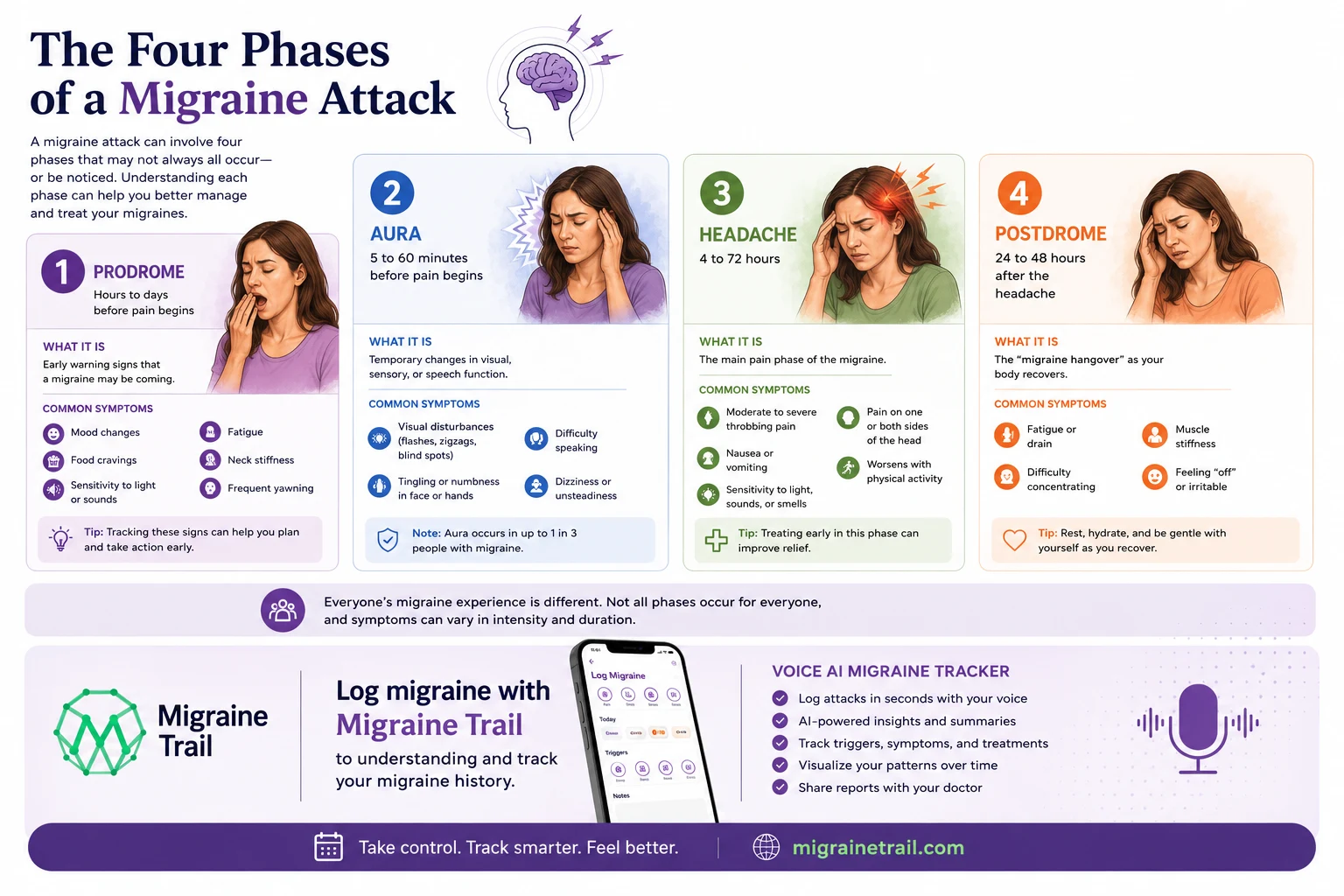
- The hallucination typically lasts 5 to 60 minutes
- It occurs shortly before, or at the same time as, the onset of head pain
- It is a highly specific and unpleasant odour — most commonly burning
- It occurred most often in women with migraine
On how common it is, estimates vary widely by setting and method: about 0.66% of all patients at a headache centre over 30 months, around 0.1% of migraine patients in one report, but 3.9% of children with migraine in a paediatric series — rising to 6.5% among those with aura. A study of olfactory symptoms in migraineurs with and without aura found higher rates again, at 6.2% for olfactory hallucinations.
The range tells you something useful: this is rare in general practice and less rare in specialist headache clinics, which is roughly what you would expect.
Why It Is Not Called "Aura"
This distinction matters if you are reading elsewhere and finding contradictions. The international classification recognises visual, sensory, speech and language, motor, brainstem and retinal aura. Olfactory symptoms are not on that list.
Researchers in the case series argue they probably are an uncommon form of aura, on the basis of their semiology, their timing, and their response to preventive treatment. That is a reasonable argument, and it has not yet changed the classification.
So the accurate description is: a recognised, reported migraine-associated phenomenon that is not formally classified as aura. If a clinician says "that isn't aura," they are correct by the current criteria — and the symptom is still real and still documented.
What Else Causes Phantom Smells
This is why the symptom warrants reporting rather than filing away. Phantosmia occurs in:
- Sinus and nasal disease, and after upper respiratory infections
- Temporal lobe epilepsy — olfactory hallucination is a recognised seizure aura, and this is the most important overlap
- Head injury
- Some neurodegenerative conditions
- Some medications
- Rarely, intracranial lesions affecting olfactory pathways
The epilepsy overlap deserves emphasis: seizures can begin with a smell. The distinguishing features are typically duration, associated symptoms, and whether awareness is affected — which is a clinical assessment, not a self-check.
When Phantom Smells Need Assessment
See your doctor about any new phantom smell — it warrants assessment rather than watchful waiting. Seek urgent care if it comes with loss of awareness, staring episodes, lip-smacking or repetitive movements, confusion afterwards, or convulsions, as these suggest seizure activity. Also seek prompt review for phantom smells with new persistent headache, after a head injury, with progressive loss of your normal sense of smell, with new one-sided nasal symptoms or bleeding, or with new neurological symptoms such as weakness, vision or personality change.
This article is educational and is not a substitute for individual medical advice.
What to Track
If you get these, a short record makes the specialist conversation far more efficient:
| Field | Why |
|---|---|
| What the smell was | Burning is the most reported; consistency matters |
| Duration | 5-60 minutes fits the reported migraine pattern |
| Timing vs headache | Just before or with onset is the reported pattern |
| Other aura present? | Visual or sensory symptoms alongside |
| Any lost time or confusion? | The critical question — flag immediately |
| Headache followed? | Distinguishes migraine-associated from isolated |
The row about lost time or confusion is the one your clinician will most want answered, because it is what separates a migraine-associated phenomenon from a possible seizure. Note it every time, including when the answer is no.
The aura pattern checker covers timing and sequence for the recognised aura types, which is a useful frame even though olfactory symptoms sit outside them. Because these episodes are brief and infrequent, capturing them by voice as they occur tends to produce a far better record than trying to recall them months later at an appointment.
Sources