Tingling that creeps from your fingers up your arm to your face over several minutes has a recognisable signature: sensory aura spreads gradually, while ischaemic events tend to be maximal at onset. That single difference is the most useful discriminator in the literature. It is also not something to rely on by yourself the first time it happens — a first episode of one-sided numbness needs medical assessment, because getting this wrong in the stroke direction is far more costly than an unnecessary trip to be checked.
What Sensory Aura Looks Like
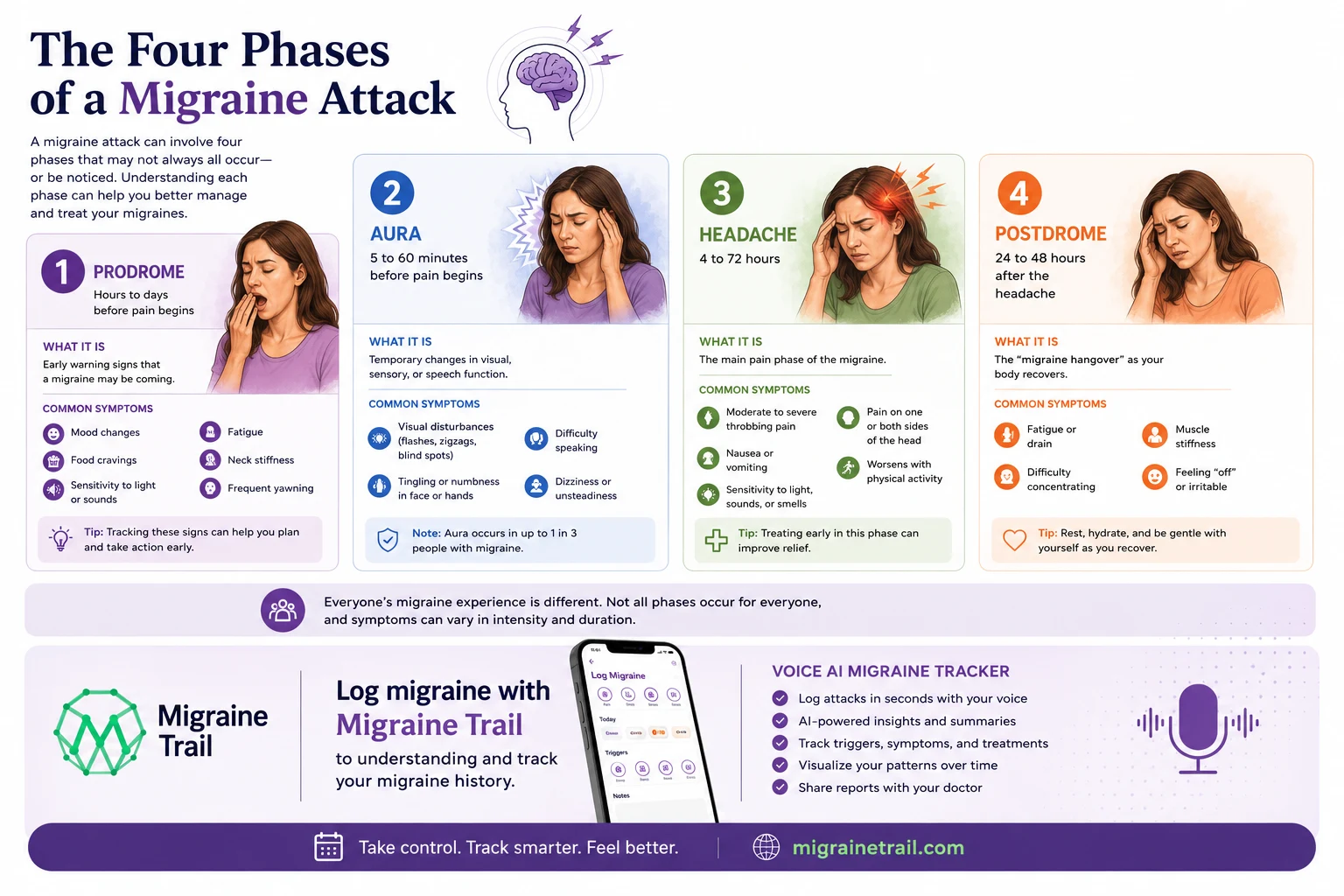
Sensory aura is the second most common aura type after visual, affecting roughly a third of people who get aura. Its defining features under the international criteria are timing and spread: symptoms develop gradually over five minutes or more and last between 5 and 60 minutes.
The classic description is a "march" — tingling begins in the fingers, travels up the arm over minutes, and reaches the face or tongue. Following the pins and needles, localised numbness can persist for up to an hour.
Two further clues:
- Positive symptoms followed by negative ones. Tingling (a positive symptom, something added) that gives way to numbness (negative, something lost) is characteristic of migraine.
- Aura types in succession. Visual disturbance followed by sensory symptoms, one after another rather than all at once, is a migraine pattern.
Our guide to migraine with aura covers the full criteria, and the visual aura gallery covers the more common visual form.
Why the Slow Spread Matters
The slow, spreading quality of aura is what distinguishes it from ischaemic deficits, which are typically maximal at onset — a stroke or TIA usually arrives all at once rather than creeping across the body over ten minutes.
But treat that as a clinical pattern, not a self-assessment tool. Some TIA mimics do march. Aura and TIA can look genuinely similar, particularly in older adults and in people whose first aura arrives later in life. The pattern helps a clinician; it should not talk you out of getting checked.
The Honest Position on Risk
Two things are true at once, and both matter:
- Sensory aura is common, benign in itself, and usually resolves fully within an hour.
- A first episode of one-sided numbness or weakness is a "get assessed today" event. So is any episode that differs from your usual pattern.
Aura should never involve true weakness. Tingling and numbness are sensory; genuine loss of power is not typical aura and points either to hemiplegic migraine — a specific, uncommon subtype needing formal diagnosis — or to something requiring urgent exclusion.
If you have established, unchanged aura you have had for years, you likely already know its shape. Anything that deviates from that shape deserves fresh attention rather than pattern-matching.
When Tingling Is an Emergency
Call emergency services if numbness or tingling appears suddenly at full intensity, affects one whole side of the body, or comes with facial droop, arm weakness, slurred speech, confusion, severe sudden headache, vision loss, or difficulty walking. Use the FAST test: Face drooping, Arm weakness, Speech difficulty, Time to call. Seek same-day assessment for a first-ever episode of one-sided numbness, for any aura lasting longer than an hour, for aura that includes weakness, or for aura that is new or different in someone over 50. Do not wait to see whether it resolves.
This article is educational and is not a substitute for individual medical advice.
What to Track
Once serious causes have been excluded, the pattern of your own aura is worth documenting — for you and for your clinician:
| Field | Why |
|---|---|
| Where it started | The march has a starting point; note it |
| How it spread, and over how long | Gradual over 5+ minutes is the aura signature |
| Total duration | Aura is typically 5-60 minutes |
| Tingling, numbness, or both | Positive-then-negative is characteristic |
| Any weakness? | Not typical aura — flag it every time |
| Visual symptoms too? | Aura types in succession is a migraine pattern |
| Headache followed? | Aura can occur without headache — see silent migraine |
The aura pattern checker walks through visual and sensory aura timing together. Because aura resolves within the hour and details fade fast, recording it by voice while it happens captures the spread and duration that memory reliably loses.
Sources