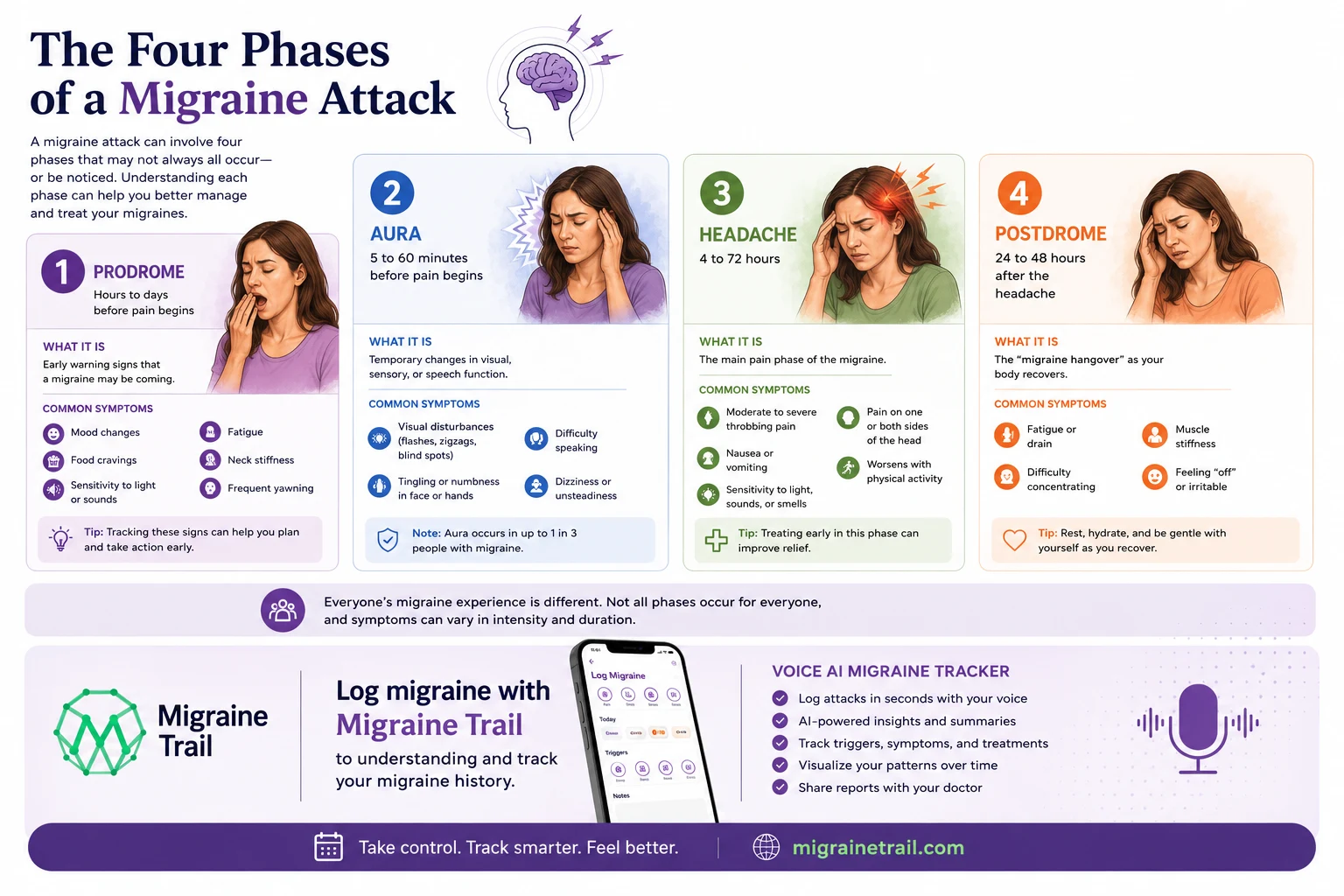
If your hair hurts during a migraine, you are not imagining it and it is not the hair. The symptom is called cutaneous allodynia — pain in response to something that should not cause pain, like a hairbrush, glasses, an earring, or a pillow. It is common in migraine, it reflects a specific change in how the nervous system is processing signals during an attack, and it tends to appear at a predictable point in the attack rather than at the start.
That timing is the useful part, because it marks the closing of your best treatment window.
What Allodynia Actually Is
Allodynia is regarded as an expression of central sensitization — neurons in the trigeminal pain pathway becoming more excitable, so ordinary touch signals get read as pain. A narrative review of cutaneous allodynia in migraine describes the mechanism: once second-order neurons in the trigeminal nucleus and third-order neurons in the thalamus are sensitized, the threshold for what counts as painful drops.
In plain terms: the volume knob on incoming sensation has been turned up, and it is not being turned up by your scalp.
How Common, and When It Starts
A population study of allodynia in headache sufferers found it to be a frequent feature of migraine specifically. Clinic-based estimates put it around two-thirds of people with migraine, with the range varying by how it is measured.
The timing is the clinically interesting part. Throbbing typically begins 5 to 20 minutes after headache onset, while allodynia develops later — generally in the 20-to-120-minute window. It is a later phenomenon in the attack.
Why That Matters for Treatment
This is the practical takeaway, and it is worth stating carefully: allodynia is associated with poorer response to acute treatment, and has been proposed as a marker for progression toward chronic migraine.
The reasonable interpretation is not "my medication has stopped working." It is that the attack has progressed past the point where acute treatment does its best work. If you can identify the symptoms that arrive before allodynia — for many people that is neck stiffness, yawning, or mood change — you are identifying your actual treatment window.
Note the direction of the evidence here: allodynia predicts a worse treatment response, but that does not prove treating earlier prevents allodynia. It is a strong reason to track your own sequence rather than a guarantee.
Recognising It
Allodynia shows up in ordinary ways people rarely report to a doctor because they sound trivial:
- Brushing or tying up your hair hurts
- Glasses or sunglasses feel painful on the nose or behind the ears
- Earrings, a hat, or a hair tie become intolerable
- Resting the affected side on a pillow hurts
- Shaving, or water in the shower, feels painful
- A necklace, collar, or scarf feels like too much
If several of those are familiar during attacks, that is worth saying explicitly at your next appointment. It is a recognised feature, not a quirk.
When to Seek Medical Assessment
New scalp tenderness in someone over 50 — particularly with jaw pain when chewing, vision changes, or a tender, prominent temporal artery — needs urgent same-day assessment, as it can indicate giant cell arteritis, which is treatable but can threaten sight if missed. Also seek prompt review for scalp or facial sensitivity with a rash, or after a head injury.
This article is educational and is not a substitute for individual medical advice.
What to Track
The goal is to find what reliably comes before the allodynia:
| Field | Why |
|---|---|
| Time head pain started | Your baseline reference point |
| Time touch first hurt | Usually 20-120 minutes later; yours may differ |
| What hurt | Hair, glasses, pillow — consistency confirms the pattern |
| Earliest symptom of the attack | This is your real treatment window |
| Time you treated, and relief | Tests whether treating before allodynia works better for you |
Five to ten attacks is usually enough for the ordering to become obvious.
To map which areas are involved, the headache location checker covers location and associated symptoms together. To test whether treating before allodynia actually improves your outcome, the medication effectiveness tracker compares relief across attacks rather than relying on the impression left by the most recent one.
Sources