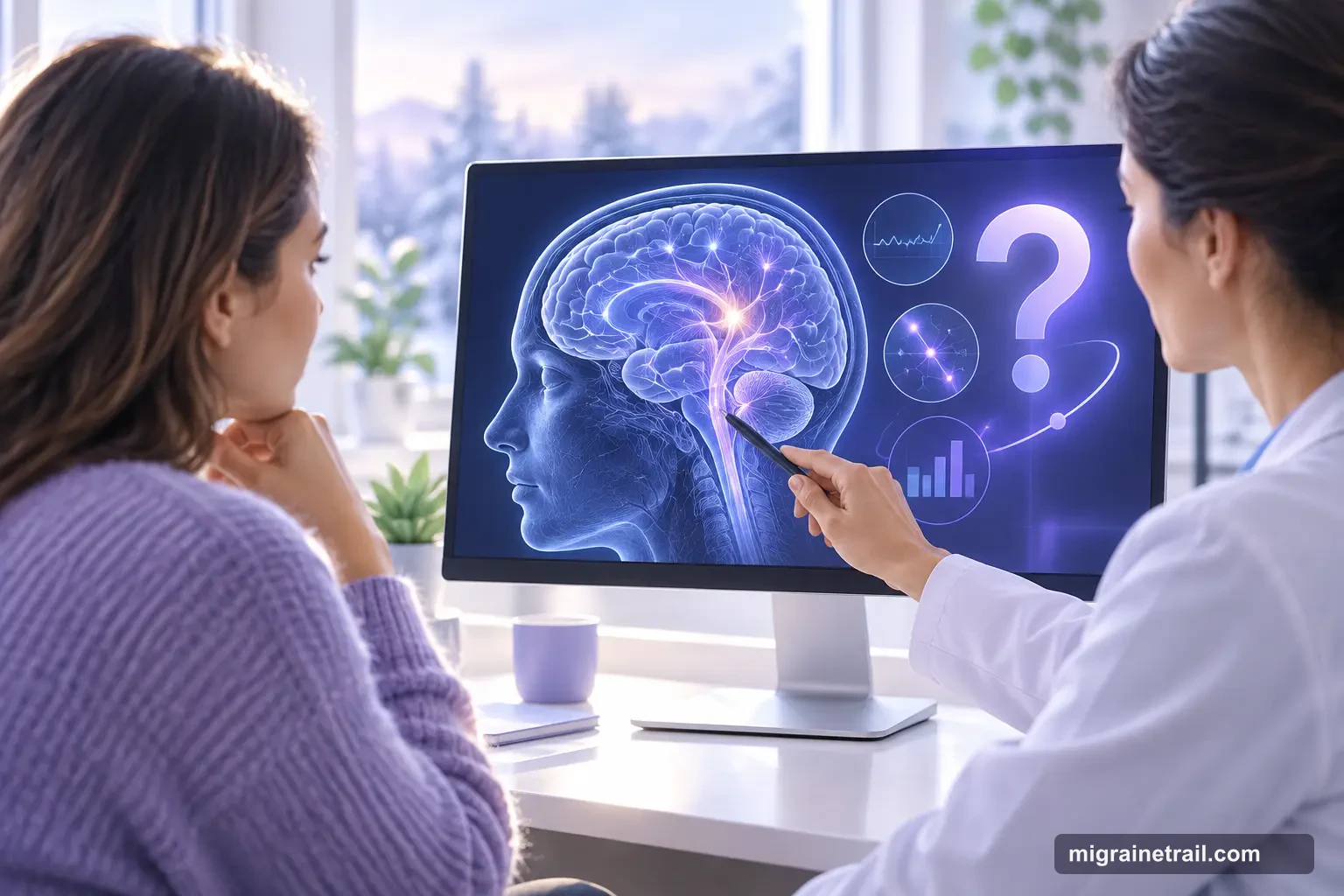
If an MRI report mentions white matter hyperintensities, it is understandable to wonder whether years of migraine have damaged your brain. The reassuring answer is that a spot on an MRI is not the same thing as progressive brain injury, and a typical migraine pattern with a normal neurological examination usually does not require routine imaging.
The more precise answer is that research has found associations between migraine and some imaging findings, while the meaning of those findings is still being studied. MRI cannot diagnose migraine by itself, and a scan should always be interpreted in the context of your symptoms and examination.
What are the “white spots”?
White matter hyperintensities are areas that look brighter on particular MRI sequences. They can occur for many reasons, including age, blood-vessel risk factors, migraine, prior inflammation, and other conditions. The appearance, location, number, size, and clinical context all matter.
A 2025 systematic review concluded that white matter hyperintensities are often seen in people with migraine, but their clinical significance remains unclear. Differences in MRI machines, protocols, study populations, and how lesions are counted make it difficult to turn the research into a prediction about one person.
Does migraine cause cognitive decline?
During an attack, brain fog, slowed processing, word-finding difficulty, and poor concentration can be real and disabling. Those symptoms often improve as the attack and postdrome resolve. That is different from proving that migraine is causing progressive memory loss or dementia.
If cognitive symptoms do not return to your usual baseline between attacks, are steadily worsening, or occur without your typical migraine symptoms, arrange a medical assessment. Sleep problems, medication effects, mood symptoms, thyroid disease, anemia, infection, and neurological conditions can all affect thinking.
What about stroke risk?
Migraine with aura has been associated with a higher relative risk of ischemic stroke in epidemiologic studies. The absolute risk for an individual person remains low, and risk is influenced by factors such as smoking, high blood pressure, diabetes, obesity, and some estrogen-containing medicines. This is a reason to review vascular risk factors with a clinician, not a reason to panic over every migraine.
The symptoms of a stroke and migraine aura can overlap. A first episode, a sudden deficit, weakness, facial droop, or speech problem should not be assumed to be aura. Call emergency services when those symptoms are new or severe.
When might an MRI be considered?
The American Headache Society guideline says neuroimaging is not necessary for a headache pattern consistent with migraine, a normal neurological examination, and no red flags. Imaging may be considered for features such as:
- A first or worst headache
- A substantial change in frequency, severity, or clinical features
- Persistent or unusually prolonged aura
- New motor symptoms, confusion, or brainstem symptoms
- A side-locked headache
- A new headache later in life
- A headache after head injury
That decision belongs to a clinician who can examine you and choose the right scan. An MRI ordered for a specific concern is different from an MRI requested only to reassure someone with a stable, typical pattern.
Questions to ask about an MRI report
Ask what the finding is called, where it is located, whether it is typical for your age and history, and whether it changes management. Ask whether blood pressure, cholesterol, diabetes, smoking, sleep apnea, or another condition needs attention. Do not compare your scan with an online image or ask an app to interpret it.
Keep tracking your migraine days, aura details, neurological symptoms, blood pressure if advised, and recovery time. A clear timeline helps your clinician decide whether a finding is incidental or needs further evaluation.
Get urgent help for a new neurological emergency
Seek emergency care for a sudden maximal headache, new one-sided weakness or numbness, facial droop, trouble speaking, persistent vision loss, seizure, fainting, fever with a stiff neck, or a severe headache after injury. These symptoms need evaluation even when you have a long migraine history.
Related Resources
This article is educational and is not a substitute for individual medical advice.
Sources