Migraine TrailMigraine Trail
Features
BlogHealth LibraryMigraine Guide
Free ToolsCompareHelpPricingGet the App
FeaturesBlogHealth LibraryFree ToolsCompareMigraine GuideHelpPricingGet the AppContact
2026-08-18

Migraine at Night: Why Head Pain Wakes You

By Migraine Trail TeamReviewed by Rita S
Share
Migraine at Night: Why Head Pain Wakes You
Share
TM
The Migraine Trail Team
Editorial Team

A team of migraine patients, data scientists, and health writers dedicated to making migraine management accessible through data-driven insights.

Learn about our editorial process
Free PDF Guide

Get the free migraine tracking guide

A practical 12-page guide: which triggers to watch, how to log symptoms doctors actually use, and how to spot your patterns. Emailed free — no credit card.

Get the free guide

Medical Disclaimer

The content provided in this article is for general informational purposes only and does not constitute medical advice. Always check with a doctor or neurologist regarding any medical questions or treatment decisions. Never disregard professional medical advice or delay in seeking it because of something you have read on this website.

Continue Reading

2026-10-06

Migraine Tracker for Sharing With Doctors: What to Export and How

Learn what a doctor-ready migraine report should include, from headache days and medication response to symptoms, patterns, and the questions you want answered.

2026-10-01

Migraine Medication Tracking: Dosage, Timing, and Headache Outcomes

Learn what to record when you take migraine medication, including dose, timing, repeat doses, side effects, and headache outcomes, so your diary supports a better treatment conversation.

2026-09-26

How Migraine Tracking Data Should Be Used: Patterns, Not Just Logs

A migraine diary becomes useful when it helps you ask better questions. Learn how to review attack patterns, medication response, and possible triggers without overinterpreting your data.

From the Health Library

Triggers9 min read

Why Do I Wake Up With a Migraine? 9 Clues to Track Before Breakfast

Migraine attacks peak in the early morning hours, and the reasons often trace back to the night before. Here are nine things worth tracking between waking and breakfast.

Triggers6 min read

Sleep Deprivation and Migraines - The Critical Link

Poor sleep is both a trigger and a symptom of migraines. Discover how to optimize your sleep to reduce headache frequency.

Management6 min read

Migraine Red Flags: When a Headache Is a Medical Emergency

Most migraines are not emergencies. But certain headache features (thunderclap onset, fever with stiff neck, new neurological deficits, sudden severe headache after 50) are red flags for stroke, hemorrhage, meningitis, or other dangerous conditions. Here are the symptoms that should send you straight to the emergency room.

Ready to start tracking?

Download Migraine Trail free on the App Store.

Download Migraine Trail free on the App Store
Migraine TrailMigraine Trail

The AI-powered migraine tracker built by patients, for patients.

Download App

Product

  • Pricing
  • Compare
  • Best Apps 2026
  • Partners
  • Advertise with Us
  • Affiliates
  • Help
  • Send Feedback

Features

  • Everything included
  • Voice Logging
  • Weather Risk Prediction
  • Migraine Weather Forecast
  • Doctor-Ready Reports
  • Apple Watch App

About

  • About Migraine Trail
  • Migraine Tracker App
  • Free Migraine Tracker
  • Headache Diary
  • Migraine Journal
  • Symptom Tracker
  • Trigger Tracking
  • Track Without Typing
  • Easy Tracker
  • AI Tracking

Learn

  • Blog
  • Health Library
  • Migraine Guide
  • Free Tools
  • Editorial Policy

Legal

  • Privacy Policy
  • Terms of Service
  • Health Data Privacy
  • Cookies

Connect

  • Contact

© 2026 Migraine Trail

Migraine Trail is not a healthcare provider or medical device. Content and tools are educational only and do not provide diagnosis, treatment, or medical advice. Never delay care or change treatment based on this site. See our full Medical Disclaimer and Privacy Policy.

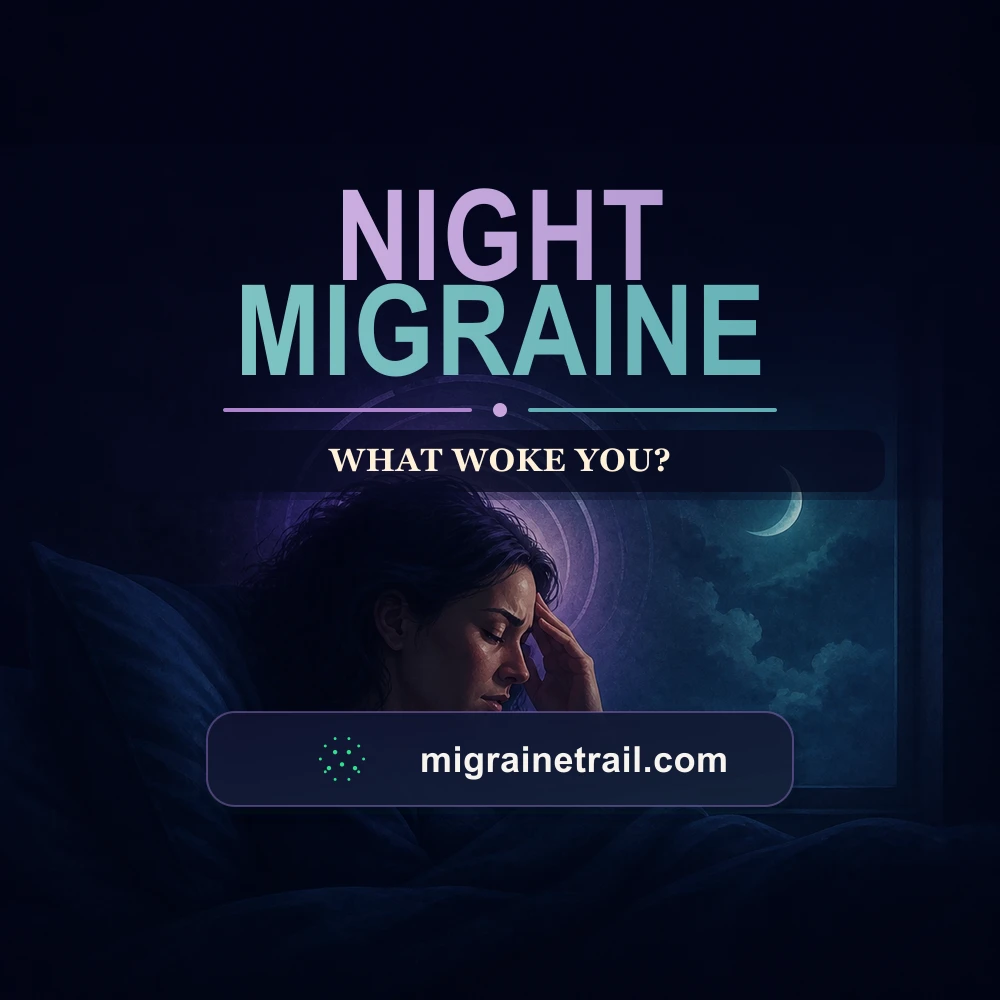
Migraine can begin during sleep and wake you, but “headache at night” is not a diagnosis. Timing, duration, accompanying symptoms, age at onset, medication use, and whether the pain happens only during sleep help separate nocturnal migraine from other headache and sleep disorders.

What nocturnal migraine can feel like

A migraine that begins overnight generally has familiar migraine features: moderate or severe pain, nausea, sensitivity to light or sound, and discomfort worsened by routine movement. You may wake during the headache phase or notice postdrome fatigue and fog in the morning.

Sleep and migraine have a two-way relationship. Migraine can disrupt sleep, while insomnia, irregular timing, and other sleep disorders can make attacks harder to manage. That relationship does not mean every overnight headache is migraine.

Patterns clinicians may compare

| Pattern | Clues that distinguish it | |---|---| | Migraine | Often lasts hours; nausea or light/sound sensitivity; movement may worsen pain | | Cluster headache | Excruciating one-sided eye or temple pain; tearing or blocked nose on the same side; restlessness; 15 to 180 minutes | | Hypnic headache | Develops only during sleep and repeatedly wakes the person; usually begins after age 50; requires exclusion of other causes | | Sleep-apnea-related morning headache | Snoring, gasping, witnessed breathing pauses, unrefreshing sleep, morning predominance | | Medication-overuse headache | Frequent headache plus regular overuse of acute headache medicines for more than three months |

The International Headache Society specifically notes that recurrent sleep-only headache requires attention to sleep apnea, nighttime blood pressure, low blood sugar, medication overuse, and intracranial disorders before hypnic headache is diagnosed.

What to record immediately

Night attacks are hard to reconstruct the next day. Capture:

  • The time pain woke you and whether pain was already severe.
  • Side and location of pain.
  • Tearing, red eye, nasal blockage, eyelid droop, or restlessness.
  • Nausea and light or sound sensitivity.
  • Medication taken and time relief began.
  • Bedtime, awakenings, snoring or gasping, and wake time.

Voice logging can reduce the effort of recording in the dark. A ten-second note such as “2:20 a.m., right eye pain, tearing, pacing, no nausea” preserves details that matter more than a polished entry the next morning. See how voice logging works.

Use the sleep and migraine pattern checker for timing and sleep context. If the pain is strictly one-sided with eye or nasal symptoms, the cluster headache vs migraine checker provides a safer side-by-side comparison.

When to seek urgent help

Call emergency services for a sudden extremely painful headache, new weakness or trouble speaking, seizure, fainting, severe confusion, fever with a stiff neck, new vision loss, or severe pain after a head injury. Seek prompt assessment for a new pattern during pregnancy or postpartum, new headache with cancer or immune suppression, or a major change in a known headache disorder.

Even without emergency signs, arrange a medical review when headaches repeatedly wake you, begin for the first time after age 50, or steadily worsen. Night timing alone does not prove a dangerous cause, but a recurring new pattern deserves evaluation.

Frequently asked questions

Can migraine happen at the same time every night?

It can have circadian regularity, but highly clock-like short attacks with severe one-sided eye pain and restlessness raise the need to compare cluster headache and other disorders.

Is a headache that wakes me always serious?

No. Migraine and primary headache disorders can wake people. Repetition, new onset, progression, neurological symptoms, and other red flags determine how urgently it should be assessed.

Should I take migraine medicine during the night?

Follow the rescue plan prescribed for you. If you are frequently treating overnight attacks or are unsure which medicine is safe, review the plan with your clinician rather than repeatedly improvising.

Sources
  • ICHD-3: Hypnic headache
  • Comorbidities of migraine: Sleep disorders — Handbook of Clinical Neurology, 2024