Migraine TrailMigraine Trail
Features
BlogHealth LibraryMigraine Guide
Free ToolsCompareHelpPricingGet the App
FeaturesBlogHealth LibraryFree ToolsCompareMigraine GuideHelpPricingGet the AppContact
2026-10-08

Altitude Migraine or Mountain Sickness?

By Migraine Trail TeamReviewed by Rita S
Share
Altitude Migraine or Mountain Sickness?
Share
TM
The Migraine Trail Team
Editorial Team

A team of migraine patients, data scientists, and health writers dedicated to making migraine management accessible through data-driven insights.

Learn about our editorial process
Free PDF Guide

Get the free migraine tracking guide

A practical 12-page guide: which triggers to watch, how to log symptoms doctors actually use, and how to spot your patterns. Emailed free — no credit card.

Get the free guide

Medical Disclaimer

The content provided in this article is for general informational purposes only and does not constitute medical advice. Always check with a doctor or neurologist regarding any medical questions or treatment decisions. Never disregard professional medical advice or delay in seeking it because of something you have read on this website.

Continue Reading

2026-10-06

Migraine Tracker for Sharing With Doctors: What to Export and How

Learn what a doctor-ready migraine report should include, from headache days and medication response to symptoms, patterns, and the questions you want answered.

2026-10-01

Migraine Medication Tracking: Dosage, Timing, and Headache Outcomes

Learn what to record when you take migraine medication, including dose, timing, repeat doses, side effects, and headache outcomes, so your diary supports a better treatment conversation.

2026-09-26

How Migraine Tracking Data Should Be Used: Patterns, Not Just Logs

A migraine diary becomes useful when it helps you ask better questions. Learn how to review attack patterns, medication response, and possible triggers without overinterpreting your data.

From the Health Library

Triggers8 min read

The Science of Weather Migraines: A 2026 Deep Dive

It is not in your head, it is in the atmosphere. We analyze the 2026 findings connecting barometric pressure, NO2 pollution, and temperature flux to trigeminal nerve activation.

Management6 min read

Migraine Red Flags: When a Headache Is a Medical Emergency

Most migraines are not emergencies. But certain headache features (thunderclap onset, fever with stiff neck, new neurological deficits, sudden severe headache after 50) are red flags for stroke, hemorrhage, meningitis, or other dangerous conditions. Here are the symptoms that should send you straight to the emergency room.

Triggers7 min read

Migraine Trigger Stacking: Why Small Triggers Combine Into Big Attacks

Most migraine attacks are not caused by one trigger. They are caused by 2 to 5 small triggers stacking up and crossing your personal threshold within the same 24 to 48 hours. Understanding the stacking effect explains why the same food, weather, or stressor sometimes triggers you and sometimes does not.

Ready to start tracking?

Download Migraine Trail free on the App Store.

Download Migraine Trail free on the App Store
Migraine TrailMigraine Trail

The AI-powered migraine tracker built by patients, for patients.

Download App

Product

  • Pricing
  • Compare
  • Best Apps 2026
  • Partners
  • Advertise with Us
  • Affiliates
  • Help
  • Send Feedback

Features

  • Everything included
  • Voice Logging
  • Weather Risk Prediction
  • Migraine Weather Forecast
  • Doctor-Ready Reports
  • Apple Watch App

About

  • About Migraine Trail
  • Migraine Tracker App
  • Free Migraine Tracker
  • Headache Diary
  • Migraine Journal
  • Symptom Tracker
  • Trigger Tracking
  • Track Without Typing
  • Easy Tracker
  • AI Tracking

Learn

  • Blog
  • Health Library
  • Migraine Guide
  • Free Tools
  • Editorial Policy

Legal

  • Privacy Policy
  • Terms of Service
  • Health Data Privacy
  • Cookies

Connect

  • Contact

© 2026 Migraine Trail

Migraine Trail is not a healthcare provider or medical device. Content and tools are educational only and do not provide diagnosis, treatment, or medical advice. Never delay care or change treatment based on this site. See our full Medical Disclaimer and Privacy Policy.

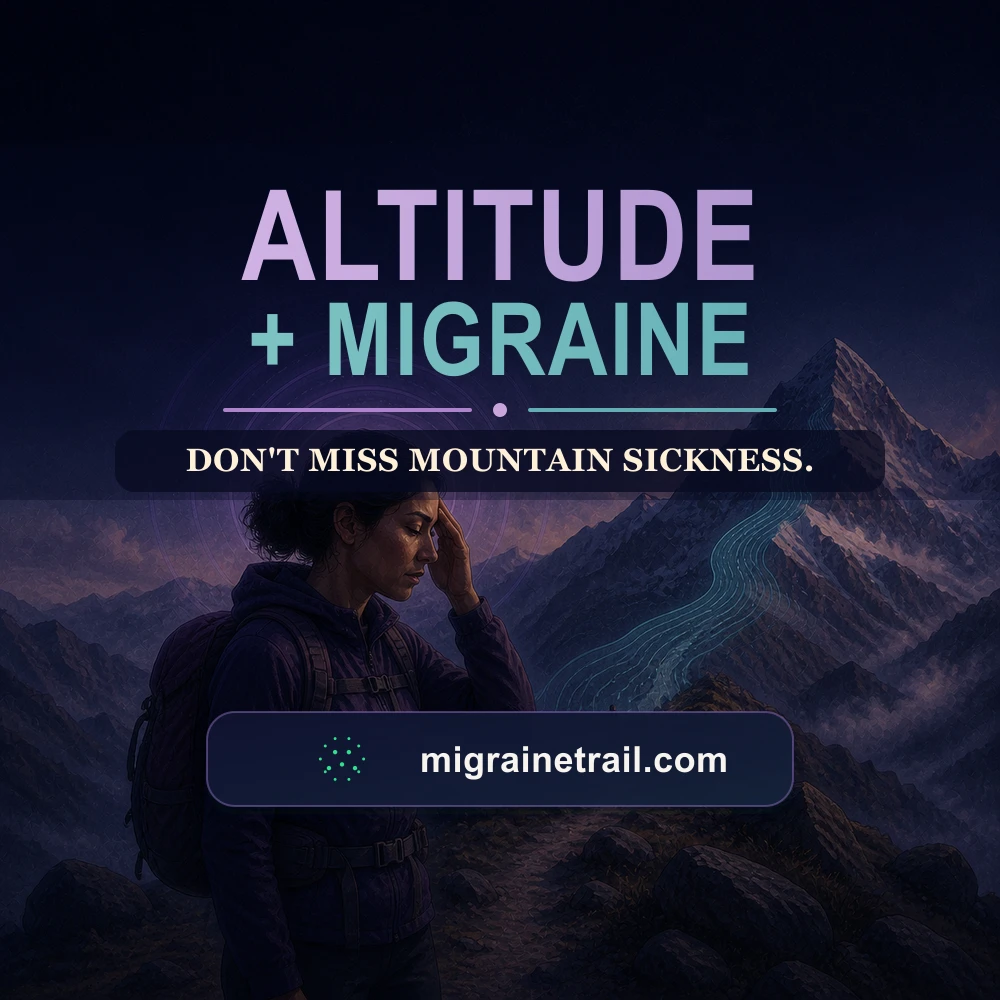
Headache after climbing to altitude may be a familiar migraine, high-altitude headache, or acute mountain sickness. Recent ascent is the key context; headache plus nausea, dizziness, unusual fatigue, or sleep disturbance after ascent should not be dismissed as “just migraine.”

Compare the patterns

| Pattern | Typical clues | |---|---| | Migraine | Familiar pain with nausea or light/sound sensitivity; may resemble attacks at home | | High-altitude headache | Usually bilateral, worsened by exertion, begins after ascent above roughly 2,500 meters, improves after descent | | Acute mountain sickness | Headache after ascent plus fatigue, dizziness, poor appetite, nausea, vomiting, or sleep disturbance |

Symptoms of acute mountain sickness often begin 2 to 12 hours after arrival or further ascent and commonly appear during or after the first night. Migraine history can increase susceptibility to high-altitude headache, but it does not make every altitude symptom migraine.

Safer ascent matters more than a perfect label

CDC travel guidance emphasizes gradual ascent. Avoid a rapid jump to a high sleeping altitude when possible, limit further sleeping-elevation gain above 3,000 meters, and build in acclimatization time. Keep exertion mild during the first 48 hours and avoid alcohol early in the stay.

If you regularly use caffeine, an abrupt stop can add withdrawal headache and confuse the picture. Keep medication and caffeine planning consistent with advice from your clinician.

Stop ascending when symptoms appear

Do not go higher while symptoms of acute mountain sickness are present. Descending is the decisive response when symptoms worsen or severe altitude illness is suspected. A clinician familiar with altitude medicine can advise whether preventive medicine is appropriate for your itinerary and health history.

Emergency altitude signs

Loss of coordination, confusion, marked drowsiness, severe weakness, shortness of breath at rest, chest congestion, or cough after ascent can signal life-threatening high-altitude cerebral or pulmonary edema. Descend and obtain emergency help immediately. Do not leave the person alone.

Track the ascent, not only the headache

Record sleeping elevation, the day and speed of ascent, exertion, alcohol, caffeine, fluid intake, sleep, oxygen symptoms, and headache timing. A printable migraine diary works offline and can travel with you.

Frequently asked questions

At what altitude do headaches start?

Risk rises with sleeping altitude and ascent speed; susceptibility varies. CDC guidance treats travel above about 2,450 meters or 8,000 feet as a meaningful altitude-illness context.

Does drinking water prevent altitude migraine?

Normal hydration is sensible, but excess water does not prevent altitude illness and can be harmful. Gradual ascent is more important.

Can I use my usual migraine medicine at altitude?

Ask your prescriber before travel. Altitude, other preventive medicines, medical conditions, and the need to distinguish mountain sickness can affect the plan.

Sources
  • CDC Yellow Book: High-altitude travel and altitude illness
  • International Classification of Headache Disorders, 3rd edition