Medically reviewed by Dr. Sarah Chen, MD (Neurology) · Last reviewed: May 2026
Key takeaway: Triggers rarely act alone — most attacks happen when 2-3 stack within the same 48-hour window. Tracking is the only reliable way to find your personal pattern.
Migraine triggers are notorious for being slippery. A glass of red wine causes an attack on Tuesday but not on Friday. Skipping breakfast doesn't faze you in spring but wrecks your week in summer. The science behind this inconsistency is now well understood: triggers don't act in isolation — they stack.
This article covers the 20 most common migraine triggers identified in published research, what makes them likely to fire, and the 30-day method for separating real personal triggers from coincidence.
What are the most common migraine triggers?
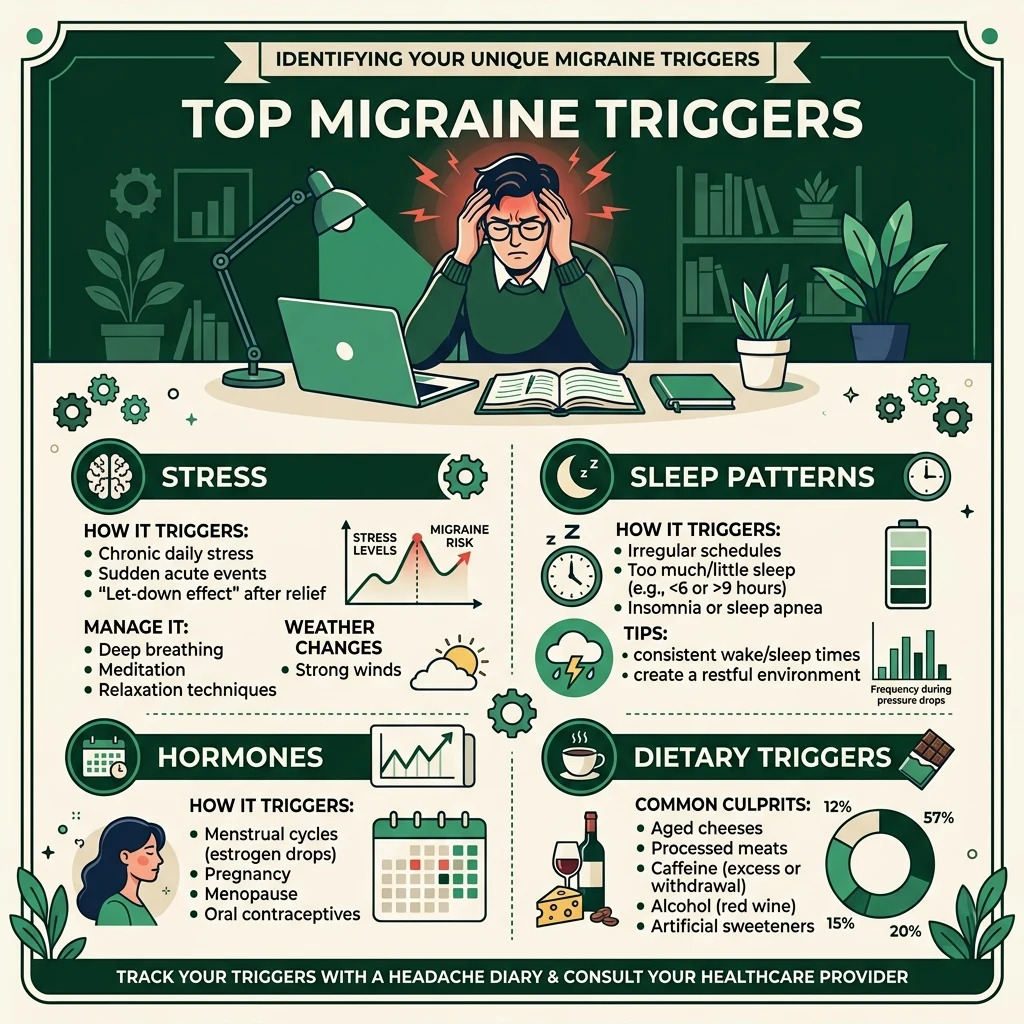
The most common migraine triggers are stress (reported by 50-80% of patients), disrupted sleep, hormonal changes (especially around menstruation), weather and barometric pressure shifts, dehydration, skipped meals, alcohol (red wine especially), bright or flickering light, strong smells, and certain foods including aged cheeses, processed meats, and chocolate. Most attacks involve 2-3 triggers stacking within the same 24-48 hour window.
Stress and the 'let-down' migraine
Stress tops every trigger survey. But what catches many people off guard is the let-down migraine — an attack that hits on Saturday morning after a stressful workweek, or the first day of vacation. The mechanism appears to involve a sudden drop in cortisol after sustained elevation. If you get migraines on weekends or holidays, this is likely a factor.
Stress management isn't just "try to relax." Specific evidence-based approaches — CBT, biofeedback, regular aerobic exercise, mindfulness — show measurable reductions in attack frequency.
Sleep, hormones, and the body's clock
Both too little and too much sleep can trigger attacks. Sleep regularity matters more than total hours: a consistent schedule reduces attacks even if total sleep is on the shorter side. Hormonal changes are responsible for the female predominance in migraine — up to 75% of women with migraine report attacks linked to their menstrual cycle, typically in the 2 days before and first 3 days of menstruation when estrogen drops sharply.
Pregnancy, perimenopause, and starting or stopping hormonal contraception all reshape attack patterns, often dramatically.
Weather, light, smell, and other environmental triggers
Barometric pressure changes are the most-reported environmental trigger — about 50% of people with migraine identify weather as a factor. Storms, frontal systems, sudden temperature swings, and high heat or humidity all rank high. Bright sunlight, fluorescent flicker, and screen glare account for many "office migraines." Strong smells (perfume, cleaning products, gasoline, smoke) can trigger attacks even at low concentrations.
These triggers are difficult to avoid completely, but they're forecastable — which is why weather alerts and AQI tracking belong in any modern migraine plan.
Food, drink, and the truth about 'trigger foods'
The most reliably implicated foods are alcohol (especially red wine and beer), aged cheeses, processed and cured meats containing nitrates, monosodium glutamate, and skipping meals (which causes blood sugar dips). Caffeine is dose-dependent — small amounts can abort attacks, but withdrawal headaches are real. Chocolate is a more controversial trigger; some research suggests it's actually a prodrome craving rather than a true cause.
The cleanest way to find food triggers is a structured 30-day elimination-and-reintroduction process, ideally guided by a clinician.
The other 10 triggers: caffeine, dehydration, exercise, screens, and more
Beyond the headline list, watch for: caffeine withdrawal, dehydration, low blood sugar, exhaustive exercise, altitude changes, jet lag, neck strain (forward-head posture), tight ponytails or hats (allodynia), MSG and aspartame in some people, and medication overuse (taking acute meds more than 2-3 days per week). Each of these is well-documented in the medical literature.
Frequently asked questions
How do I know if something is really a trigger or just a coincidence?
Track everything — including triggers, time of onset, and the gap between exposure and attack — for at least 30-60 attacks. Real triggers show statistical patterns over time. A single "wine then migraine" incident proves nothing; 8 out of 10 incidents proves a lot.
Do triggers add up?
Yes. This is called trigger stacking, and it explains the inconsistency you've probably noticed. A glass of wine alone may not trigger an attack, but wine plus a poor night of sleep plus an incoming weather front often will. The "threshold theory" of migraine helps explain why.
How quickly does a trigger cause a migraine?
It varies by trigger. Bright light or strong smells can fire an attack in under an hour. Foods often have a 6-24 hour delay. Hormonal triggers and weather changes can cause attacks 24-72 hours later. This delay is exactly why memory-based "trigger spotting" fails — you can't reliably link Tuesday's red wine to Thursday's attack from memory alone.
Should I avoid every possible trigger?
No. Aggressive avoidance often makes life worse without preventing many attacks, because you're guessing at triggers that may not be yours. A targeted approach — tracking, identifying your top 3-4 personal triggers, and managing those specifically — is more sustainable and more effective.
What this means for you
Pick a 30-day window. Log every attack with onset time, intensity, duration, and the 24 hours before it (sleep, food, stress, weather, hormones). At day 30, look for the 2-3 factors that show up most often before attacks. Those are your personal top triggers — and the ones worth managing first.
→ Voice-log triggers in 10 seconds with Migraine Trail — AI surfaces your pattern automatically.
Sources
- American Migraine Foundation — Top 10 Migraine Triggers
- The Migraine Trust — Common triggers
- NIH MedlinePlus Magazine — 10 common migraine triggers
- Pavlovic et al., "Trigger factors and premonitory features of migraine attacks," Headache, 2014